


The presidents of Ukraine and Russia on Monday agreed to revive the peace process on the bloody separatist conflict in eastern Ukraine and exchange all their prisoners, but they failed to resolve crucial issues such as a timeline on local elections and control of the borders in the rebel-held region.
At the first meeting between Ukrainian President Volodymyr Zelenskiy and Russian President Vladimir Putin, the two leaders failed to find a compromise to bring an end to the five-year-old war that has killed 14,000 people, emboldened the Kremlin and reshaped European geopolitics.
However, they did agree to try again in four months to find new solutions, said French President Emmanuel Macron, who mediated the talks along with German Chancellor Angela Merkel and called them “fruitful” in that it brought all four leaders together.
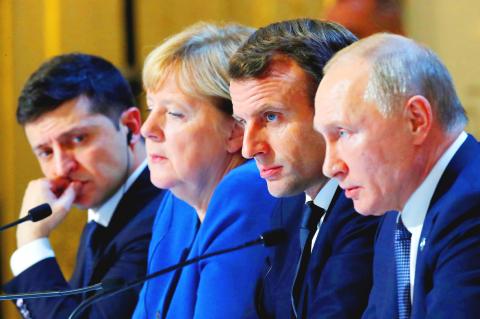
Photo: AFP
“There are disagreements, especially on timeline and next steps. We had a very long discussion on this,” Macron said at a news conference after the talks in the Elysee Palace in Paris.
The talks focused on reviving a largely stalled 2015 peace agreement intended to end fighting between Ukrainian troops and Russia-backed separatists in eastern Ukraine.
Putin said they agreed that there was no alternative to the 2015 accord reached in the Belarusian capital of Minsk.
He added that Ukraine should quickly extend a law giving wide autonomy to the rebel-held regions in line with the deal and also approve a legislation granting amnesty to the rebels.
In addition to the prisoner swap, agreement was reached to continue pulling back troops in other areas in the east, clear mines there and remove fortifications, Putin said.
Zelenskiy acknowledged many previous ceasefire deals did not hold, but added that “this time we agreed to treat it seriously.”
“I’m convinced that if all parties want it strongly, we will be able to implement it,” he said.
The two nations conducted several rounds of prisoner exchange, most recently in September. Monday’s deal goes further, envisaging a blanket “all for all” exchange of all known prisoners held by Ukraine and the rebels.
“I would very much like our people to come home in time to spend the New Year holidays with their families,” Zelenskiy said after the talks.
However, there was little clarity on the key contentious issues — autonomy for the east and control of the border.
Russia wanted the summit to increase pressure on Zelenskiy to fulfill the 2015 Minsk peace accord, which promises wide autonomy to Ukraine’s rebel-held regions.
The Minsk deal puts forth that Ukraine can regain control over the border with Russia in the separatist-held regions only after they are granted a broad self-rule and hold local elections.
In particular, it stipulates that the Ukrainian law should allow municipal authorities in the east to appoint judges and prosecutors in the region and form local police. It says the law should also provide for an amnesty for those who took part in the fighting. Those provisions were anathema to many in Ukraine.
The 2015 deal was a diplomatic coup for Russia, ensuring that the rebel regions get a broad authority and resources to survive on their own without cross-border support.
Zelenskiy wants to tweak the timeline laid out in the accord, which calls for Ukraine to be able to regain control of its border with Russia only after local elections are held in the separatist regions and the regions receive autonomous status.
He said Ukraine must get control of its border first before local elections are held, but the Kremlin insisted that is not an option.
Macron praised Zelenskiy’s courage and determination, adding that he made “gestures” that allowed peace talks to be relaunched.
“Today an important step was made. That’s the first time in three years such a summit is being held,” Macron said. “That’s the first time President Zelenskiy and President Putin are meeting... and we have tangible results.”
A major breakthrough at the Paris talks had been seen as unlikely, and Ukrainian protesters in Kiev had put pressure on their new leader not to surrender too much to Putin, who has been in office nearly 20 years.
Nonetheless, the fact that Putin and Zelenskiy met at all was a significant step after years of war. The two faced each other across the table, flanked by Macron and Merkel. They also held a separate one-on-one meeting.
While opinion surveys have shown an overwhelming support for Zelenskiy’s peace efforts, a minority opposing them is highly mobilized and energetic. Thousands rallied on Kiev’s main square on Sunday to warn him against making any concessions, and some set up a tent camp around his headquarters.
Cries of “shame”!” and whistles of derision greeted announcements from the leaders’ news conference in Paris.
“We didn’t see any real steps — Putin did not promise control of the border or the withdrawal of his troops,” 38-year-old demonstrator Nina Onufrik said.

A plan by Switzerland’s right-wing People’s Party to cap the population at 10 million has the backing of almost half the country, according to a poll before an expected vote next year. The party, which has long campaigned against immigration, argues that too-fast population growth is overwhelming housing, transport and public services. The level of support comes despite the government urging voters to reject it, warning that strict curbs would damage the economy and prosperity, as Swiss companies depend on foreign workers. The poll by newspaper group Tamedia/20 Minuten and released yesterday showed that 48 percent of the population plan to vote
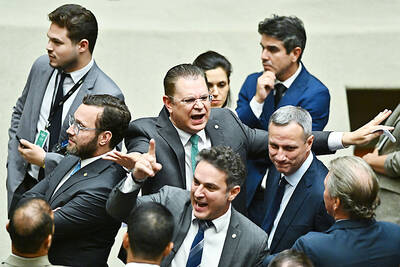
PARLIAMENT CHAOS: Police forcibly removed Brazilian Deputy Glauber Braga after he called the legislation part of a ‘coup offensive’ and occupied the speaker’s chair Brazil’s lower house of Congress early yesterday approved a bill that could slash former Brazilian president Jair Bolsonaro’s prison sentence for plotting a coup, after efforts by a lawmaker to disrupt the proceedings sparked chaos in parliament. Bolsonaro has been serving a 27-year term since last month after his conviction for a scheme to stop Brazilian President Luiz Inacio Lula da Silva from taking office after the 2022 election. Lawmakers had been discussing a bill that would significantly reduce sentences for several crimes, including attempting a coup d’etat — opening up the prospect that Bolsonaro, 70, could have his sentence cut to

A powerful magnitude 7.6 earthquake shook Japan’s northeast region late on Monday, prompting tsunami warnings and orders for residents to evacuate. A tsunami as high as three metres (10 feet) could hit Japan’s northeastern coast after an earthquake with an estimated magnitude of 7.6 occurred offshore at 11:15 p.m. (1415 GMT), the Japan Meteorological Agency (JMA) said. Tsunami warnings were issued for the prefectures of Hokkaido, Aomori and Iwate, and a tsunami of 40cm had been observed at Aomori’s Mutsu Ogawara and Hokkaido’s Urakawa ports before midnight, JMA said. The epicentre of the quake was 80 km (50 miles) off the coast of
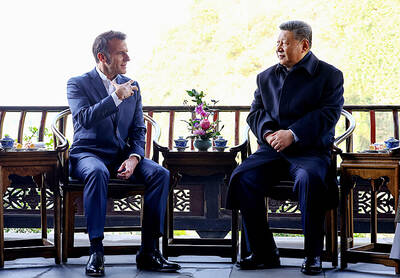
RELAXED: After talks on Ukraine and trade, the French president met with students while his wife visited pandas, after the pair parted ways with their Chinese counterparts French President Emmanuel Macron concluded his fourth state visit to China yesterday in Chengdu, striking a more relaxed note after tough discussions on Ukraine and trade with Chinese President Xi Jinping (習近平) a day earlier. Far from the imposing Great Hall of the People in Beijing where the two leaders held talks, Xi and China’s first lady, Peng Liyuan (彭麗媛), showed Macron and his wife Brigitte around the centuries-old Dujiangyan Dam, a World Heritage Site set against the mountainous landscape of Sichuan Province. Macron was told through an interpreter about the ancient irrigation system, which dates back to the third century


 RSS
RSS