


Education performance has largely stagnated in many Organisation for Economic Co-operation and Development (OECD) countries over the past two decades, despite greater spending, the group said yesterday in report on a survey of international learning standards.
The Programme for International Student Assessment (PISA) is carried out every three years by the Paris-based OECD, this time among its 37 member states and 42 partner countries and economies.
The PISA survey did not spell out the reasons for the lack of improvement, but in the past the OECD has suggested that improving teacher performance is more important to the quality of learning than other factors like spending more to reduce class sizes.
Students’ average performance in reading, mathematics and science was largely stable in OECD countries last year, according to the results of the global test.
The Paris-based policy’s forum said it was “disappointing” that there had been practically no improvement in OECD countries’ performance since it started the PISA project in 2000.
It was all the more galling as per student spending in OECD member countries had risen more than 15 percent over the past decade, the report said.
About 600,000 15-year-olds in 79 countries and economies took the two-hour test for the latest study, which is closely watched by policymakers as the largest international comparison of education performance.
As OECD countries stagnated, students from areas surveyed in non-OECD member China — Beijing and Shanghai, as well as Jiangsu and Zhejiang provinces — and in Singapore once again outperformed peers from all other countries in reading, mathematics and science.
Out of the 79 countries and territories, only Albania, Colombia, Macau, Moldova, Peru, Portugal and Qatar had seen an improvement in their scores since joining in program, and only Portugal is a member of the OECD.
While important, funding was not everything, as demonstrated by the case of Estonia, which was the top-scoring OECD country in reading, despite education spending 30 percent less than the OECD average, the report said.
It was followed by Canada, Finland and Ireland.
Australia, Finland, Iceland, South Korea, the Netherlands, New Zealand and Slovakia have all seen their average performances in reading, mathematics and science decline since participating in program, it said.
With reading the main focus of the test this time, it found that one out of four students in OECD countries could not complete basic reading tasks, leaving them dangerously ill-prepared for a life in an increasingly digitalized economy, the report said.
Taiwan, listed as “Chinese Taipei,” tied with Australia in reading, with a score of 503, above the international average of 487, while its students were ranked fifth in math, with a score of 531, and 10th in science, with 516, well above the international average of 489 in those two categories.
In the 2015 survey, Taiwanese students were ranked fourth in science and math, and 23rd in reading, a result that one local professor blamed on the introduction of a computer-based version of the test, the doubling of reading comprehension questions and the inclusion of more open-ended questions.
Students’ social and economic background remained a leading factor for success at school last year, with the richest 10 percent of students in OECD countries reading at a level three years ahead of the poorest 10 percent, it said.
However, the link between background and performance was weakest in Australia, Canada, Denmark, Estonia, Finland, Japan, South Korea, Norway and the UK, which meant that their education systems were fairer, the OECD said.
Screen time was found to be increasingly eating into students’ reading outside of school in the 79 countries surveyed, with the time reported online nearly three hours per workday, up from less than two in 2012, it added.
Additional reporting by staff writer

PARLIAMENT CHAOS: Police forcibly removed Brazilian Deputy Glauber Braga after he called the legislation part of a ‘coup offensive’ and occupied the speaker’s chair Brazil’s lower house of Congress early yesterday approved a bill that could slash former Brazilian president Jair Bolsonaro’s prison sentence for plotting a coup, after efforts by a lawmaker to disrupt the proceedings sparked chaos in parliament. Bolsonaro has been serving a 27-year term since last month after his conviction for a scheme to stop Brazilian President Luiz Inacio Lula da Silva from taking office after the 2022 election. Lawmakers had been discussing a bill that would significantly reduce sentences for several crimes, including attempting a coup d’etat — opening up the prospect that Bolsonaro, 70, could have his sentence cut to

A plan by Switzerland’s right-wing People’s Party to cap the population at 10 million has the backing of almost half the country, according to a poll before an expected vote next year. The party, which has long campaigned against immigration, argues that too-fast population growth is overwhelming housing, transport and public services. The level of support comes despite the government urging voters to reject it, warning that strict curbs would damage the economy and prosperity, as Swiss companies depend on foreign workers. The poll by newspaper group Tamedia/20 Minuten and released yesterday showed that 48 percent of the population plan to vote

A powerful magnitude 7.6 earthquake shook Japan’s northeast region late on Monday, prompting tsunami warnings and orders for residents to evacuate. A tsunami as high as three metres (10 feet) could hit Japan’s northeastern coast after an earthquake with an estimated magnitude of 7.6 occurred offshore at 11:15 p.m. (1415 GMT), the Japan Meteorological Agency (JMA) said. Tsunami warnings were issued for the prefectures of Hokkaido, Aomori and Iwate, and a tsunami of 40cm had been observed at Aomori’s Mutsu Ogawara and Hokkaido’s Urakawa ports before midnight, JMA said. The epicentre of the quake was 80 km (50 miles) off the coast of
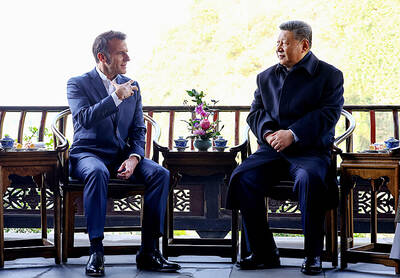
RELAXED: After talks on Ukraine and trade, the French president met with students while his wife visited pandas, after the pair parted ways with their Chinese counterparts French President Emmanuel Macron concluded his fourth state visit to China yesterday in Chengdu, striking a more relaxed note after tough discussions on Ukraine and trade with Chinese President Xi Jinping (習近平) a day earlier. Far from the imposing Great Hall of the People in Beijing where the two leaders held talks, Xi and China’s first lady, Peng Liyuan (彭麗媛), showed Macron and his wife Brigitte around the centuries-old Dujiangyan Dam, a World Heritage Site set against the mountainous landscape of Sichuan Province. Macron was told through an interpreter about the ancient irrigation system, which dates back to the third century


 RSS
RSS