


Britain’s political leaders are sparring over who is responsible for the early release of a convicted extremist who launched a stabbing attack in central London on Friday that left two people dead and three injured.
The argument centers over the early release from prison of Usman Khan, who served about half his sentence before being set free.
After a one-day pause out of respect for victims, the Friday attack is dominating the political scene as the election nears. The vote is set for Dec. 12.
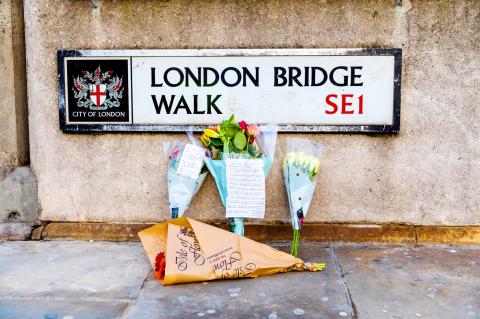
Photo: EPA-EFE
British Prime Minister Boris Johnson yesterday blamed Khan’s freedom on changes in sentencing rules made by the last Labour Party government before Johnson’s Conservative Party took power in 2010 and he promised to toughen sentencing laws.
“We are going to bring in tougher sentences for serious sexual and violent offenders and for terrorists,” he told the BBC’s Andrew Marr. “I absolutely deplore the fact that this man was out on the street, I think it was absolutely repulsive and we are going to take action.”
However, he sought to distance himself from decisions made by previous Conservative governments.
When pushed on the record of the Tories on law and order and spending since 2010, Johnson repeatedly said that he has only been prime minister since the summer, and that previous governments had to implement “prudent” management of public finances.
He also announced plans to review Britain’s security, defense and foreign policy in the wake of the terror attack, which came ahead of a NATO summit that begins in London later today.
Labour leader Jeremy Corbyn accused the Conservatives of trying to provide security “on the cheap,” but said that he did not agree that convicted terrorists always should serve out their full prison terms.
“It depends on the circumstances; it depends on the sentence, but crucially it depends on what they’ve done in prison,” Corbyn said in an interview on Sky’s Sophy Ridge on Sunday.
He said he understood that the Parole Board was not involved in Khan’s early release and there was no probation service involvement in monitoring him.
He also accused governments of worsening the threat of such attacks and said the “war on terror has manifestly failed.”
Liberal Democrat Foreign Affairs spokesman Chuka Umunna criticized the two main parties for turning the terror attack into a “political football,” saying instead the Conservatives, Labour and Liberal Democrats should all accept at least some blame for creating the current justice system because they have all been in government over the last two decades.
On Saturday, shocked and saddened Londoners found solace in the way bystanders fought to subdue the London Bridge attacker, keeping the death count lower than it would have been if they had fled.
Particularly striking were the weapons they used to confront the killer: a fire extinguisher and a 1.5m narwhal tusk apparently taken from the wall of Fishmongers’ Hall when the attack began.
Remarkable video from the scene shows one man spraying the fire extinguisher at the knife-wielding attacker and trying to hit him with the blunt instrument, while another uses the whale tusk to try to pin the man down.
Others ganged up on the man, wrestling him to the ground and stripping away his weapons.
Additional footage shows another man — said by some media outlets to be a plainclothes policeman — calmly walking away from the scene with one of the attacker’s knives, making sure it could not be used to kill again.
London Mayor Sadiq Khan said the bystanders who brought down the attacker could have followed advice and run away for their own safety, but decided to run toward danger instead.
“We saw Londoners, ordinary citizens, acting in an extraordinary way,” he said.
Some of those who challenged the attacker were former prisoners attending a conference on rehabilitation along with the assailant at Fishmongers’ Hall.
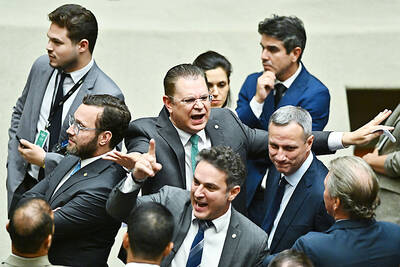
PARLIAMENT CHAOS: Police forcibly removed Brazilian Deputy Glauber Braga after he called the legislation part of a ‘coup offensive’ and occupied the speaker’s chair Brazil’s lower house of Congress early yesterday approved a bill that could slash former Brazilian president Jair Bolsonaro’s prison sentence for plotting a coup, after efforts by a lawmaker to disrupt the proceedings sparked chaos in parliament. Bolsonaro has been serving a 27-year term since last month after his conviction for a scheme to stop Brazilian President Luiz Inacio Lula da Silva from taking office after the 2022 election. Lawmakers had been discussing a bill that would significantly reduce sentences for several crimes, including attempting a coup d’etat — opening up the prospect that Bolsonaro, 70, could have his sentence cut to

A plan by Switzerland’s right-wing People’s Party to cap the population at 10 million has the backing of almost half the country, according to a poll before an expected vote next year. The party, which has long campaigned against immigration, argues that too-fast population growth is overwhelming housing, transport and public services. The level of support comes despite the government urging voters to reject it, warning that strict curbs would damage the economy and prosperity, as Swiss companies depend on foreign workers. The poll by newspaper group Tamedia/20 Minuten and released yesterday showed that 48 percent of the population plan to vote

A powerful magnitude 7.6 earthquake shook Japan’s northeast region late on Monday, prompting tsunami warnings and orders for residents to evacuate. A tsunami as high as three metres (10 feet) could hit Japan’s northeastern coast after an earthquake with an estimated magnitude of 7.6 occurred offshore at 11:15 p.m. (1415 GMT), the Japan Meteorological Agency (JMA) said. Tsunami warnings were issued for the prefectures of Hokkaido, Aomori and Iwate, and a tsunami of 40cm had been observed at Aomori’s Mutsu Ogawara and Hokkaido’s Urakawa ports before midnight, JMA said. The epicentre of the quake was 80 km (50 miles) off the coast of
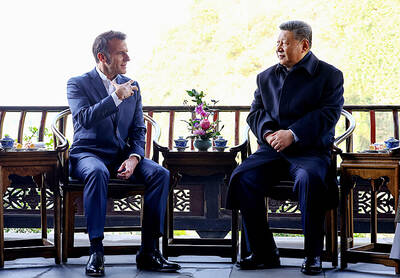
RELAXED: After talks on Ukraine and trade, the French president met with students while his wife visited pandas, after the pair parted ways with their Chinese counterparts French President Emmanuel Macron concluded his fourth state visit to China yesterday in Chengdu, striking a more relaxed note after tough discussions on Ukraine and trade with Chinese President Xi Jinping (習近平) a day earlier. Far from the imposing Great Hall of the People in Beijing where the two leaders held talks, Xi and China’s first lady, Peng Liyuan (彭麗媛), showed Macron and his wife Brigitte around the centuries-old Dujiangyan Dam, a World Heritage Site set against the mountainous landscape of Sichuan Province. Macron was told through an interpreter about the ancient irrigation system, which dates back to the third century


 RSS
RSS