


An Australian teacher held captive with an American colleague by the Taliban for more than three years believes US special forces tried and failed six times to free them.
Timothy Weeks was released last month in a prisoner swap along with Kevin King, ending an ordeal that began with their abduction in 2016 outside the American University in Kabul, where they worked.
Weeks, 50, told a news conference on Sunday that he believed that US Navy SEAL teams tried repeatedly to rescue them, sometimes missing them only by “hours” after the two hostages were moved to other locations by their captors.
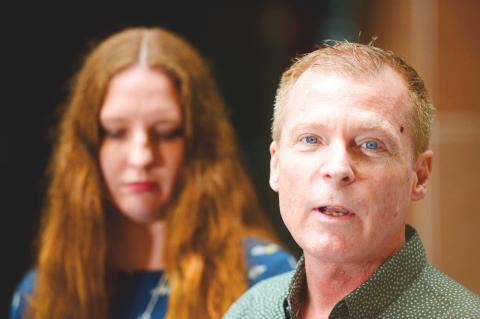
Photo: EPA-EFE
“I believe, and I hope this is correct, that they came in six times to try to get us, and that a number of times they missed us only by hours,” Weeks said.
One attempt came in April this year.
Weeks said he was woken at 2am by his guards, who told him they were under attack from Islamic State fighters, and moved him into a tunnel beneath where they were being held.
“I believe now that it was the Navy SEALs coming in to get us,” Weeks said.
“I believe they were right outside our door. The moment that we got into the tunnels, we were one or two meters underground and there was a huge bang at the front door. And our guards went up and there was a lot of machine gun fire,” he said.
“They pushed me over the top into the tunnels, and I fell backwards and rolled and knocked myself unconscious,” he added.
Weeks said he and King were shifted through various remote locations in Afghanistan and neighboring Pakistan throughout their captivity, and were often kept in tiny, windowless cells.
While their lives were often at risk, he said he never gave up hope of being rescued.
“I never, ever gave up hope, and I think in that sort of situation, that if you give up hope, there is very little left for you,” said Weeks, flanked by his sisters Alyssa and Jo Carter.
“I knew that I would leave that place eventually. It just took a little longer than I expected.”
While expressing thanks to US President Donald Trump and Australian Prime Minister Scott Morrison for the work that led to their release, Weeks said some Taliban guards he had encountered were “lovely people.”
“I don’t hate them at all,” he said. “And some of them, I have great respect for, and great love for, almost. Some of them were so compassionate and such lovely, lovely people. And it really led me to think about ... how did they end up like this?”
“I know a lot of people don’t admit this, but for me, they were soldiers. And soldiers obey the commands of their commanders. [They] don’t get a choice,” he added.
Weeks said he had hugged some of his Taliban guards when they parted company on the day of his and King’s release.
Still, the sight of the two US Black Hawk helicopters arriving to take them away had been an enormous relief.
“From the moment I sighted both Black Hawk helicopters and was placed in the hands of special forces, I knew my long and tortuous ordeal had come to an end,” he said.
“Out of a big dust cloud came six special forces and they walked towards us and one of them stepped towards me and he just put his arm around me and he held me and he said: ‘Are you OK?’ And then he walked me back to the Black Hawk.”
Weeks, from the small rural city of Wagga Wagga in New South Wales state, said his ordeal had had “a profound and unimaginable effect on me.”
“At times I felt as if my death was imminent and that I would never return to see those that I love again, but by the will of God I am here, I am alive and I am safe and I am free,” he said, his voice breaking.
“There is nothing else in the world that I need,” Weeks said.

A plan by Switzerland’s right-wing People’s Party to cap the population at 10 million has the backing of almost half the country, according to a poll before an expected vote next year. The party, which has long campaigned against immigration, argues that too-fast population growth is overwhelming housing, transport and public services. The level of support comes despite the government urging voters to reject it, warning that strict curbs would damage the economy and prosperity, as Swiss companies depend on foreign workers. The poll by newspaper group Tamedia/20 Minuten and released yesterday showed that 48 percent of the population plan to vote

PARLIAMENT CHAOS: Police forcibly removed Brazilian Deputy Glauber Braga after he called the legislation part of a ‘coup offensive’ and occupied the speaker’s chair Brazil’s lower house of Congress early yesterday approved a bill that could slash former Brazilian president Jair Bolsonaro’s prison sentence for plotting a coup, after efforts by a lawmaker to disrupt the proceedings sparked chaos in parliament. Bolsonaro has been serving a 27-year term since last month after his conviction for a scheme to stop Brazilian President Luiz Inacio Lula da Silva from taking office after the 2022 election. Lawmakers had been discussing a bill that would significantly reduce sentences for several crimes, including attempting a coup d’etat — opening up the prospect that Bolsonaro, 70, could have his sentence cut to

A powerful magnitude 7.6 earthquake shook Japan’s northeast region late on Monday, prompting tsunami warnings and orders for residents to evacuate. A tsunami as high as three metres (10 feet) could hit Japan’s northeastern coast after an earthquake with an estimated magnitude of 7.6 occurred offshore at 11:15 p.m. (1415 GMT), the Japan Meteorological Agency (JMA) said. Tsunami warnings were issued for the prefectures of Hokkaido, Aomori and Iwate, and a tsunami of 40cm had been observed at Aomori’s Mutsu Ogawara and Hokkaido’s Urakawa ports before midnight, JMA said. The epicentre of the quake was 80 km (50 miles) off the coast of
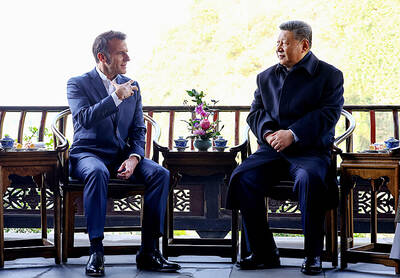
RELAXED: After talks on Ukraine and trade, the French president met with students while his wife visited pandas, after the pair parted ways with their Chinese counterparts French President Emmanuel Macron concluded his fourth state visit to China yesterday in Chengdu, striking a more relaxed note after tough discussions on Ukraine and trade with Chinese President Xi Jinping (習近平) a day earlier. Far from the imposing Great Hall of the People in Beijing where the two leaders held talks, Xi and China’s first lady, Peng Liyuan (彭麗媛), showed Macron and his wife Brigitte around the centuries-old Dujiangyan Dam, a World Heritage Site set against the mountainous landscape of Sichuan Province. Macron was told through an interpreter about the ancient irrigation system, which dates back to the third century


 RSS
RSS