


Peruvian opposition leader Keiko Fujimori was on Friday released from prison after spending 13 months in pretrial detention in a corruption case linked to Brazilian construction giant Odebrecht.
Her release came days after the Peruvian Constitutional Court ordered her freed in a ruling related only to her detention and which otherwise has no bearing on the corruption case against her.
“For me, it was the most painful event of my life,” Fujimori said as she left prison and hugged her husband in front of a large group of supporters and journalists.
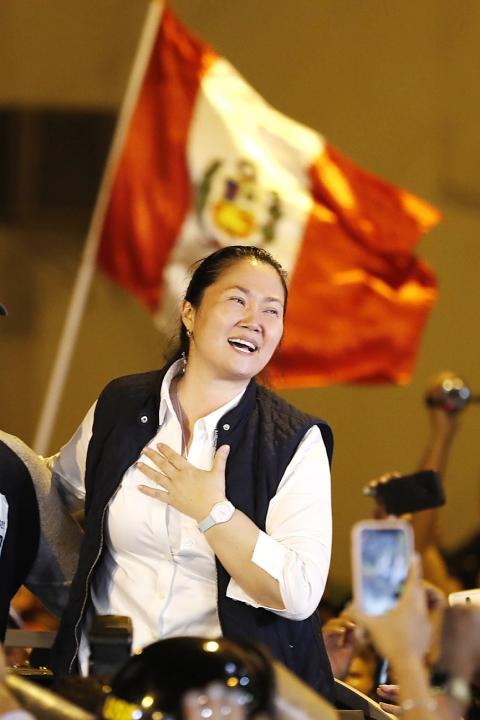
Photo: EPA-EFE
The court “has corrected damage that has been inflicted on us. I will continue to face the investigation, as I have always done,” she said.
Supporters welcomed her release with applause and shouts of “Keiko liberty!” and “Keiko president!”
The 44-year-old eldest daughter of disgraced former Peruvian president Alberto Fujimori had been held since Oct. 31 last year. Her American husband, Mark Vito, had been on hunger strike outside his wife’s prison on the outskirts of Lima to press for her release.
“I’m going to take some time to reunite with my family,” she told journalists, when asked about her immediate political future.
Once Peru’s most popular politician, Keiko Fujimori theoretically now has time to campaign for presidential elections set for July 2021. She is accused of accepting US$1.2 million in illicit party funding for her 2011 election campaign as leader of the right-wing Popular Force party.
Odebrecht has admitted to paying at least US$29 million to Peruvian officials since 2004 and bribing four former Peruvian presidents.
Three of the presidents are being investigated over Odebrecht while a fourth, Alan Garcia, committed suicide in April after police arrived at his house to arrest him for money laundering.
Known simply as Keiko by followers and political rivals alike, she emerged from prison to a very different political landscape to the one she left just more than a year ago.
Once a major player in the country’s politics, Popular Force has lost ground in the past several years, in part due to Keiko Fujimori’s two successive defeats in the second round of presidential elections in 2011 and 2016.
Peruvian President Martin Vizcarra has called for new legislative elections on Jan. 26 after dissolving the unicameral Peruvian Congress in September as part of an anti-corruption campaign.
Keiko Fujimori’s party risks losing its majority in congress, following repeated clashes with Vizcarra, whose anti-graft drive has proven popular with the public.

A plan by Switzerland’s right-wing People’s Party to cap the population at 10 million has the backing of almost half the country, according to a poll before an expected vote next year. The party, which has long campaigned against immigration, argues that too-fast population growth is overwhelming housing, transport and public services. The level of support comes despite the government urging voters to reject it, warning that strict curbs would damage the economy and prosperity, as Swiss companies depend on foreign workers. The poll by newspaper group Tamedia/20 Minuten and released yesterday showed that 48 percent of the population plan to vote

PARLIAMENT CHAOS: Police forcibly removed Brazilian Deputy Glauber Braga after he called the legislation part of a ‘coup offensive’ and occupied the speaker’s chair Brazil’s lower house of Congress early yesterday approved a bill that could slash former Brazilian president Jair Bolsonaro’s prison sentence for plotting a coup, after efforts by a lawmaker to disrupt the proceedings sparked chaos in parliament. Bolsonaro has been serving a 27-year term since last month after his conviction for a scheme to stop Brazilian President Luiz Inacio Lula da Silva from taking office after the 2022 election. Lawmakers had been discussing a bill that would significantly reduce sentences for several crimes, including attempting a coup d’etat — opening up the prospect that Bolsonaro, 70, could have his sentence cut to

A powerful magnitude 7.6 earthquake shook Japan’s northeast region late on Monday, prompting tsunami warnings and orders for residents to evacuate. A tsunami as high as three metres (10 feet) could hit Japan’s northeastern coast after an earthquake with an estimated magnitude of 7.6 occurred offshore at 11:15 p.m. (1415 GMT), the Japan Meteorological Agency (JMA) said. Tsunami warnings were issued for the prefectures of Hokkaido, Aomori and Iwate, and a tsunami of 40cm had been observed at Aomori’s Mutsu Ogawara and Hokkaido’s Urakawa ports before midnight, JMA said. The epicentre of the quake was 80 km (50 miles) off the coast of
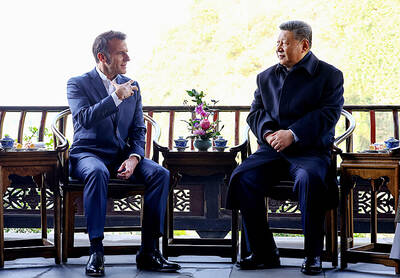
RELAXED: After talks on Ukraine and trade, the French president met with students while his wife visited pandas, after the pair parted ways with their Chinese counterparts French President Emmanuel Macron concluded his fourth state visit to China yesterday in Chengdu, striking a more relaxed note after tough discussions on Ukraine and trade with Chinese President Xi Jinping (習近平) a day earlier. Far from the imposing Great Hall of the People in Beijing where the two leaders held talks, Xi and China’s first lady, Peng Liyuan (彭麗媛), showed Macron and his wife Brigitte around the centuries-old Dujiangyan Dam, a World Heritage Site set against the mountainous landscape of Sichuan Province. Macron was told through an interpreter about the ancient irrigation system, which dates back to the third century


 RSS
RSS