


Deeply unpopular Hong Kong Chief Executive Carrie Lam (林鄭月娥) yesterday acknowledged that public dissatisfaction with her government fueled a landslide win by pro-democracy candidates in local elections, but offered no new concessions to resolve months of violent protests.
In China, state media sought to downplay and discredit the Sunday ballot that delivered a stinging rebuke to the territory’s pro-Beijing establishment in what was widely seen as a referendum on Lam’s handling of the unrest.
Lam pledged to “improve governance” in the wake of the district council elections, which she acknowledged revealed concern over “deficiencies in the government, including unhappiness with the time taken to deal with the current unstable environment.”
In a rout that stunned the semi-autonomous territory, candidates campaigning against greater control by China seized an overwhelming majority of 452 elected seats in the 18 district councils, bodies that have historically been firmly in the grip of a Beijing-aligned establishment.
The result — the first vote held since protests engulfed the territory — was a humiliating rebuke to Beijing and Lam, who has dismissed calls for political reform and repeatedly suggested that a silent majority supported her administration.
In the wake of the elections, pro-democracy politicians have stepped up calls for Lam to address the movement’s key demands — such as direct popular elections for the territory’s leadership and legislature, and a probe into alleged police brutality against demonstrators.
However, in yesterday’s weekly media briefing, Lam sidestepped those calls, denouncing the street violence and repeating an earlier pledge to open a dialogue on the unrest, a proposal that opponents have dismissed as too little, too late.
Millions of Hong Kongers earlier this year took to the streets after Lam’s government introduced a bill to allow extraditions to China’s opaque judicial system.
Although it was eventually withdrawn under public pressure, the bill added fuel to growing fears that Beijing was tightening its grip on the territory, unleashing broader public demands for reform and leading to violent clashes between police and protesters.
The public support for change indicated by the election result appeared to pour cold water on repeated claims by the chief executive and China’s central government that the protests were the work of a violent radical fringe.
Lam’s latest comments indicated “no reflection, no response and no resolution” for Hong Kong’s ongoing crisis, Democratic Party Legislator Lam Cheuk-ting (林卓廷) said.
“While the pro-establishment camp was finally awakened by votes, [Carrie] Lam still chooses to remain asleep, as deeply as in a coma,” he said.
However, Chinese state media cast doubt on the vote’s legitimacy, focusing on violence that marred campaigning.
The People’s Daily said that “social unrest ... has seriously disrupted the electoral process,” with an editorial in the English-language version of the China Daily saying that it was “skewed by intimidation” and “dirty tricks” that hurt pro-establishment candidates.
“External forces that have helped stoke the months-long anti-government campaign in [Hong Kong] also contributed greatly to damaging the election chances of pro-establishment candidates,” it said.
The result revived speculation that Carrie Lam might be dumped by Beijing, but a Chinese Ministry of Foreign Affairs spokesman on Monday reiterated the government’s backing.
Asked whether China’s leaders had asked her to take responsibility for the rout, Carrie Lam said that she had received such no communications from Beijing.

PARLIAMENT CHAOS: Police forcibly removed Brazilian Deputy Glauber Braga after he called the legislation part of a ‘coup offensive’ and occupied the speaker’s chair Brazil’s lower house of Congress early yesterday approved a bill that could slash former Brazilian president Jair Bolsonaro’s prison sentence for plotting a coup, after efforts by a lawmaker to disrupt the proceedings sparked chaos in parliament. Bolsonaro has been serving a 27-year term since last month after his conviction for a scheme to stop Brazilian President Luiz Inacio Lula da Silva from taking office after the 2022 election. Lawmakers had been discussing a bill that would significantly reduce sentences for several crimes, including attempting a coup d’etat — opening up the prospect that Bolsonaro, 70, could have his sentence cut to

A plan by Switzerland’s right-wing People’s Party to cap the population at 10 million has the backing of almost half the country, according to a poll before an expected vote next year. The party, which has long campaigned against immigration, argues that too-fast population growth is overwhelming housing, transport and public services. The level of support comes despite the government urging voters to reject it, warning that strict curbs would damage the economy and prosperity, as Swiss companies depend on foreign workers. The poll by newspaper group Tamedia/20 Minuten and released yesterday showed that 48 percent of the population plan to vote

A powerful magnitude 7.6 earthquake shook Japan’s northeast region late on Monday, prompting tsunami warnings and orders for residents to evacuate. A tsunami as high as three metres (10 feet) could hit Japan’s northeastern coast after an earthquake with an estimated magnitude of 7.6 occurred offshore at 11:15 p.m. (1415 GMT), the Japan Meteorological Agency (JMA) said. Tsunami warnings were issued for the prefectures of Hokkaido, Aomori and Iwate, and a tsunami of 40cm had been observed at Aomori’s Mutsu Ogawara and Hokkaido’s Urakawa ports before midnight, JMA said. The epicentre of the quake was 80 km (50 miles) off the coast of
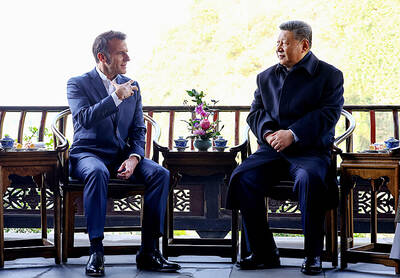
RELAXED: After talks on Ukraine and trade, the French president met with students while his wife visited pandas, after the pair parted ways with their Chinese counterparts French President Emmanuel Macron concluded his fourth state visit to China yesterday in Chengdu, striking a more relaxed note after tough discussions on Ukraine and trade with Chinese President Xi Jinping (習近平) a day earlier. Far from the imposing Great Hall of the People in Beijing where the two leaders held talks, Xi and China’s first lady, Peng Liyuan (彭麗媛), showed Macron and his wife Brigitte around the centuries-old Dujiangyan Dam, a World Heritage Site set against the mountainous landscape of Sichuan Province. Macron was told through an interpreter about the ancient irrigation system, which dates back to the third century


 RSS
RSS