


Pope Francis yesterday demanded world leaders renounce atomic weapons and the Cold War-era doctrine of deterrence, saying the stockpiling of nuclear arms decreases security, wastes money and threatens humanity.
Francis blasted the demise of arms control treaties while visiting Nagasaki, the site of the second of the two US atomic bombings on Japan in 1945.
After laying a wreath of flowers and praying at the foot of the memorial to the victims, Francis said the place stands as a stark reminder “of the pain and horror that we human beings are capable of inflicting upon one another.”
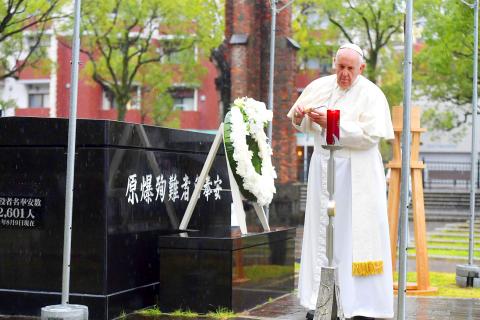
Photo: AFP
“Convinced as I am that a world without nuclear weapons is possible and necessary, I ask political leaders not to forget that these weapons cannot protect us from current threats to national and international security,” he said.
The mood was somber and silent, darkened by the downpour that drenched the terraced fields and rice paddies of Nagasaki and the thousands of Japanese who came out in plastic raincoats to witness the second pope to pay his respects to victims of the bomb.
Francis visited Nagasaki — and later Hiroshima — at the start of his three-day trip to Japan aimed at emphasizing his call for a global ban on atomic weapons.
Nagasaki was the perfect place to begin his visit, the birthplace of Christianity in Japan and ground zero of the bomb.
The Holy See was among the first countries to sign and ratify the new UN nuclear prohibition treaty, and Francis himself has gone further than any pope before him in saying not only the use, but the mere possession of atomic weapons is “to be condemned.”
While Francis yesterday did not repeat his 2017 condemnation, he made a similar point.
“One of the deepest longings of the human heart is for security, peace and stability,” he said.
“The possession of nuclear and other weapons of mass destruction is not the answer to this desire; indeed they seem always to thwart it,” he said.
The first US atomic bomb fell on Hiroshima on Aug. 6, 1945, killing 140,000 people. The second one dropped three days later on Nagasaki and killed another 74,000 by the end of the same year.
Many of the survivors have suffered the lasting impact of radiation and developed various forms of cancer.
“In a world where millions of children and families live in inhumane conditions, the money that is squandered and the fortunes made through the manufacture, upgrading, maintenance and sale of ever more destructive weapons, are an affront crying out to heaven,” Francis said.
He lamented the “climate of distrust” that is eating away at non-proliferation efforts and the arms control framework, a reference to a series of violated treaties and the demise this year of the Intermediate-range Nuclear Forces treaty, a landmark Cold War-era arms control agreement.
The US formally withdrew from the treaty in August, after accusing Moscow of developing a Russian missile system prohibited under it.
Gerald Powers, director of the Catholic Peacebuilding Network at the University of Notre Dame’s Kroc Institute, said Francis did not break any new ground on the morality of deterrence in his remarks yesterday, after he shifted the church’s position in 2017.
“Instead, the pope reinforces the church’s long-standing efforts to delegitimize the nuclear status quo and convince the world that nuclear disarmament is not only a moral imperative but should be a policy goal,” Powers said in an e-mail.
Starting 1982, then-pope John Paul II had held that nuclear deterrence could be morally acceptable in the interim “so long as it is used as a step toward mutual, verifiable nuclear disarmament.”
However, the Holy See has come to realize in recent years that the policy was becoming a permanent condition, and not leading to disarmament.
By condemning nuclear deterrence in 2017, Francis pleased liberals and agitated conservatives, perhaps informing his more nuanced remarks yesterday.
Japanese who came out to see Francis were grateful, regardless.
Negoro Fumiyo, a 62-year-old Christian from Osaka, waited for hours in the rain for Francis’ Mass, celebrated in Nagasaki’s baseball stadium before a crowd of about 35,000 — and the remains of a wooden statue of the Virgin Mary rescued from a cathedral destroyed in the 1945 atomic bomb.
“I think he is a person who can deliver the message of peace without inhibition,” Fumiyo said.
Francis’ visit to Nagasaki also gave him the chance to honor Christian missionaries and martyrs centuries after St Francis Xavier first brought Christianity to the archipelago in 1549.
He laid a second wreath of flowers at the memorial of 26 Nagasaki Martyrs, who were crucified in 1597 at the start of the two-century wave of anti-Christian persecution by Japanese rulers.
Francis was scheduled to return to Tokyo last night, where he today he is to meet victims of the March 11, 2011, earthquake, tsunami and nuclear meltdown.
He is also scheduled to deliver a Mass at a Tokyo baseball stadium, meet Emperor Naruhito and hold talks with Japanese government officials and local Catholic leaders.
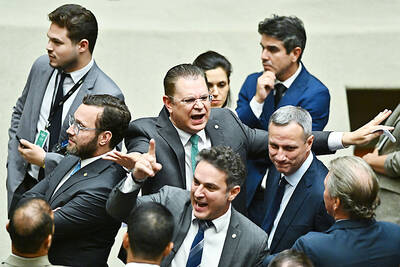
PARLIAMENT CHAOS: Police forcibly removed Brazilian Deputy Glauber Braga after he called the legislation part of a ‘coup offensive’ and occupied the speaker’s chair Brazil’s lower house of Congress early yesterday approved a bill that could slash former Brazilian president Jair Bolsonaro’s prison sentence for plotting a coup, after efforts by a lawmaker to disrupt the proceedings sparked chaos in parliament. Bolsonaro has been serving a 27-year term since last month after his conviction for a scheme to stop Brazilian President Luiz Inacio Lula da Silva from taking office after the 2022 election. Lawmakers had been discussing a bill that would significantly reduce sentences for several crimes, including attempting a coup d’etat — opening up the prospect that Bolsonaro, 70, could have his sentence cut to

A plan by Switzerland’s right-wing People’s Party to cap the population at 10 million has the backing of almost half the country, according to a poll before an expected vote next year. The party, which has long campaigned against immigration, argues that too-fast population growth is overwhelming housing, transport and public services. The level of support comes despite the government urging voters to reject it, warning that strict curbs would damage the economy and prosperity, as Swiss companies depend on foreign workers. The poll by newspaper group Tamedia/20 Minuten and released yesterday showed that 48 percent of the population plan to vote
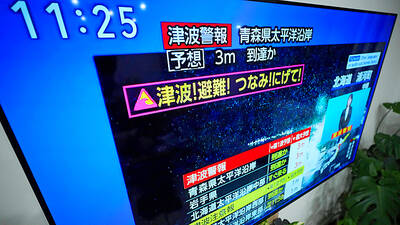
A powerful magnitude 7.6 earthquake shook Japan’s northeast region late on Monday, prompting tsunami warnings and orders for residents to evacuate. A tsunami as high as three metres (10 feet) could hit Japan’s northeastern coast after an earthquake with an estimated magnitude of 7.6 occurred offshore at 11:15 p.m. (1415 GMT), the Japan Meteorological Agency (JMA) said. Tsunami warnings were issued for the prefectures of Hokkaido, Aomori and Iwate, and a tsunami of 40cm had been observed at Aomori’s Mutsu Ogawara and Hokkaido’s Urakawa ports before midnight, JMA said. The epicentre of the quake was 80 km (50 miles) off the coast of
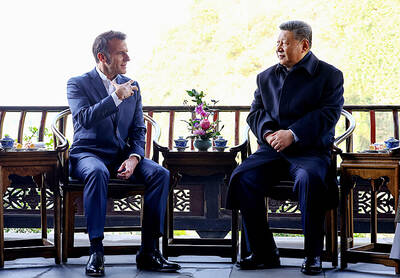
RELAXED: After talks on Ukraine and trade, the French president met with students while his wife visited pandas, after the pair parted ways with their Chinese counterparts French President Emmanuel Macron concluded his fourth state visit to China yesterday in Chengdu, striking a more relaxed note after tough discussions on Ukraine and trade with Chinese President Xi Jinping (習近平) a day earlier. Far from the imposing Great Hall of the People in Beijing where the two leaders held talks, Xi and China’s first lady, Peng Liyuan (彭麗媛), showed Macron and his wife Brigitte around the centuries-old Dujiangyan Dam, a World Heritage Site set against the mountainous landscape of Sichuan Province. Macron was told through an interpreter about the ancient irrigation system, which dates back to the third century


 RSS
RSS