


Protesters picketed the home of Colombian President Ivan Duque on Friday, defying a curfew and his promises of a “national conversation” on social policies following massive anti-government demonstrations that have left three dead and dozens wounded.
“Starting next week, I will launch a national conversation to strengthen the current social policy agenda, working in a united way with medium and long-term vision, which will allow us to close the social gaps,” Duque said in a televised speech earlier in the day.
“This conversation will take place regionally with all the social and political sectors. I will use electronic media and participatory mechanisms ... so that we can all build a meaningful path of reform,” he said.
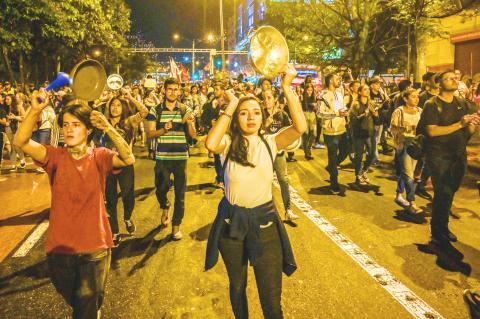
Photo: AFP
The popularity of Duque’s right-wing government — a key ally of the US — has been on the wane since his election 18 months ago, as it deals with hosting 1.4 million refugees from neighboring Venezuela’s economic meltdown, as well as the complex fallout of a 2016 peace deal with FARC rebels and rampant drug trafficking.
Hundreds of thousands of Colombians on Thursday took to the streets in Bogota and other cities to protest Duque’s economic, social and security policies as part of a nationwide general strike.
There were arrests and clashes as trade unions, students, opposition parties and the South American country’s indigenous organizations vented their anger.
The protests came amid social upheaval across South America, as a wave of unrest over the past two months has battered governments in Chile, Bolivia and Ecuador.
Duque’s statement on Friday came shortly after Bogota Mayor Enrique Penalosa declared a nighttime curfew in the capital, following clashes between protesters and police in the southern part of the city of 7 million earlier in the day.
Duque said he was stepping up the police presence and ordering the “deployment of joint patrols of police and army in the most critical places.”
However, that did not stop hundreds of people from showing up outside the president’s house in Bogota, singing the national anthem while banging pots and pans in a form of protest that is common in parts of Latin America, although not in Colombia.
The protesters dispersed peacefully about one hour after the 9pm curfew began.
Hundreds of demonstrators protested in cities across the country earlier in the day, following protests in the western Valle del Cauca department on Thursday that Colombian Minister of Defense Carlos Holmes Trujillo told reporters had left three dead.
Penalosa said 76 bus stations were attacked during the violence in Bogota, some of which were totally destroyed, and 79 buses were vandalized. About 230 people were arrested, he added.
The violence and looting paralyzed the public transport system, forcing hundreds of people to hoof it to their homes or offices.
There were also 122 civilians wounded, 151 security forces hurt and 146 people detained, the government said.
Trujillo announced late on Friday that vandalism had been brought under control in Bogota and the curfew was mostly successful.
“There is no vandalism at present, the curfew is 90 percent respected,” he told reporters.
Three police officers were killed and seven other people injured after an attack on a police station in southwestern Colombia on Friday, a local official told reporters.
However, city secretary Jaime Asprilla attributed the attack to armed groups in the area, and not to the protests against Duque.

PARLIAMENT CHAOS: Police forcibly removed Brazilian Deputy Glauber Braga after he called the legislation part of a ‘coup offensive’ and occupied the speaker’s chair Brazil’s lower house of Congress early yesterday approved a bill that could slash former Brazilian president Jair Bolsonaro’s prison sentence for plotting a coup, after efforts by a lawmaker to disrupt the proceedings sparked chaos in parliament. Bolsonaro has been serving a 27-year term since last month after his conviction for a scheme to stop Brazilian President Luiz Inacio Lula da Silva from taking office after the 2022 election. Lawmakers had been discussing a bill that would significantly reduce sentences for several crimes, including attempting a coup d’etat — opening up the prospect that Bolsonaro, 70, could have his sentence cut to

A plan by Switzerland’s right-wing People’s Party to cap the population at 10 million has the backing of almost half the country, according to a poll before an expected vote next year. The party, which has long campaigned against immigration, argues that too-fast population growth is overwhelming housing, transport and public services. The level of support comes despite the government urging voters to reject it, warning that strict curbs would damage the economy and prosperity, as Swiss companies depend on foreign workers. The poll by newspaper group Tamedia/20 Minuten and released yesterday showed that 48 percent of the population plan to vote

A powerful magnitude 7.6 earthquake shook Japan’s northeast region late on Monday, prompting tsunami warnings and orders for residents to evacuate. A tsunami as high as three metres (10 feet) could hit Japan’s northeastern coast after an earthquake with an estimated magnitude of 7.6 occurred offshore at 11:15 p.m. (1415 GMT), the Japan Meteorological Agency (JMA) said. Tsunami warnings were issued for the prefectures of Hokkaido, Aomori and Iwate, and a tsunami of 40cm had been observed at Aomori’s Mutsu Ogawara and Hokkaido’s Urakawa ports before midnight, JMA said. The epicentre of the quake was 80 km (50 miles) off the coast of
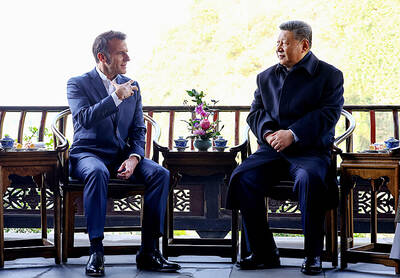
RELAXED: After talks on Ukraine and trade, the French president met with students while his wife visited pandas, after the pair parted ways with their Chinese counterparts French President Emmanuel Macron concluded his fourth state visit to China yesterday in Chengdu, striking a more relaxed note after tough discussions on Ukraine and trade with Chinese President Xi Jinping (習近平) a day earlier. Far from the imposing Great Hall of the People in Beijing where the two leaders held talks, Xi and China’s first lady, Peng Liyuan (彭麗媛), showed Macron and his wife Brigitte around the centuries-old Dujiangyan Dam, a World Heritage Site set against the mountainous landscape of Sichuan Province. Macron was told through an interpreter about the ancient irrigation system, which dates back to the third century


 RSS
RSS