


Police are to be out in force at polling stations in Hong Kong this weekend as keenly contested local elections take place amid ongoing anti-government protests.
New Hong Kong Police Commissioner Chris Tang (鄧炳強) yesterday told reporters that officers would deal with any outbreak of violence immediately without hesitation.
Six masked protesters surrendered before dawn, bringing to about 30 the number who have come out in the past day from the Hong Kong Polytechnic University campus besieged by police.
The group emerged from a campus entrance and held hands as they walked toward a checkpoint at about 3am. Five wore the black clothing favored by the movement and the other was in a blue checked shirt.
Most of the protesters who took over the university last week have left, but an unknown number have remained inside for days, hoping to somehow avoid arrest.
Police are arresting all the adults, while those younger than 18 can go home, but might face charges later.
The anti-government protesters battled with police and blocked the nearby approach to a major road tunnel, which remains closed.
It was the latest bout in more than five months of unrest in the semi-autonomous territory. Protesters are demanding fully democratic elections and an investigation into alleged police brutality in suppressing the demonstrations.
Anti-government rallies were held in at least two places on Thursday night. Riot police kept watch, exchanging heated words with some protesters, but there were no major clashes ahead of district council elections tomorrow.
Protesters fear that the government could cancel the elections because of the unrest.
Hong Kong’s leaders have said that they want to go ahead with the vote, but warned that violence could make it impossible to hold a fair and safe election.
Asked if the police presence would make voters feel uncomfortable, Tang said that it would make residents “feel safe to go out and vote.”
The election is seen as a bellwether for public support for the protests.

PARLIAMENT CHAOS: Police forcibly removed Brazilian Deputy Glauber Braga after he called the legislation part of a ‘coup offensive’ and occupied the speaker’s chair Brazil’s lower house of Congress early yesterday approved a bill that could slash former Brazilian president Jair Bolsonaro’s prison sentence for plotting a coup, after efforts by a lawmaker to disrupt the proceedings sparked chaos in parliament. Bolsonaro has been serving a 27-year term since last month after his conviction for a scheme to stop Brazilian President Luiz Inacio Lula da Silva from taking office after the 2022 election. Lawmakers had been discussing a bill that would significantly reduce sentences for several crimes, including attempting a coup d’etat — opening up the prospect that Bolsonaro, 70, could have his sentence cut to

A plan by Switzerland’s right-wing People’s Party to cap the population at 10 million has the backing of almost half the country, according to a poll before an expected vote next year. The party, which has long campaigned against immigration, argues that too-fast population growth is overwhelming housing, transport and public services. The level of support comes despite the government urging voters to reject it, warning that strict curbs would damage the economy and prosperity, as Swiss companies depend on foreign workers. The poll by newspaper group Tamedia/20 Minuten and released yesterday showed that 48 percent of the population plan to vote

A powerful magnitude 7.6 earthquake shook Japan’s northeast region late on Monday, prompting tsunami warnings and orders for residents to evacuate. A tsunami as high as three metres (10 feet) could hit Japan’s northeastern coast after an earthquake with an estimated magnitude of 7.6 occurred offshore at 11:15 p.m. (1415 GMT), the Japan Meteorological Agency (JMA) said. Tsunami warnings were issued for the prefectures of Hokkaido, Aomori and Iwate, and a tsunami of 40cm had been observed at Aomori’s Mutsu Ogawara and Hokkaido’s Urakawa ports before midnight, JMA said. The epicentre of the quake was 80 km (50 miles) off the coast of
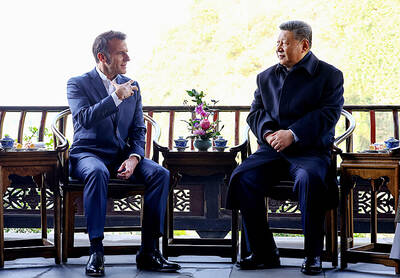
RELAXED: After talks on Ukraine and trade, the French president met with students while his wife visited pandas, after the pair parted ways with their Chinese counterparts French President Emmanuel Macron concluded his fourth state visit to China yesterday in Chengdu, striking a more relaxed note after tough discussions on Ukraine and trade with Chinese President Xi Jinping (習近平) a day earlier. Far from the imposing Great Hall of the People in Beijing where the two leaders held talks, Xi and China’s first lady, Peng Liyuan (彭麗媛), showed Macron and his wife Brigitte around the centuries-old Dujiangyan Dam, a World Heritage Site set against the mountainous landscape of Sichuan Province. Macron was told through an interpreter about the ancient irrigation system, which dates back to the third century


 RSS
RSS