


Hundreds of thousands of Colombians on Thursday took to the streets of the capital, Bogota, amid a general strike to protest the policies of Colombian President Ivan Duque’s right-wing government.
There were reports of clashes and arrests as trade unions, students, opposition parties and the South American country’s indigenous organizations challenged the full gamut of Duque’s economic, social and security policies.
At night, a thunderous chorus of pot-banging, unusual in Colombia, took place in the cities of Cali and Medellin, and lasted for hours in Bogota.
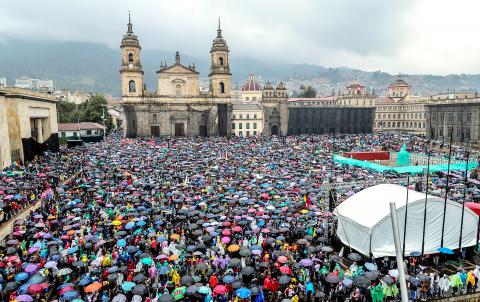
Photo: EPA-EFE
“Colombia won on this historic day of citizen mobilization,” a statement by organizers from the National Strike Committee said, as they requested an “immediate” meeting with Duque to discuss the protesters’ array of complaints.
“We call on all citizens to be ready to take further action in the street if the national government continues to neglect our demands,” they added.
Duque later said that he had heard the protesters’ demands, but did not respond to their request for direct dialogue.
“Today, Colombians spoke. We hear them. Social dialogue has been a main principle of this government and we need to deepen it with all sectors of society,” he said.
The protests came amid social upheaval across South America, as a wave of unrest over the past two months has battered governments in Chile, Bolivia and Ecuador.
The popularity of Duque’s right-wing government — a key US ally in the region — has been on the wane since his election 18 months ago, as it deals with hosting 1.4 million refugees from neighboring Venezuela’s economic meltdown, as well as the complex fallout of a 2016 peace deal with Revolutionary Armed Forces of Colombia rebels and rampant drug trafficking.
Troops were deployed in the capital and other cities to protect “strategic facilities,” authorities said.
The Colombian office of the UN High Commissioner for Human Rights voiced concern over the deployment, saying that states must limit the use of military forces “for the control of internal disturbances.”
Spokespeople for several organizations backing the protests said that more than 1 million people had marched nationwide.
Colombian Minister of the Interior Nancy Patricia Gutierrez said there were about 207,000 demonstrators, adding that “in general terms, the participants marched peacefully,” while denouncing “some vandals who wanted to disrupt public order.”
At least 42 civilians and 37 police were wounded in clashes, and 36 people were arrested across the country, authorities said.
In the center of Bogota, clashes took place at nightfall, when people wearing ski masks and hoods threw stones and other projectiles at police, who fought back with tear gas.
A new gathering of people banging pots was called for yesterday afternoon, as young protesters continued to demonstrate into the night shouting: “Long live the national strike.”
The general strike was widely followed in big cities like Bucaramanga in the northeast and Medellin in the northwest, along with Bogota, where riot police used stun grenades to turn back thousands of students walking toward the El Dorado International Airport, one journalist said.
Several separate marches converged on Plaza de Bolivar, the historic center of the capital close to the presidency.
Groups that participated in the strike have taken issue with Duque’s security policy, as well as attempts to introduce a more flexible labor market, weaken public pension funds and raise the retirement age.
Students are demanding more funding for education, while indigenous communities insist on greater protection in remote areas where 134 activists have been killed since Duque took office in August last year.
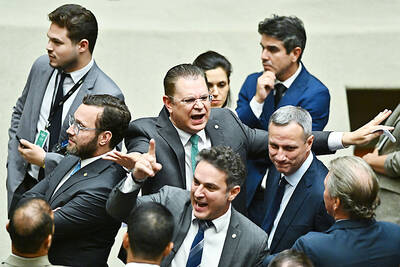
PARLIAMENT CHAOS: Police forcibly removed Brazilian Deputy Glauber Braga after he called the legislation part of a ‘coup offensive’ and occupied the speaker’s chair Brazil’s lower house of Congress early yesterday approved a bill that could slash former Brazilian president Jair Bolsonaro’s prison sentence for plotting a coup, after efforts by a lawmaker to disrupt the proceedings sparked chaos in parliament. Bolsonaro has been serving a 27-year term since last month after his conviction for a scheme to stop Brazilian President Luiz Inacio Lula da Silva from taking office after the 2022 election. Lawmakers had been discussing a bill that would significantly reduce sentences for several crimes, including attempting a coup d’etat — opening up the prospect that Bolsonaro, 70, could have his sentence cut to

A plan by Switzerland’s right-wing People’s Party to cap the population at 10 million has the backing of almost half the country, according to a poll before an expected vote next year. The party, which has long campaigned against immigration, argues that too-fast population growth is overwhelming housing, transport and public services. The level of support comes despite the government urging voters to reject it, warning that strict curbs would damage the economy and prosperity, as Swiss companies depend on foreign workers. The poll by newspaper group Tamedia/20 Minuten and released yesterday showed that 48 percent of the population plan to vote

A powerful magnitude 7.6 earthquake shook Japan’s northeast region late on Monday, prompting tsunami warnings and orders for residents to evacuate. A tsunami as high as three metres (10 feet) could hit Japan’s northeastern coast after an earthquake with an estimated magnitude of 7.6 occurred offshore at 11:15 p.m. (1415 GMT), the Japan Meteorological Agency (JMA) said. Tsunami warnings were issued for the prefectures of Hokkaido, Aomori and Iwate, and a tsunami of 40cm had been observed at Aomori’s Mutsu Ogawara and Hokkaido’s Urakawa ports before midnight, JMA said. The epicentre of the quake was 80 km (50 miles) off the coast of
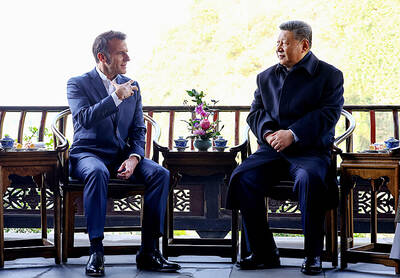
RELAXED: After talks on Ukraine and trade, the French president met with students while his wife visited pandas, after the pair parted ways with their Chinese counterparts French President Emmanuel Macron concluded his fourth state visit to China yesterday in Chengdu, striking a more relaxed note after tough discussions on Ukraine and trade with Chinese President Xi Jinping (習近平) a day earlier. Far from the imposing Great Hall of the People in Beijing where the two leaders held talks, Xi and China’s first lady, Peng Liyuan (彭麗媛), showed Macron and his wife Brigitte around the centuries-old Dujiangyan Dam, a World Heritage Site set against the mountainous landscape of Sichuan Province. Macron was told through an interpreter about the ancient irrigation system, which dates back to the third century


 RSS
RSS