


South Korean and US officials resumed talks yesterday to narrow a US$4 billion gap in how much they want Seoul to pay for the cost of hosting the American military amid public protests of “highway robbery” against sharply increased US demands.
US President Donald Trump’s demand that Seoul take on a greater share of the cost of stationing 28,500 US troops as deterrence against North Korea has tested South Korea’s confidence in the security alliance with Washington.
Reports of Trump’s US$5 billion demand earlier this month were greeted with shock in Seoul, and yesterday, progressive groups protested at the negotiation venue against what they said was “highway robbery” by “greedy” Americans.
South Korea’s negotiating team is led by a former top financial regulator with experience in tough bargaining at times of crisis for Asia’s fourth-largest economy, unprecedented in fronting a non-military expert in nearly 30 years of talks for the cost-sharing deals.
Chief US negotiator James DeHart said there was a lot of work to do, but sounded a note of optimism as he arrived in South Korea on Sunday.
“I’m very confident that we will reach an agreement that is mutually acceptable, that both sides can support, and that will ultimately strengthen our great alliance,” he told reporters.
Yesterday’s meeting marked the third round of talks for him and the second for South Korean top negotiator Jeong Eun-bo, who was appointed to his post after the first round in September. He was previously vice chairman of the Financial Services Commission and a deputy finance minister.
“His metier is budget, payment. I think the [South Korean] government decided that was the expertise needed this time,” said a person who had worked with Jeong, declining to be identified because of the sensitivity of the ongoing talks.
Jeong was involved in South Korea’s debt negotiations with international financial agencies during the 1998 Asian financial crisis, and currency swap deals during the 2008 global financial crisis, the person said.
A South Korean lawmaker said earlier this month that US officials had demanded up to US$5 billion a year, more than five times the 1.04 trillion won (US$896 million) Seoul agreed to pay this year.
South Korea “is a wealthy country and could and should pay more,” US Secretary of Defense Mark Esper said after his meeting with South Korea’s Minister of Defense Jeong Kyeong-doo last week.
Trump has long railed against what he says are inadequate contributions from allies toward defense costs.
Trump has floated the idea of pulling US troops from the Korean Peninsula, which remains in a technical state of war under a truce that suspended the 1950-1953 Korean War.
South Korea’s Ministry of Defense denied reports on some South Korean YouTube channels that US troops would be withdrawn or reduced.
Esper “reaffirmed the commitment to maintain the current level of US forces in Korea and to improve their combat readiness” last week, the ministry’s press office said on its Twitter feed.
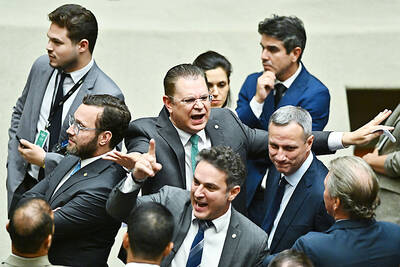
PARLIAMENT CHAOS: Police forcibly removed Brazilian Deputy Glauber Braga after he called the legislation part of a ‘coup offensive’ and occupied the speaker’s chair Brazil’s lower house of Congress early yesterday approved a bill that could slash former Brazilian president Jair Bolsonaro’s prison sentence for plotting a coup, after efforts by a lawmaker to disrupt the proceedings sparked chaos in parliament. Bolsonaro has been serving a 27-year term since last month after his conviction for a scheme to stop Brazilian President Luiz Inacio Lula da Silva from taking office after the 2022 election. Lawmakers had been discussing a bill that would significantly reduce sentences for several crimes, including attempting a coup d’etat — opening up the prospect that Bolsonaro, 70, could have his sentence cut to

A plan by Switzerland’s right-wing People’s Party to cap the population at 10 million has the backing of almost half the country, according to a poll before an expected vote next year. The party, which has long campaigned against immigration, argues that too-fast population growth is overwhelming housing, transport and public services. The level of support comes despite the government urging voters to reject it, warning that strict curbs would damage the economy and prosperity, as Swiss companies depend on foreign workers. The poll by newspaper group Tamedia/20 Minuten and released yesterday showed that 48 percent of the population plan to vote

A powerful magnitude 7.6 earthquake shook Japan’s northeast region late on Monday, prompting tsunami warnings and orders for residents to evacuate. A tsunami as high as three metres (10 feet) could hit Japan’s northeastern coast after an earthquake with an estimated magnitude of 7.6 occurred offshore at 11:15 p.m. (1415 GMT), the Japan Meteorological Agency (JMA) said. Tsunami warnings were issued for the prefectures of Hokkaido, Aomori and Iwate, and a tsunami of 40cm had been observed at Aomori’s Mutsu Ogawara and Hokkaido’s Urakawa ports before midnight, JMA said. The epicentre of the quake was 80 km (50 miles) off the coast of
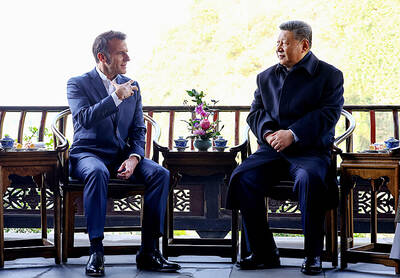
RELAXED: After talks on Ukraine and trade, the French president met with students while his wife visited pandas, after the pair parted ways with their Chinese counterparts French President Emmanuel Macron concluded his fourth state visit to China yesterday in Chengdu, striking a more relaxed note after tough discussions on Ukraine and trade with Chinese President Xi Jinping (習近平) a day earlier. Far from the imposing Great Hall of the People in Beijing where the two leaders held talks, Xi and China’s first lady, Peng Liyuan (彭麗媛), showed Macron and his wife Brigitte around the centuries-old Dujiangyan Dam, a World Heritage Site set against the mountainous landscape of Sichuan Province. Macron was told through an interpreter about the ancient irrigation system, which dates back to the third century


 RSS
RSS