


Twitter’s new ban on political advertising is to cover appeals for votes, solicitations for campaign contributions and any political content, the company said on Friday, but added that it expects to make mistakes as individuals and groups look for loopholes.
Twitter is defining political content to include any ad that references a candidate, political party, government official, ballot measure, or legislative or judicial outcome.
The ban also applies to all ads — even non-political ones — from candidates, political parties and elected or appointed government officials.
However, Twitter is allowing ads related to social causes such as climate change, gun control and abortion. People and groups running such ads would not be able to target those ads down to a user’s ZIP code or use political categories such as “conservative” or “liberal.” Rather, targeting must be kept broad, based on a user’s state or province, for instance.
News organizations will be exempt so they can promote stories that cover political issues.
While Twitter has issued guidelines for what counts as a news organization — single-issue advocacy outlets do not qualify, for instance — it was unclear if this will be enough prevent partisan Web sites from promoting political content.
Twitter announced its worldwide ban on political ads on Oct. 30, but did not release details until Friday. The policy, which is to go into effect on Friday next week, is in stark contrast to Facebook’s approach of allowing political ads, even if they contain false information.
Facebook has said it wants to provide politicians with a “level playing field” for communication and not intervene when they speak, regardless of what they are saying.
Response to Twitter’s ban has been strong and mixed, with critics questioning the company’s ability to enforce the new policy given its poor history of removing unwanted content from its service.
The company said it would make mistakes, but added that it is better to start addressing the issue now rather than wait until all the kinks are worked out.
Aside from ongoing concerns about interference in US elections by outside parties, the political advertising issue rose to the forefront in recent months as Twitter, along with Facebook and Google, refused to remove a video ad from US President Donald Trump’s campaign that targeted former US vice president Joe Biden, a Democratic presidential hopeful.
In response, US Senator Elizabeth Warren, another presidential hopeful, ran her own ad on Facebook taking aim at Facebook chief executive officer Mark Zuckerberg. The ad claimed — admittedly falsely to make its point — that Zuckerberg endorsed Trump for re-election.
Over the past several weeks, Facebook has been pressed to change its policy.
However, it was Twitter instead that jumped in with its ban.
Drew Margolin, a Cornell University communications professor who studies social networks, said Twitter’s broad ban is a reflection that “vetting is not realistic and is potentially unfair.”
A TV network might be in a position to vet all political ads, but Twitter and Facebook cannot easily do so, he said.
While their reliance on automated systems makes online ads easier and cheaper to run, Margolin said it also makes them an “attractive target” for spreading misinformation.

PARLIAMENT CHAOS: Police forcibly removed Brazilian Deputy Glauber Braga after he called the legislation part of a ‘coup offensive’ and occupied the speaker’s chair Brazil’s lower house of Congress early yesterday approved a bill that could slash former Brazilian president Jair Bolsonaro’s prison sentence for plotting a coup, after efforts by a lawmaker to disrupt the proceedings sparked chaos in parliament. Bolsonaro has been serving a 27-year term since last month after his conviction for a scheme to stop Brazilian President Luiz Inacio Lula da Silva from taking office after the 2022 election. Lawmakers had been discussing a bill that would significantly reduce sentences for several crimes, including attempting a coup d’etat — opening up the prospect that Bolsonaro, 70, could have his sentence cut to

A plan by Switzerland’s right-wing People’s Party to cap the population at 10 million has the backing of almost half the country, according to a poll before an expected vote next year. The party, which has long campaigned against immigration, argues that too-fast population growth is overwhelming housing, transport and public services. The level of support comes despite the government urging voters to reject it, warning that strict curbs would damage the economy and prosperity, as Swiss companies depend on foreign workers. The poll by newspaper group Tamedia/20 Minuten and released yesterday showed that 48 percent of the population plan to vote

A powerful magnitude 7.6 earthquake shook Japan’s northeast region late on Monday, prompting tsunami warnings and orders for residents to evacuate. A tsunami as high as three metres (10 feet) could hit Japan’s northeastern coast after an earthquake with an estimated magnitude of 7.6 occurred offshore at 11:15 p.m. (1415 GMT), the Japan Meteorological Agency (JMA) said. Tsunami warnings were issued for the prefectures of Hokkaido, Aomori and Iwate, and a tsunami of 40cm had been observed at Aomori’s Mutsu Ogawara and Hokkaido’s Urakawa ports before midnight, JMA said. The epicentre of the quake was 80 km (50 miles) off the coast of
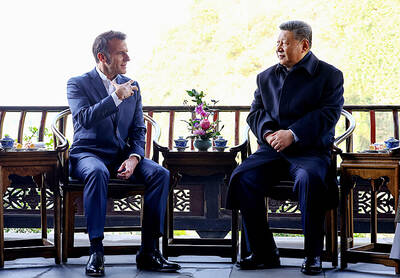
RELAXED: After talks on Ukraine and trade, the French president met with students while his wife visited pandas, after the pair parted ways with their Chinese counterparts French President Emmanuel Macron concluded his fourth state visit to China yesterday in Chengdu, striking a more relaxed note after tough discussions on Ukraine and trade with Chinese President Xi Jinping (習近平) a day earlier. Far from the imposing Great Hall of the People in Beijing where the two leaders held talks, Xi and China’s first lady, Peng Liyuan (彭麗媛), showed Macron and his wife Brigitte around the centuries-old Dujiangyan Dam, a World Heritage Site set against the mountainous landscape of Sichuan Province. Macron was told through an interpreter about the ancient irrigation system, which dates back to the third century


 RSS
RSS