


Having fled the Hong Kong universities they had thought were a ticket to success, Chinese students sit in hostels and noodle shops in the neighboring city of Shenzhen wondering how they are to complete their studies.
With campuses turned into blazing battlegrounds, courses canceled and anti-China sentiment growing more virulent, Chinese students are getting out of Hong Kong with little idea if they would ever go back.
“It’s really just not safe any more and I don’t see it getting any better,” said one 20-something student.
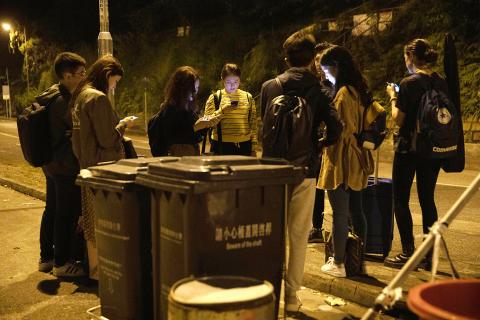
Photo: AP
Fears intensified this week because of a widely circulated video of a Chinese student being beaten by protesters at the Hong Kong University of Science and Technology.
Anger boiled over following the death of a local student who fell from a car park as police used tear gas against protesters.
“The discrimination towards mainlanders is growing worse,” said 22-year-old Frank, a postgraduate student who had just left the university for Shenzhen. “They’re so prejudiced towards us mainlanders and that’s not going to change, so why go back?”
Before anti-government protests erupted in Hong Kong more than five months ago, there were about 12,000 students among more than 1 million Chinese living in Hong Kong, according to official figures.
The pace of departures accelerated this week as intensifying violence turned campuses into nightmarish scenes of blazing Molotov cocktails and swirling tear gas.
Dozens of Chinese students from the Chinese University of Hong Kong were so fearful they called police and fled by police boat from a dock near the Sha Tin campus on Wednesday to avoid having to use roads blockaded by black clad protesters.
Support groups in Shenzhen and Hong Kong-based associations with mainland ties have rushed to help.
The Shenzhen Youth Community, operated by the Communist Youth League, said it was flooded with calls after offering free temporary hostel accommodation for students fleeing Hong Kong.
Peking University HSBC EMBA’s student association said it would host some students from Hong Kong so that they could continue studies near a Shenzhen university campus with up to seven days of accommodation for free.
Within hours of the offer, it had received more than 300 requests, according to a staffer running the hotline side.
Victor Mou, 35, chairman of the Hong Kong Nanjing Youth Association, said the group had already helped about 100 students get to Shenzhen.
Some students hoped they would not be away for long.
“If the government can control the situation I’ll go back to Hong Kong next week,” said Shuai, a 22-year-old post-graduate student from the Hong Kong University of Science and Technology, squatting on the steps of a hostel in Shenzhen.
Good academic reputations, greater freedom and the possibility of gaining a foothold overseas were all reasons for Chinese students to study in Hong Kong.
With three universities ranked in the top Top 100 of the Times Higher Education World University Rankings, it has the same number as mainland China.
However, some classes are now being canceled or being switched to online learning.
“If the whole semester is canceled they have no reason to go back to Hong Kong,” said one Chinese woman, who works in public relations in Hong Kong and had volunteered to help the fleeing students, as she shepherded three nervous-looking girls to dinner in Shenzhen.
Not all are giving up.
“As long as I stay home during clashes and don’t violate laws and protest-taboos ... I will be safe,” said Jane Chen, a student studying at City University. “I am convinced that the spirit of Hong Kong will soon recover.”
Even if all classes resume, another factor driving students away is growing anti-China sentiment in Hong Kong, generated by fears of Beijing’s tightening grip.
Those fears have fueled the protests and a groundswell of popular anger.
In everyday life, some Chinese complain of discrimination. They stand out because of their accents or inability to speak Cantonese.
A professor in charge of a post-graduate program at Hong Kong Baptist University said he expected applications to drop by a quarter — though with 1,000 Chinese applications for 100 spaces it would not mean they go unfilled.
“The masked, black-clad students have really damaged the reputations of Hong Kong University of Science and Technology and the University of Hong Kong,” China’s nationalist Global Times said.
“Mainland students will surely think twice before applying for colleges and universities in Hong Kong,” it said.
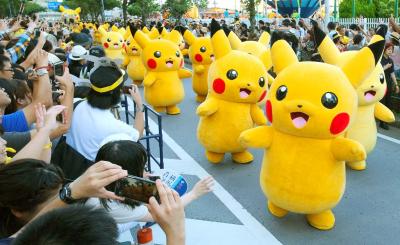
China’s military news agency yesterday warned that Japanese militarism is infiltrating society through series such as Pokemon and Detective Conan, after recent controversies involving events at sensitive sites. In recent days, anime conventions throughout China have reportedly banned participants from dressing as characters from Pokemon or Detective Conan and prohibited sales of related products. China Military Online yesterday posted an article titled “Their schemes — beware the infiltration of Japanese militarism in culture and sports.” The article referenced recent controversies around the popular anime series Pokemon, Detective Conan and My Hero Academia, saying that “the evil influence of Japanese militarism lives on in

DIPLOMATIC THAW: The Canadian prime minister’s China visit and improved Beijing-Ottawa ties raised lawyer Zhang Dongshuo’s hopes for a positive outcome in the retrial China has overturned the death sentence of Canadian Robert Schellenberg, a Canadian official said on Friday, in a possible sign of a diplomatic thaw as Canadian Prime Minister Mark Carney seeks to boost trade ties with Beijing. Schellenberg’s lawyer, Zhang Dongshuo (張東碩), yesterday confirmed China’s Supreme People’s Court struck down the sentence. Schellenberg was detained on drug charges in 2014 before China-Canada ties nosedived following the 2018 arrest in Vancouver of Huawei chief financial officer Meng Wanzhou (孟晚舟). That arrest infuriated Beijing, which detained two Canadians — Michael Spavor and Michael Kovrig — on espionage charges that Ottawa condemned as retaliatory. In January

A sign hanging from a rusty ice-green shipping container installed by Thai forces on what they say is the border with Cambodia reads: “Cambodian citizens are strictly prohibited from entering this area.” On opposite sides of the makeshift barricade, fronted by coils of barbed wire, Cambodians lamented their lost homes and livelihoods as Thailand’s military showed off its gains. Thai forces took control of several patches of disputed land along the border during fighting last year, which could amount to several square kilometers in total. Cambodian Kim Ren said her house in Chouk Chey used to stand on what is now the Thai

NEW RULES: There would be fewer school days, four-day workweeks, and a reduction in transportation services as the country battles a crisis exacerbated by US pressure The Cuban government on Friday announced emergency measures to address a crippling energy crisis worsened by US sanctions, including the adoption of a four-day work week for state-owned companies and fuel sale restrictions. Cuban Deputy Prime Minister Oscar Perez-Oliva Fraga blamed Washington for the crisis, telling Cuban television the government would “implement a series of decisions, first and foremost to guarantee the vitality of our country and essential services, without giving up on development.” “Fuel will be used to protect essential services for the population and indispensable economic activities,” he said. Among the new measures are the reduction of the working week in


 RSS
RSS