


Reviving decades-old cries of “Death to America,” Iran yesterday marked the 40th anniversary of the 1979 student takeover of the US embassy in Tehran and the 444-day hostage crisis that followed as tensions remain high over the country’s collapsing nuclear deal with world powers.
Demonstrators gathered in front of the former US embassy in downtown Tehran as state television aired footage from other cities across the country.
This year’s rallies come as Iran’s regional allies in Iraq and Lebanon face widespread protests. The Iranian consulate in Karbalah, Iraq, a holy city for Shiites, was attacked by a mob overnight.
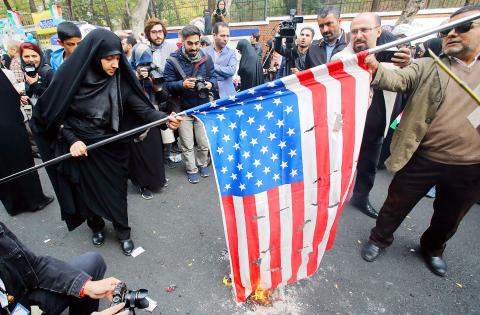
Photo: EPA-EFE/ABEDIN TAHERKENAREH
Associated Press video showed a fire burned its gate as demonstrators threw gasoline bombs and climbed its walls, some waving an Iraqi flag. Iranian media only reported a “protest outside” of the diplomatic post, adding that things had returned to normal.
The main event in Tehran yesterday was to be a rally at the former embassy and an address by Iranian army commander General Abdolrahim Mousavi. Demonstrators at other rallies yesterday also cried: “Death to America!” and “Death to Israel!”
A billboard at Tehran’s Vali-e Asr Square, often used to highlight political views, showed people waving flags from around the world and cheering as a US flag burned.
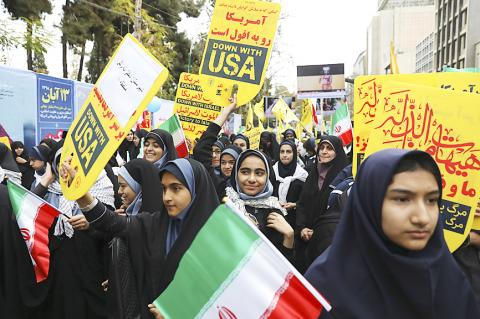
Photo: AP
A caption on it read: “We are the superpower.”
What exactly led to the 1979 takeover of the embassy remained obscure at the time to Americans who for months could only watch in horror as TV newscasts showed Iranian protests at the embassy.
Popular anger against the US was rooted in the 1953 CIA-engineered coup that toppled Iran’s elected prime minister and cemented the power of Shah Mohammad Reza Pahlavi.
The shah, dying from cancer, fled Iran in January 1979, paving the way for the country’s Islamic Revolution. However, for months, Iran faced widespread unrest, ranging from separatist attacks, worker revolts and internal power struggles.
Police reported for work but not for duty, allowing chaos to unfold, including for Marxist students to briefly seize the US embassy.
In this power vacuum, then-US president Jimmy Carter allowed the shah to seek medical treatment in New York. That lit the fuse for the Nov. 4, 1979, takeover by Islamist students, who initially planned a sit-in at the embassy.
However, the situation quickly spun out of their control.
Ayatollah Ruhollah Khomeini, the long-exiled Shiite cleric whose return to Iran sparked the Islamic Revolution, gave his support to the takeover. He would use that popular angle to expand the Islamists’ power.
Some hostages would be released as the crisis unfolded, while several others who escaped the embassy and found safety with Canada’s ambassador, left Iran via a CIA-planned escape — dramatic moments that were recounted in the 2012 film Argo.
Another 52 American hostages would be held for 444 days until the inauguration of former US President Ronald Reagan, when they were freed.
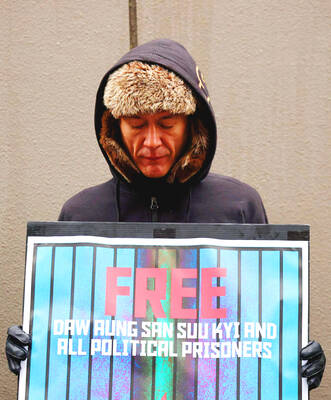
The Burmese junta has said that detained former leader Aung San Suu Kyi is “in good health,” a day after her son said he has received little information about the 80-year-old’s condition and fears she could die without him knowing. In an interview in Tokyo earlier this week, Kim Aris said he had not heard from his mother in years and believes she is being held incommunicado in the capital, Naypyidaw. Aung San Suu Kyi, a Nobel Peace Prize laureate, was detained after a 2021 military coup that ousted her elected civilian government and sparked a civil war. She is serving a
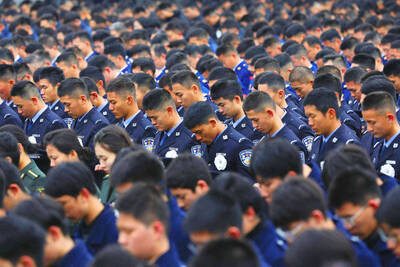
China yesterday held a low-key memorial ceremony for the 1937 Nanjing Massacre, with Chinese President Xi Jinping (習近平) not attending, despite a diplomatic crisis between Beijing and Tokyo over Taiwan. Beijing has raged at Tokyo since Japanese Prime Minister Sanae Takaichi last month said that a hypothetical Chinese attack on Taiwan could trigger a military response from Japan. China and Japan have long sparred over their painful history. China consistently reminds its people of the 1937 Nanjing Massacre, in which it says Japanese troops killed 300,000 people in what was then its capital. A post-World War II Allied tribunal put the death toll
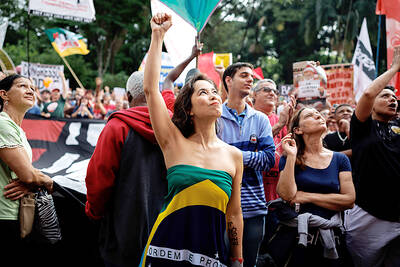
‘NO AMNESTY’: Tens of thousands of people joined the rally against a bill that would slash the former president’s prison term; President Lula has said he would veto the bill Tens of thousands of Brazilians on Sunday demonstrated against a bill that advanced in Congress this week that would reduce the time former president Jair Bolsonaro spends behind bars following his sentence of more than 27 years for attempting a coup. Protests took place in the capital, Brasilia, and in other major cities across the nation, including Sao Paulo, Florianopolis, Salvador and Recife. On Copacabana’s boardwalk in Rio de Janeiro, crowds composed of left-wing voters chanted “No amnesty” and “Out with Hugo Motta,” a reference to the speaker of the lower house, which approved the bill on Wednesday last week. It is
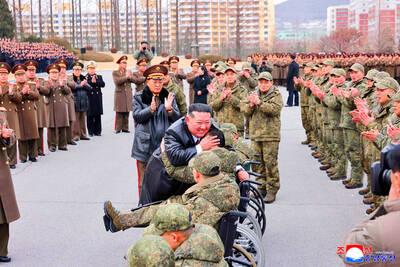
FALLEN: The nine soldiers who were killed while carrying out combat and engineering tasks in Russia were given the title of Hero of the Democratic People’s Republic of Korea North Korean leader Kim Jong-un attended a welcoming ceremony for an army engineering unit that had returned home after carrying out duties in Russia, North Korean state media KCNA reported on Saturday. In a speech carried by KCNA, Kim praised officers and soldiers of the 528th Regiment of Engineers of the Korean People’s Army (KPA) for “heroic” conduct and “mass heroism” in fulfilling orders issued by the ruling Workers’ Party of Korea during a 120-day overseas deployment. Video footage released by North Korea showed uniformed soldiers disembarking from an aircraft, Kim hugging a soldier seated in a wheelchair, and soldiers and officials


 RSS
RSS