


British Prime Minister Boris Johnson and the EU on Thursday gave themselves a week to agree on a Brexit plan. Otherwise, the UK will be heading for either a no-deal exit or another humiliating postponement of its departure from the EU.
While support is building for Johnson’s proposals at home, the EU’s chief negotiator, Michel Barnier, told a private meeting of European senior diplomats that the latest British blueprint for post-Brexit arrangements along the border with Ireland falls far short of his conditions for a deal, three EU officials said.
Johnson’s challenge is to reach a compromise with Brussels without losing his new converts at home.
The EU is to make a decision in a week about whether the two sides are closing in on a deal, having demanded the British government come up with a better offer.
In a sign of the determination to thrash out an agreement, David Frost, Johnson’s envoy to the EU, immediately resumed talks in Brussels that continued yesterday.
Johnson himself could hold meetings in several European capitals over the weekend, officials said.
After politely welcoming the proposals on Wednesday, the main European institutions broke cover to criticize the plans.
European Council President Donald Tusk, who spoke by telephone to Johnson and Irish President Leo Varadkar, said he was “unconvinced” by the proposals.
European Commission President Jean-Claude Juncker described them as “problematic,” while the European Parliament, which has a veto over the final deal, said it had “grave concerns.”
A spokeswoman for the British government said it does not accept the downbeat assessment from European leaders and that progress has been made.
Failure to reach a deal would set the UK on course for a constitutional showdown with few precedents: Johnson has promised to pull the UK out of the EU on Oct. 31 whether the talks succeed or not, while Parliament has already legislated to prevent him pulling the UK out of the EU without a withdrawal agreement.
A Scottish court is to start hearing a case on Friday designed to ensure he complies.
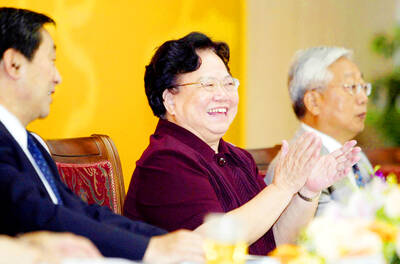
The death of a former head of China’s one-child policy has been met not by tributes, but by castigation of the abandoned policy on social media this week. State media praised Peng Peiyun (彭珮雲), former head of China’s National Family Planning Commission from 1988 to 1998, as “an outstanding leader” in her work related to women and children. The reaction on Chinese social media to Peng’s death in Beijing on Sunday, just shy of her 96th birthday, was less positive. “Those children who were lost, naked, are waiting for you over there” in the afterlife, one person posted on China’s Sina Weibo platform. China’s
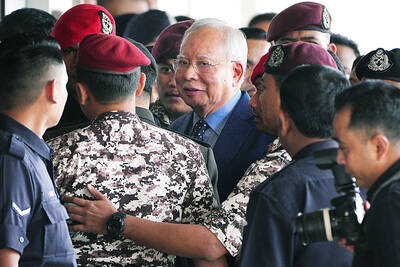
‘NO COUNTRY BUMPKIN’: The judge rejected arguments that former prime minister Najib Razak was an unwitting victim, saying Najib took steps to protect his position Imprisoned former Malaysian prime minister Najib Razak was yesterday convicted, following a corruption trial tied to multibillion-dollar looting of the 1Malaysia Development Berhad (1MDB) state investment fund. The nation’s high court found Najib, 72, guilty on four counts of abuse of power and 21 charges of money laundering related to more than US$700 million channeled into his personal bank accounts from the 1MDB fund. Najib denied any wrongdoing, and maintained the funds were a political donation from Saudi Arabia and that he had been misled by rogue financiers led by businessman Low Taek Jho. Low, thought to be the scandal’s mastermind, remains
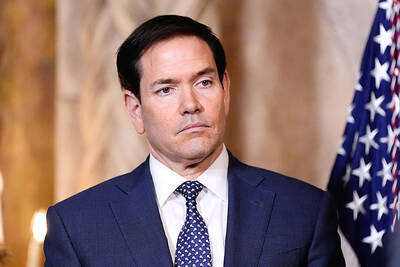
‘POLITICAL LOYALTY’: The move breaks with decades of precedent among US administrations, which have tended to leave career ambassadors in their posts US President Donald Trump’s administration has ordered dozens of US ambassadors to step down, people familiar with the matter said, a precedent-breaking recall that would leave embassies abroad without US Senate-confirmed leadership. The envoys, career diplomats who were almost all named to their jobs under former US president Joe Biden, were told over the phone in the past few days they needed to depart in the next few weeks, the people said. They would not be fired, but finding new roles would be a challenge given that many are far along in their careers and opportunities for senior diplomats can

Australian Prime Minister Anthony Albanese yesterday announced plans for a national bravery award to recognize civilians and first responders who confronted “the worst of evil” during an anti-Semitic terror attack that left 15 dead and has cast a heavy shadow over the nation’s holiday season. Albanese said he plans to establish a special honors system for those who placed themselves in harm’s way to help during the attack on a beachside Hanukkah celebration, like Ahmed al-Ahmed, a Syrian-Australian Muslim who disarmed one of the assailants before being wounded himself. Sajid Akram, who was killed by police during the Dec. 14 attack, and


 RSS
RSS