


Starbucks has emerged as the latest brand to fall foul of Hong Kong’s pro-democracy protesters after a family member of a local caterer that runs the local franchise spoke out against demonstrators.
Multiple branches were covered with graffiti over the weekend as the territory convulsed with some of the most intense clashes between hardcore protesters and riot police in weeks.
One cafe in Wanchai District was daubed with “boycott” slogans, as well as insults to the police and Maxim’s Caterers, the major Hong Kong restaurant chain that runs Starbucks outlets in the territory.
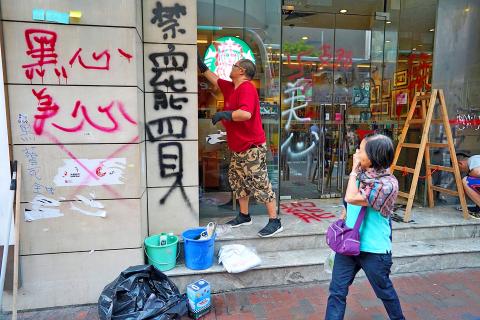
Photo: AFP
The vandalism illustrates the huge pressures on international brands as Beijing pressures businesses to publicly condemn the protests. Those that do risk a protester backlash — but staying silent risks financial punishment in China, a far more lucrative market.
The boycott campaign against Maxim’s snowballed after Annie Wu (伍淑清), the daughter of Maxim’s wealthy founder, delivered a speech earlier this month in which she condemned the protests and said that Beijing’s hardline stance against the pro-democracy advocates should be supported.
She was speaking at the UN Human Rights Council in Geneva alongside Pansy Ho (何超瓊), a billionaire casino magnate who made similar calls.
Their comments were seized on by protesters and portrayed as an example of how Hong Kong’s wealthy elite are out of touch with public sentiment and in the pockets of Beijing.
Prominent democracy campaigner Joshua Wong (黃之鋒) was among those calling for a boycott of Starbucks since Wu’s speech and more than 50,000 people have signed a petition asking the Seattle-headquartered company to sever ties with Maxim’s.
“We herein urge the Board of Directors to consider whether Maxim’s truly represents the social values of Starbucks and terminate the franchise to Maxim’s immediately,” Wong wrote on Twitter on Friday.
Maxim’s did not respond to requests for comment yesterday, but it has previously issued statements distancing itself from Wu’s comments and saying that she is not employed by the company.
Other major brands have been rounded on by protesters, either for pro-Beijing comments made by owners or because the owners themselves are linked to the Chinese Communist Party.
Yoshinoya, a popular beef bowl chain, and Genki Sushi — also owned by Maxim’s — have been repeatedly tagged with graffiti, along with Bank of China branches.
Brands deemed to be sympathetic to protesters have also had a torrid time and faced boycotts in China. Chinese authorities tore into Cathay Pacific after staff joined protests, forcing the company to go through stricter regulatory checks.
The moves led to major staff changes on Cathay’s board, including the resignation of its CEO, as well as multiple staff being fired for expressing pro-democracy sentiments, something some employees have described as a “purge.”

‘CROSSING THE LINE’: China’s embassy in Seoul criticized US Forces Korea Commander General Xavier Brunson, asking if his ‘hostile’ remarks were authorized by Washington South Korea and the US are in talks over recent public remarks by the commander of US Forces Korea, Seoul’s presidential office said yesterday, after the comments drew sharp criticism from China. In a recent podcast interview, US Forces Korea Commander General Xavier Brunson described South Korea as “the dagger in the heart of Asia” from China’s east coast, prompting the Chinese embassy in Seoul to say that he had “truly crossed the line.” The interview came amid growing speculation that Washington might seek to expand the role of US Forces Korea in countering the growing regional influence of China, a key

SEEKING ORDER: Rodrigo Paz said that ‘anyone who wants to destroy the nation will have to deal with this president and the full force of the constitution’ Bolivian President Rodrigo Paz on Wednesday said that the nation was at a “breaking point” after nearly a month of protests that have caused shortages of food, fuel and medicine. Paz, who took office six months ago amid the worst economic crisis there in four decades, is battling a groundswell of fury over his policies. The political capital, La Paz, has been besieged by low-income workers and members of the indigenous majority calling for his resignation. “The country needs order and is reaching breaking point,” the 58-year-old said at a public event in La Paz, renewing his appeal for dialogue. On Tuesday, the Bolivian

Through the noise of rushing papers and whirring belts at a print factory in Kyoto, two creators watch their photo essay come to life in broadsheet form — part of an effort to win new audiences in the age of artificial intelligence (AI). Despite the decline of the publishing industry, self-publication and handmade “zine” magazines are growing in popularity in Japan, reflecting the nation’s enduring love of paper in the digital era. While speaking to Agence France-Presse at the plant, his hands black with ink, one of the creators, Kazuma Obara, said: “I think [paper] is a medium that engages all five

Australian researchers have trained lab-grown brain cells on a silicon computer chip to play the 1990s shooter game Doom and said they are just scratching the surface of what the neurons could be capable of doing. It is the science-fiction work of biotech boffins at Cortical Labs, who researched and developed the technology that harnesses the workings of the brain’s networking system. Each so-called “biological computer” contains about 200,000 living human brain cells, grown from stem cells that were harvested from blood donations. Having mastered the simple computer game Pong, where a paddle is moved up and down to send a ball


 RSS
RSS