


Thousands of demonstrators chanted slogans, sang the British national anthem and marched through a downtown Hong Kong shopping district yesterday in defiance of a police ban as shops shuttered amid fears of renewed violence.
A crowd of protesters in black and wearing masks, along with families with children, spilled into the roads of the Causeway Bay shopping belt. Some waved US and British flags, while others carried posters reiterating their calls for democratic reforms.
Police had turned down a request by the Civil Human Rights Front to hold the march, but the demonstrators were undeterred as they have been all summer.
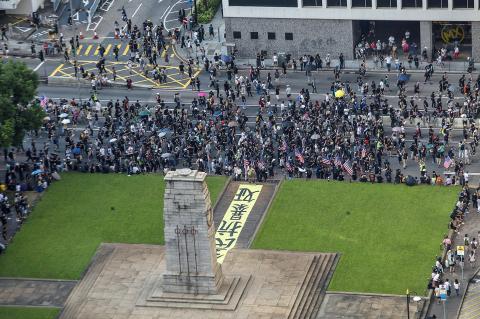
Photo: Bloomberg
The march disrupted traffic and many shops, including the Sogo department store, closed their doors.
As the crowd approached the police headquarters nearby, police raised a flag warning that they were participating in an illegal gathering, but protesters just shouted slogans and kept walking.
The protests were triggered in June by an extradition bill that many saw as an example of China’s increasing intrusion and a chipping away at Hong Kong’s freedoms and rights.

Photo: Bloomberg
Earlier yesterday, hundreds of protesters waved British flags, sang God Save the Queen and chanted “UK save Hong Kong” outside the British Consulate as they stepped up calls for international support for their campaign.
With banners declaring “one country, two systems is dead,” they repeated calls for Hong Kong’s former colonial ruler to ensure that the territory’s autonomy is upheld under agreements made when it ceded power to China in 1997.
Many of the protest signs accused Britain of not doing enough to confront Beijing over its tightening grip on Hong Kong.
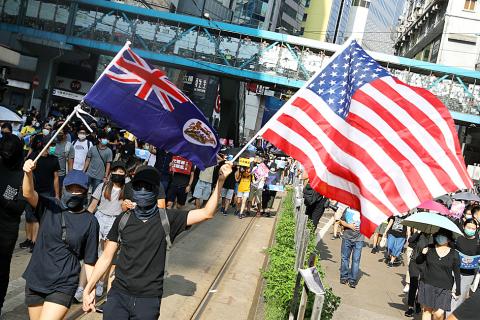
Photo: Bloomberg
“Sino-British joint declaration is void,” one read, referencing the 1984 agreement that paved the way for the handover, a deal that Hong Kongers were given no say over.
“So far I’m quite disappointed by the fact that the UK hasn’t done anything to support us,” protester Alex Leung, a recent graduate, told reporters.
Many called for Hong Kongers who want to leave the city to be granted citizenship in Britain or other Commonwealth nations.
Some Hong Kongers were given British National Overseas (BNO) passports before the handover, a document that allows holders easy travel to the UK, but grants no working or residency rights.
“At least with the full citizenship, they can protect Hong Kong people from the Chinese government,” protester Anthony Chau, who holds a BNO passport, told reporters.

‘CROSSING THE LINE’: China’s embassy in Seoul criticized US Forces Korea Commander General Xavier Brunson, asking if his ‘hostile’ remarks were authorized by Washington South Korea and the US are in talks over recent public remarks by the commander of US Forces Korea, Seoul’s presidential office said yesterday, after the comments drew sharp criticism from China. In a recent podcast interview, US Forces Korea Commander General Xavier Brunson described South Korea as “the dagger in the heart of Asia” from China’s east coast, prompting the Chinese embassy in Seoul to say that he had “truly crossed the line.” The interview came amid growing speculation that Washington might seek to expand the role of US Forces Korea in countering the growing regional influence of China, a key
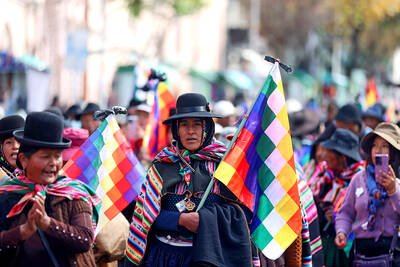
SEEKING ORDER: Rodrigo Paz said that ‘anyone who wants to destroy the nation will have to deal with this president and the full force of the constitution’ Bolivian President Rodrigo Paz on Wednesday said that the nation was at a “breaking point” after nearly a month of protests that have caused shortages of food, fuel and medicine. Paz, who took office six months ago amid the worst economic crisis there in four decades, is battling a groundswell of fury over his policies. The political capital, La Paz, has been besieged by low-income workers and members of the indigenous majority calling for his resignation. “The country needs order and is reaching breaking point,” the 58-year-old said at a public event in La Paz, renewing his appeal for dialogue. On Tuesday, the Bolivian

Through the noise of rushing papers and whirring belts at a print factory in Kyoto, two creators watch their photo essay come to life in broadsheet form — part of an effort to win new audiences in the age of artificial intelligence (AI). Despite the decline of the publishing industry, self-publication and handmade “zine” magazines are growing in popularity in Japan, reflecting the nation’s enduring love of paper in the digital era. While speaking to Agence France-Presse at the plant, his hands black with ink, one of the creators, Kazuma Obara, said: “I think [paper] is a medium that engages all five

Australian researchers have trained lab-grown brain cells on a silicon computer chip to play the 1990s shooter game Doom and said they are just scratching the surface of what the neurons could be capable of doing. It is the science-fiction work of biotech boffins at Cortical Labs, who researched and developed the technology that harnesses the workings of the brain’s networking system. Each so-called “biological computer” contains about 200,000 living human brain cells, grown from stem cells that were harvested from blood donations. Having mastered the simple computer game Pong, where a paddle is moved up and down to send a ball


 RSS
RSS