


The lights went out across much of Venezuela on Monday, reviving fears of the blackouts that plunged the country into chaos a few months ago as the government once again accused opponents of sabotaging the nation’s hydroelectric power system.
The power in the capital went out after 4pm and immediately backed up traffic as stop lights and the subway stopped working during rush hour.
As night fell in Caracas many were wondering how long they would be left in the dark.
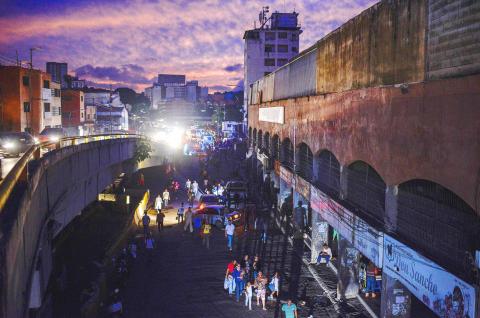
Photo: AFP
“This is horrible, a disaster,” Reni Blanco, a 48-year-old teacher, said as she joined a crush of people who flooded into the streets of the capital trying to make it home before nightfall.
Almost three hours into the blackout authorities broke their silence and blamed an “electromagnetic attack” on a series of dams located in southern Venezuela — the same culprit it attributed an almost week-long outage in March that left millions of Venezuelans without water or the ability to communicate with loved ones.
“Those who’ve systematically attacked the noble people of Venezuela in all kinds of ways will once again be confronted with the mettle and courage that we, the children of our liberator Simon Bolivar, have demonstrated in the face of difficulties,” Venezuelan Minister of Communications Jorge Rodriguez said in a statement read on state television.

Photo: Bloomberg
Rodiguez said authorities were working to restore electricity as quickly as possible.
He said security forces had been deployed, and contingency plans activated, to guarantee basic medical services and keep streets safe.
“Without light we have nothing,” said Maria Teresa Gonzalez, fretting over the meat she had in her freezer if the outage wore on as she walked her dog in the last rays of the evening sun.
Reports on social media said that 19 of 24 Venezuelan states were also affected.
Netblocks, a group monitoring Internet activity, said network data showed most of Venezuela was knocked offline with national connectivity at just 6 percent after the latest cuts.
Normally non-stop state TV, a key way for the government to keep people informed, was also off the air for a while, adding to frustrations.
Venezuelan President Nicolas Maduro blamed the March outage on a US-sponsored attack against the nation’s biggest hydroelectric dam.
More recently, as power service in Caracas has improved amid widespread rationing in the interior, officials have even taken to downplaying the outages as similar to a nationwide blackout in Argentina and even one that knocked off the power for several thousand residents of Manhattan for a few hours amid the summer heat.
However, his opponents said the outage laid bare years of underinvestment in the nation’s grid by corrupt officials who mismanaged an oil bonanza in the nation sitting atop the world’s largest crude reserves.
“They tried to hide the tragedy by rationing supplies across the country, but their failure is evident: They destroyed the system and they don’t have answers,” Venezuelan National Assembly President Juan Guaido said on Twitter.
Guaido, who the US and more than 50 other nations recognize as Venezuela’s rightful leader, reiterated an earlier call for nationwide protests yesterday.
“We Venezuelans won’t grow accustomed to this,” he said.
Much of the government’s focus since the March blackouts has been on repairing transmission lines near the Guri Dam, which provides about 80 percent of Venezuela’s electricity.

The death of a former head of China’s one-child policy has been met not by tributes, but by castigation of the abandoned policy on social media this week. State media praised Peng Peiyun (彭珮雲), former head of China’s National Family Planning Commission from 1988 to 1998, as “an outstanding leader” in her work related to women and children. The reaction on Chinese social media to Peng’s death in Beijing on Sunday, just shy of her 96th birthday, was less positive. “Those children who were lost, naked, are waiting for you over there” in the afterlife, one person posted on China’s Sina Weibo platform. China’s
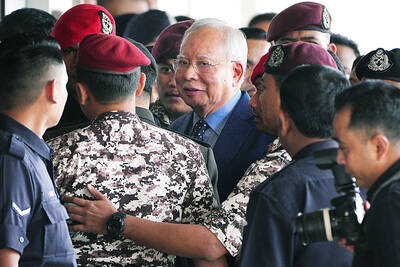
‘NO COUNTRY BUMPKIN’: The judge rejected arguments that former prime minister Najib Razak was an unwitting victim, saying Najib took steps to protect his position Imprisoned former Malaysian prime minister Najib Razak was yesterday convicted, following a corruption trial tied to multibillion-dollar looting of the 1Malaysia Development Berhad (1MDB) state investment fund. The nation’s high court found Najib, 72, guilty on four counts of abuse of power and 21 charges of money laundering related to more than US$700 million channeled into his personal bank accounts from the 1MDB fund. Najib denied any wrongdoing, and maintained the funds were a political donation from Saudi Arabia and that he had been misled by rogue financiers led by businessman Low Taek Jho. Low, thought to be the scandal’s mastermind, remains
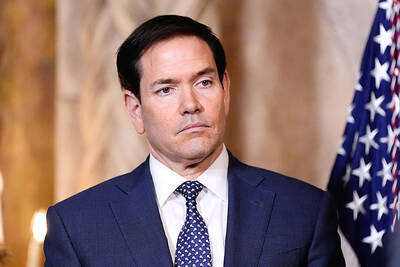
‘POLITICAL LOYALTY’: The move breaks with decades of precedent among US administrations, which have tended to leave career ambassadors in their posts US President Donald Trump’s administration has ordered dozens of US ambassadors to step down, people familiar with the matter said, a precedent-breaking recall that would leave embassies abroad without US Senate-confirmed leadership. The envoys, career diplomats who were almost all named to their jobs under former US president Joe Biden, were told over the phone in the past few days they needed to depart in the next few weeks, the people said. They would not be fired, but finding new roles would be a challenge given that many are far along in their careers and opportunities for senior diplomats can

Australian Prime Minister Anthony Albanese yesterday announced plans for a national bravery award to recognize civilians and first responders who confronted “the worst of evil” during an anti-Semitic terror attack that left 15 dead and has cast a heavy shadow over the nation’s holiday season. Albanese said he plans to establish a special honors system for those who placed themselves in harm’s way to help during the attack on a beachside Hanukkah celebration, like Ahmed al-Ahmed, a Syrian-Australian Muslim who disarmed one of the assailants before being wounded himself. Sajid Akram, who was killed by police during the Dec. 14 attack, and


 RSS
RSS