


India yesterday successfully launched its second mission to the moon, a week after a technical snag forced the South Asian nation to postpone the attempt.
The uncrewed Chandrayaan-2, which means “moon vehicle” in Sanskrit, was launched at 2:43pm from a tiny barrier island in southeastern India.
India is attempting to become the first nation to land on the south pole of Earth’s closet neighbor.
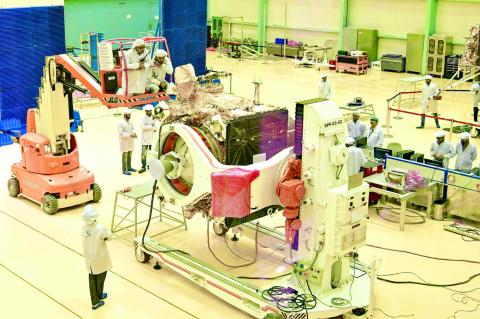
Photo: AFP
A second attempt just days after the failed one is sooner than some experts predicted, underscoring India’s confidence in the project spearheaded by the Indian Space Research Organisation.
Another failure would have been a further setback to the effort that takes place five decades after men first walked on the moon.
The mission also highlights Indian Prime Minister Narendra Modi’s renewed focus on space exploration since he came to power more than five years ago.
Several nations, as well as billionaires Jeff Bezos, Elon Musk and Richard Branson, are competing in an unofficial space race, from launching satellites to sending astronauts and paying tourists into space.
India plans to send a mission to study the sun next year, another to Venus three years later, and eventually establish its own space station.
It is also working on a US$1.4 billion Gaganyaan mission, which aims to put three Indian “gaganauts” — at least one of whom will be a woman — into orbit.
The nation, which sent an orbiter to Mars at about a 10th of the cost of NASA’s Maven probe, launched a record 104 satellites in 2017.
India is seeking to join an elite club of the former Soviet Union, the US and China in making a soft landing on the moon, in which vehicles touch down without damage.
The spacecraft is scheduled to land in 48 days, officials said.
Two Chandrayaan modules — an orbiter and a lander — are stacked together inside a launcher equipped to lift heavy satellites into orbit, while a third module, a lunar rover, is supposed to roll out on landing and operate for at least 14 days on the surface.
The aim is to explore virgin territory on the lunar surface and analyze crust samples for signs of water and helium-3. That isotope is limited on Earth yet so abundant on the moon that it theoretically could meet global energy demands for 250 years if harnessed.
The launch and the satellite together cost 8 billion rupees (US$116 million).
India has specialized in low-cost space launches since the early 1960s, when rocket sections were transported by bicycle and assembled by hand inside St Mary Magdalene Church in Thumba, a fishing village near the tip of the Indian Peninsula.

The death of a former head of China’s one-child policy has been met not by tributes, but by castigation of the abandoned policy on social media this week. State media praised Peng Peiyun (彭珮雲), former head of China’s National Family Planning Commission from 1988 to 1998, as “an outstanding leader” in her work related to women and children. The reaction on Chinese social media to Peng’s death in Beijing on Sunday, just shy of her 96th birthday, was less positive. “Those children who were lost, naked, are waiting for you over there” in the afterlife, one person posted on China’s Sina Weibo platform. China’s
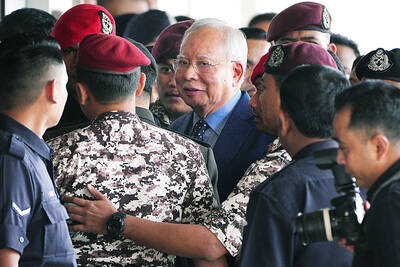
‘NO COUNTRY BUMPKIN’: The judge rejected arguments that former prime minister Najib Razak was an unwitting victim, saying Najib took steps to protect his position Imprisoned former Malaysian prime minister Najib Razak was yesterday convicted, following a corruption trial tied to multibillion-dollar looting of the 1Malaysia Development Berhad (1MDB) state investment fund. The nation’s high court found Najib, 72, guilty on four counts of abuse of power and 21 charges of money laundering related to more than US$700 million channeled into his personal bank accounts from the 1MDB fund. Najib denied any wrongdoing, and maintained the funds were a political donation from Saudi Arabia and that he had been misled by rogue financiers led by businessman Low Taek Jho. Low, thought to be the scandal’s mastermind, remains
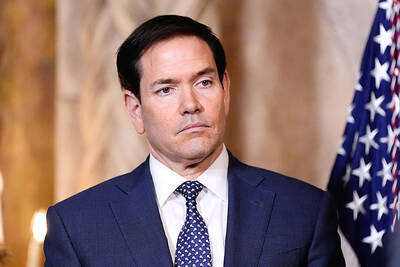
‘POLITICAL LOYALTY’: The move breaks with decades of precedent among US administrations, which have tended to leave career ambassadors in their posts US President Donald Trump’s administration has ordered dozens of US ambassadors to step down, people familiar with the matter said, a precedent-breaking recall that would leave embassies abroad without US Senate-confirmed leadership. The envoys, career diplomats who were almost all named to their jobs under former US president Joe Biden, were told over the phone in the past few days they needed to depart in the next few weeks, the people said. They would not be fired, but finding new roles would be a challenge given that many are far along in their careers and opportunities for senior diplomats can

Australian Prime Minister Anthony Albanese yesterday announced plans for a national bravery award to recognize civilians and first responders who confronted “the worst of evil” during an anti-Semitic terror attack that left 15 dead and has cast a heavy shadow over the nation’s holiday season. Albanese said he plans to establish a special honors system for those who placed themselves in harm’s way to help during the attack on a beachside Hanukkah celebration, like Ahmed al-Ahmed, a Syrian-Australian Muslim who disarmed one of the assailants before being wounded himself. Sajid Akram, who was killed by police during the Dec. 14 attack, and


 RSS
RSS