


Eleven-year-old Jerry’s crime was breaking curfew laws after fleeing violence at home. His punishment? Being sent to a youth detention center, where he says that he endured sexual abuse.
Officially called “Houses of Hope,” proponents in the Philippines say that such facilities are places for reformation and education, but critics slam many of them as “hellholes” where children are treated like caged animals.
Rights groups say Jerry should never have been detained under current laws, but warn that a proposed bill to lower the age of criminal responsibility from 15 to 12 would mean that thousands more children would be sent to overcrowded and underfunded centers — leaving them vulnerable to mistreatment.
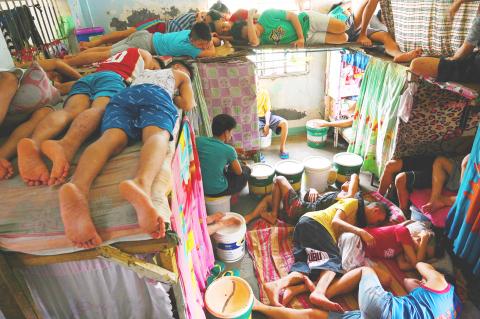
Photo: AFP
“I felt so dirty. That was the first time it happened to me,” Jerry said, as he recalled the night that he was pulled from his bed, forced to the bathroom and attacked by older boys also held at a decaying center in Manila.
“I cannot forget the sexual abuse,” he said, adding that he left home to escape beatings from his father and ended up sleeping on the streets. His mother works in Kuwait.
Under existing law, Houses of Hope are primarily to hold young offenders aged 15 to 18, but charities say that younger vulnerable children from troubled homes, like Jerry, are sometimes swept up in the dragnet, even for minor misdemeanors, and struggle to recover from the experience.
Watchdogs and former wards warn that planned legislation to criminalize children as young as 12 and then detain them with older teens, and in some cases adults, would put those least able to defend themselves at risk.
“There is a higher potential for abuse because the government is not prepared,” Melanie Ramos-Llana of Child Rights Network Philippines said.
“You put more children into Houses of Hope, which are not equipped, lack personnel and programs, and you will have problems. Jails or detention centers are not places for children,” she said.
Mixing youngsters who have committed minor infringements with older criminals could create a “school of crime,” said Louise Suamen, a youth advocate with the Bahay Tuluyan Foundation.
“If you are a child subjected to this environment, you can learn violence or abusive behavior,” Suamen said.
A bill to give authorities the power to prosecute younger children stalled in the session of the legislature that wrapped up last month, but it is a key plank of Philippine President Rodrigo Duterte’s tough-on-crime stance.
After sweeping May’s midterm polls, Duterte’s allies dominate the Philippine Congress and have vowed to advance his agenda in the session that opened yesterday.
However, critics insist that conditions in many of the facilities are identical to or worse than the jails that adults are sent to.
“Children are detained in these so-called ‘Houses of Hope’ like animals in cages,” said Father Shay Cullen, president of the PREDA Foundation, which helps boys like Jerry. “These are really hellholes of subhuman conditions.”
Children previously held in the system, including Jerry, said that they suffered abuse in youth centers. All the boys are identified using a pseudonym because they are minors or were when held.
Justin, who was 17 when he was brought to a youth center in the capital in 2017, said that other boys beat him on the pretext that he had broken house rules.
“They would punch us in the chest, stomach and sometimes the chin. It was so painful. I learned to be callous there because of what they did to me,” he said.
There are 55 government-run Houses of Hope nationwide, but this is well short of the 114 that the government has estimated that it needs to properly house troubled juveniles.
According to official data, only eight comply with social welfare rules. These guidelines include having one social worker for every 25 children and providing one bed per resident, along with nutritious meals, clothing, toiletries and rehabilitation programs.
“Some of the Houses of Hope that we saw were worse than prisons. They have no programs,” Philippine Juvenile Justice and Welfare Council Executive Director Tricia Oco told a Philippine Senate inquiry in January.
Tristan, 15, was relieved when he was transferred to a House of Hope in Manila after being held in an adult jail on a drug trafficking charge that he said police fabricated.
“I thought it would be a lovely home, but it was a prison,” he said.
Nathan Andres, 21, who was detained as a juvenile for rape, said that targeting 12-year-olds is not the answer.
“We are like the flowers we craft from old papers,” he added. “People think we are garbage, useless, but actually we still have value.”

The death of a former head of China’s one-child policy has been met not by tributes, but by castigation of the abandoned policy on social media this week. State media praised Peng Peiyun (彭珮雲), former head of China’s National Family Planning Commission from 1988 to 1998, as “an outstanding leader” in her work related to women and children. The reaction on Chinese social media to Peng’s death in Beijing on Sunday, just shy of her 96th birthday, was less positive. “Those children who were lost, naked, are waiting for you over there” in the afterlife, one person posted on China’s Sina Weibo platform. China’s
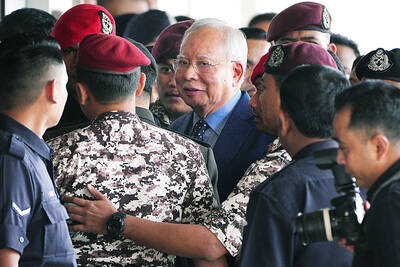
‘NO COUNTRY BUMPKIN’: The judge rejected arguments that former prime minister Najib Razak was an unwitting victim, saying Najib took steps to protect his position Imprisoned former Malaysian prime minister Najib Razak was yesterday convicted, following a corruption trial tied to multibillion-dollar looting of the 1Malaysia Development Berhad (1MDB) state investment fund. The nation’s high court found Najib, 72, guilty on four counts of abuse of power and 21 charges of money laundering related to more than US$700 million channeled into his personal bank accounts from the 1MDB fund. Najib denied any wrongdoing, and maintained the funds were a political donation from Saudi Arabia and that he had been misled by rogue financiers led by businessman Low Taek Jho. Low, thought to be the scandal’s mastermind, remains
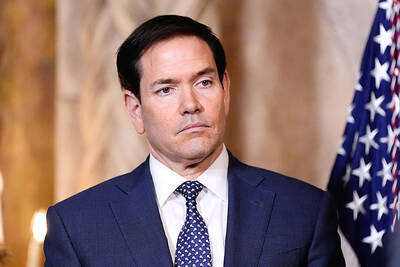
‘POLITICAL LOYALTY’: The move breaks with decades of precedent among US administrations, which have tended to leave career ambassadors in their posts US President Donald Trump’s administration has ordered dozens of US ambassadors to step down, people familiar with the matter said, a precedent-breaking recall that would leave embassies abroad without US Senate-confirmed leadership. The envoys, career diplomats who were almost all named to their jobs under former US president Joe Biden, were told over the phone in the past few days they needed to depart in the next few weeks, the people said. They would not be fired, but finding new roles would be a challenge given that many are far along in their careers and opportunities for senior diplomats can

Australian Prime Minister Anthony Albanese yesterday announced plans for a national bravery award to recognize civilians and first responders who confronted “the worst of evil” during an anti-Semitic terror attack that left 15 dead and has cast a heavy shadow over the nation’s holiday season. Albanese said he plans to establish a special honors system for those who placed themselves in harm’s way to help during the attack on a beachside Hanukkah celebration, like Ahmed al-Ahmed, a Syrian-Australian Muslim who disarmed one of the assailants before being wounded himself. Sajid Akram, who was killed by police during the Dec. 14 attack, and


 RSS
RSS