


Fifty years ago yesterday, US astronauts Neil Armstrong and Buzz Aldrin became the first humans in history to set foot on the moon, an event watched on television by half a billion people.
Their lunar module, named Eagle, touched down at 8:18pm Greenwich time on July 20, 1969.
A little more than six hours later, Armstrong placed his left foot on the lunar surface, declaring: “That’s one small step for man, one giant leap for mankind.”
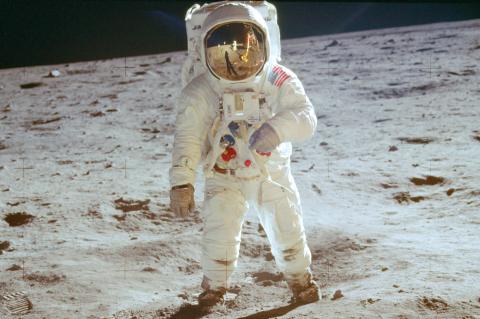
Photo :AP
NASA has been in overdrive for several weeks to mark the anniversary, with exhibits and events across the US, but most notably at the Kennedy Space Center in Cape Canaveral, Florida, and the Johnson Space Center in Houston, Texas.
US Vice President Mike Pence was yesterday due to deliver a speech from the space center, from where Armstrong, Aldrin and Michael Collins, the third crew member, took off. All three men were born in 1930.
Pence sent shockwaves through the industry in his last major space speech in March, when he advanced the deadline to return humans to the moon by four years, from 2028 to 2024.
It is within this charged context, with US President Donald Trump publicly questioning NASA’s plans to return to the moon to test technology for Mars, that the US is celebrating the anniversary of the epoch-making Apollo 11 mission.
Collins, 88, has remained the more active of the surviving Apollo veterans, and frequently shares lyrical recollections of the mission.
Speaking at a Washington event on Thursday, he said that while the moon itself was breathtaking seen up close, it was the view of Earth that has stayed with him and shaped his perspective.
“When we rolled out and looked at [the moon], oh, it was an awesome sphere,” he said.
“The sun was behind it, so it was illuminated by a rim of gold which made the strangest appearances of the craters and crater pits, the contrast between the whiter than white and darker than dark,” he added.
As magnificent as that view was, it was “nothing compared to this other window out there,” Collins said.
“Out there was this little pea about the size of your thumbnail at arm’s length: Blue, white, very shiny, you get the blue of the oceans, white of the clouds, streaks of rust we call continents, such a beautiful gorgeous tiny thing, nestled into this black velvet of the rest of the universe,” he said.
While Armstrong and Aldrin were on the surface, ex-fighter pilot Collins remained in lunar orbit, where he was in touch with ground control, providing them updates on his position.
“I said to mission control: ‘Hey, Houston, I’ve got the world in my window,’” he said.
Collins, who served as an assistant secretary of state after Apollo 11, added that the world tour he made after the mission helped him realize how the crew’s accomplishments did not belong to the US alone.
“Wherever we went, I thought people would say, well: ‘You Americans finally did it,’” he said. “And instead of that, everywhere, people said: ‘We did it, we humanity finally got off this little dinky planet and set foot elsewhere.’”
“I think the United States has to be a power in the world, but a very friendly power and not an overbearing power, not a power that tries to be dominant,” Collins said as he called for a new era of global cooperation in space.
By placing men on the moon, the US achieved the ultimate victory in the space race after losing the initial heats to the Soviet Union, which was first to put a satellite and then a man in space.
The undertaking, announced by then-president John F. Kennedy in 1961 and partly spurred by the Bay of Pigs crisis, involved enormous spending rivaled in scope only by the construction of the Panama Canal and the Manhattan Project.
It was a resounding achievement not just from a technical perspective, but also diplomatic, as the two superpowers jostled for global prestige in the Cold War.
Trump has relaunched the race to reconquer the moon — this time with the first woman — and to journey onward to the Red Planet.
However, the deadlines — 2024 and 2033 respectively — appear unrealistic and have caused turbulence within NASA.

The death of a former head of China’s one-child policy has been met not by tributes, but by castigation of the abandoned policy on social media this week. State media praised Peng Peiyun (彭珮雲), former head of China’s National Family Planning Commission from 1988 to 1998, as “an outstanding leader” in her work related to women and children. The reaction on Chinese social media to Peng’s death in Beijing on Sunday, just shy of her 96th birthday, was less positive. “Those children who were lost, naked, are waiting for you over there” in the afterlife, one person posted on China’s Sina Weibo platform. China’s
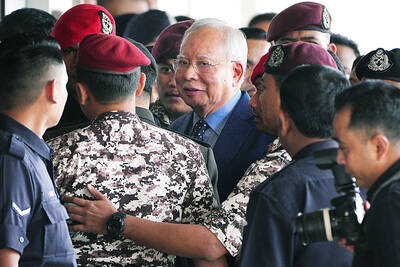
‘NO COUNTRY BUMPKIN’: The judge rejected arguments that former prime minister Najib Razak was an unwitting victim, saying Najib took steps to protect his position Imprisoned former Malaysian prime minister Najib Razak was yesterday convicted, following a corruption trial tied to multibillion-dollar looting of the 1Malaysia Development Berhad (1MDB) state investment fund. The nation’s high court found Najib, 72, guilty on four counts of abuse of power and 21 charges of money laundering related to more than US$700 million channeled into his personal bank accounts from the 1MDB fund. Najib denied any wrongdoing, and maintained the funds were a political donation from Saudi Arabia and that he had been misled by rogue financiers led by businessman Low Taek Jho. Low, thought to be the scandal’s mastermind, remains
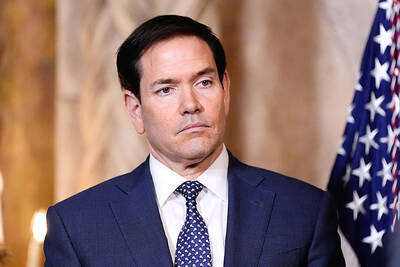
‘POLITICAL LOYALTY’: The move breaks with decades of precedent among US administrations, which have tended to leave career ambassadors in their posts US President Donald Trump’s administration has ordered dozens of US ambassadors to step down, people familiar with the matter said, a precedent-breaking recall that would leave embassies abroad without US Senate-confirmed leadership. The envoys, career diplomats who were almost all named to their jobs under former US president Joe Biden, were told over the phone in the past few days they needed to depart in the next few weeks, the people said. They would not be fired, but finding new roles would be a challenge given that many are far along in their careers and opportunities for senior diplomats can

Australian Prime Minister Anthony Albanese yesterday announced plans for a national bravery award to recognize civilians and first responders who confronted “the worst of evil” during an anti-Semitic terror attack that left 15 dead and has cast a heavy shadow over the nation’s holiday season. Albanese said he plans to establish a special honors system for those who placed themselves in harm’s way to help during the attack on a beachside Hanukkah celebration, like Ahmed al-Ahmed, a Syrian-Australian Muslim who disarmed one of the assailants before being wounded himself. Sajid Akram, who was killed by police during the Dec. 14 attack, and


 RSS
RSS