


North Korean state media yesterday released gushing reports of North Korean leader Kim Jong-un’s Demilitarized Zone summit with US President Donald Trump, as the regime sought to use another history-making meeting with the US leader to validate its policy decisions.
The front page of the ruling North Korean Workers’ Party’s Rodong Sinmun newspaper was dominated by a seven-photo splash of Trump making the first crossing of any sitting US president into North Korea, while the Korean Central News Agency (KCNA) said the meeting marked a “dramatic turn” of events.
Kim has not been able to win relief from sanctions choking his country’s paltry economy after starting his historic meetings with the US president last year in Singapore.
At their hour-long DMZ summit on Sunday, Kim and Trump agreed to resume talks and said working-level officials from the two countries would soon start discussions on the details of a disarmament deal.
KCNA quoted the North Korean leader as saying that “good personal relations” with Trump made the meeting possible even at a day’s notice, and wrote that “relations would continue to produce good results unpredictable by others and work as a mysterious force overcoming manifold difficulties and obstacles in the future, too.”
The coverage was far more robust than state media’s reporting on the collapsed summit between Trump and Kim in February, when it glossed over Trump calling off the talks and complaining that Kim asked for too much in sanctions relief while providing too little disarmament to justify the reward.
Rodong Sinmun, the country’s most prominent newspaper, featured a banner headline reading: “Respected Leader Kim Jong-un Met Donald Trump in Historic Meeting at Panmunjom.”
Photographs of the two taking their historic walk and holding talks were splashed over the first three pages, while South Korean President Moon Jae-in, also on hand to share moments with Trump and Kim, was conspicuously absent in the image collage.
Posting more than 30 photos on its Web site, KCNA described Kim and Trump’s exchange as having ended “inglorious relations between the two countries.”
It added that the leaders “voiced full understanding and sympathy” for one another.
“DPRK media has stressed in recent weeks that Kim is capable of dealing with the world’s ‘great powers’ on an equal footing,” said Rachel Minyoung Lee, a Seoul-based analyst with NK Pro.
“The photos appear designed to stress the Trump-Kim bond and DPRK-US relations, which is in line with the text of the report,” she said, using the initials of the North Korea’s official name, the Democratic People’s Republic of Korea.
Kim has been busy on the diplomatic stage in the past few months, holding summits with traditional allies China and Russia to seek support for sanctions relief in his dealings with Trump.
The tenor of his reign has differed from his father’s “military first” guiding policy principle to one where the young leader has tried to grow the economy and the military in parallel.
However, the approach poses risks of upsetting the military and the masses if he cannot deliver on his pledges.
Talks on ending North Korea’s nuclear ambitions had mostly ground to halt after the last Trump meeting in Hanoi.
Since then, North Korea put a year-end deadline for a better offer from Trump and in May reminded the region of the threat it poses by test-firing what weapons experts said was a new missile capable of delivering a nuclear warhead to almost all of South Korea.
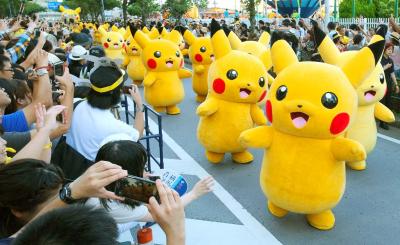
China’s military news agency yesterday warned that Japanese militarism is infiltrating society through series such as Pokemon and Detective Conan, after recent controversies involving events at sensitive sites. In recent days, anime conventions throughout China have reportedly banned participants from dressing as characters from Pokemon or Detective Conan and prohibited sales of related products. China Military Online yesterday posted an article titled “Their schemes — beware the infiltration of Japanese militarism in culture and sports.” The article referenced recent controversies around the popular anime series Pokemon, Detective Conan and My Hero Academia, saying that “the evil influence of Japanese militarism lives on in

DIPLOMATIC THAW: The Canadian prime minister’s China visit and improved Beijing-Ottawa ties raised lawyer Zhang Dongshuo’s hopes for a positive outcome in the retrial China has overturned the death sentence of Canadian Robert Schellenberg, a Canadian official said on Friday, in a possible sign of a diplomatic thaw as Canadian Prime Minister Mark Carney seeks to boost trade ties with Beijing. Schellenberg’s lawyer, Zhang Dongshuo (張東碩), yesterday confirmed China’s Supreme People’s Court struck down the sentence. Schellenberg was detained on drug charges in 2014 before China-Canada ties nosedived following the 2018 arrest in Vancouver of Huawei chief financial officer Meng Wanzhou (孟晚舟). That arrest infuriated Beijing, which detained two Canadians — Michael Spavor and Michael Kovrig — on espionage charges that Ottawa condemned as retaliatory. In January

A sign hanging from a rusty ice-green shipping container installed by Thai forces on what they say is the border with Cambodia reads: “Cambodian citizens are strictly prohibited from entering this area.” On opposite sides of the makeshift barricade, fronted by coils of barbed wire, Cambodians lamented their lost homes and livelihoods as Thailand’s military showed off its gains. Thai forces took control of several patches of disputed land along the border during fighting last year, which could amount to several square kilometers in total. Cambodian Kim Ren said her house in Chouk Chey used to stand on what is now the Thai
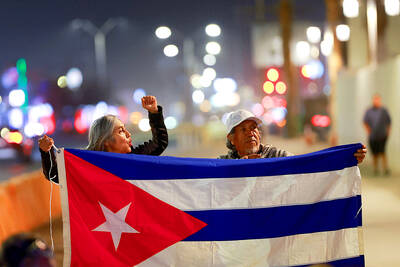
NEW RULES: There would be fewer school days, four-day workweeks, and a reduction in transportation services as the country battles a crisis exacerbated by US pressure The Cuban government on Friday announced emergency measures to address a crippling energy crisis worsened by US sanctions, including the adoption of a four-day work week for state-owned companies and fuel sale restrictions. Cuban Deputy Prime Minister Oscar Perez-Oliva Fraga blamed Washington for the crisis, telling Cuban television the government would “implement a series of decisions, first and foremost to guarantee the vitality of our country and essential services, without giving up on development.” “Fuel will be used to protect essential services for the population and indispensable economic activities,” he said. Among the new measures are the reduction of the working week in


 RSS
RSS