


The Bambao hospital, nestled in a tropical forest on Anjouan Island in the Comoros, was meant to bring state-of-the-art medical care to the poor Indian Ocean nation.
Just two years later, the hospital is deep in debt and shunned by people who find it too costly.
“A poisoned chalice,” “a colossus with feet of clay” and “a sinking ship” are among the cliches that chief pediatrician Ahmed Rakibou used to describe the facility funded and built under a Chinese aid scheme.
“If they had consulted us while building it, this could have been a jewel,” the doctor said. “Today it’s all going straight to hell.”
The hospital is about 30km east of Mutsamudu, the capital of Anjouan, the poorest of the three islands comprising the Comoros.
The aim was to make the hospital a flagship of Comoran healthcare, with 120 beds in a brand-new building, a team of 167 staff and modern equipment.
Former Chinese ambassador to the Comoros Xiao Ming (肖明) hailed a “new page in the annals of cooperation” at the opening ceremony, saying that “public health has always had a priority place in Sino-Comoran cooperation.”
However, a project that cost 4 billion Comoran francs (US$9.19 billion) today looks more like a ghost ship, with a handful of patients wandering its corridors in stifling heat. For lack of funds, about 100 staff jobs have not been filled.
In the emergency ward, a doctor silently examines a child’s injured arm. The lethargic mood is broken only by the arrival of an ambulance carrying the victim of a motorcycle accident.
“Our activity is very varied,” nurse Ali Mosthadoi said cautiously before going further. “In fact, we don’t have many patients.”
Deputy director Sidi Chaanbane was more forthcoming.
Since the hospital was opened by Comoran President Azali Assoumani in 2017, it has faced mounting difficulties, he said.
“At the start, the road from Mutsamudu was in a very bad state and patients had trouble getting here,” Chaanbane said. “It’s been repaired since, but our real problem is that we sorely lack equipment and staff.”
In addition to staff salaries, the Comoran state provides just 5 million francs a month, but the hospital needs three times as much to pay its bills.
Day-to-day management is a nightmare. The scanner broke down soon after it was first used. Repairs were not covered by the Chinese cooperation agreement, so the hospital took out a loan to get the machine working again.
The main problem is the cost of treatment, which is not free in the former French colony.
Much of the funding comes from the French Development Agency in its aid budget. France still rules over the fourth major island in the archipelago, Mayotte.
The three Comoros islands lack the standard of living on Mayotte and are far from able to make up the remaining health budget.
The hospital charges 125,000 francs for a caesarian birth, Rakibou said.
“What Comoran can pay that?” he asked. “No — this hospital is not made for the population.”
Kanissa Adbou, 27, brought her eight-year-old daughter who stepped on a nail to the hospital.
“The treatment is expensive. If I could afford it, I would go to Mayotte, because there hospital is free,” she said.
Those who believed that providing a modern hospital on Anjouan would dissuade Comorans from trying their luck on Mayotte have been disappointed, although the trip is illegal.
“People here prefer to pay 1,000 euros [US$1,131] to go to Mayotte by kwassa kwassa [human traffickers’ dugouts] than to come to us,” a nurse said. “They trust only white doctors.”
The failure to put the equipment at Bambao to regular good use enrages Ahmed Abdallah, secretary-general of the Hombo public hospital in Mutsamudu.
“The money spent there would have been enough to repair our buildings, replace our equipment and build roads so that sick people could come from nearby villages,” he said. “We don’t have even a single ambulance, yet the government has I don’t know how many four-wheel drives.”
However, Rakibou refuses to give up. He hopes that the winner of Sunday’s presidential election and the international community will come up with increased funding.
“It wouldn’t take much to change our lives,” he said.
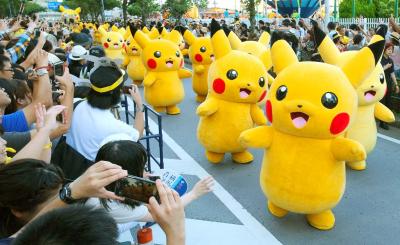
China’s military news agency yesterday warned that Japanese militarism is infiltrating society through series such as Pokemon and Detective Conan, after recent controversies involving events at sensitive sites. In recent days, anime conventions throughout China have reportedly banned participants from dressing as characters from Pokemon or Detective Conan and prohibited sales of related products. China Military Online yesterday posted an article titled “Their schemes — beware the infiltration of Japanese militarism in culture and sports.” The article referenced recent controversies around the popular anime series Pokemon, Detective Conan and My Hero Academia, saying that “the evil influence of Japanese militarism lives on in
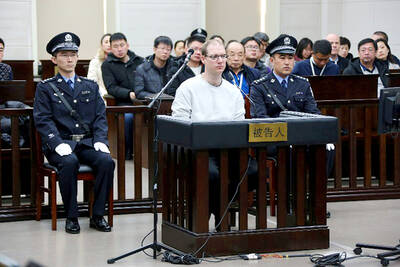
DIPLOMATIC THAW: The Canadian prime minister’s China visit and improved Beijing-Ottawa ties raised lawyer Zhang Dongshuo’s hopes for a positive outcome in the retrial China has overturned the death sentence of Canadian Robert Schellenberg, a Canadian official said on Friday, in a possible sign of a diplomatic thaw as Canadian Prime Minister Mark Carney seeks to boost trade ties with Beijing. Schellenberg’s lawyer, Zhang Dongshuo (張東碩), yesterday confirmed China’s Supreme People’s Court struck down the sentence. Schellenberg was detained on drug charges in 2014 before China-Canada ties nosedived following the 2018 arrest in Vancouver of Huawei chief financial officer Meng Wanzhou (孟晚舟). That arrest infuriated Beijing, which detained two Canadians — Michael Spavor and Michael Kovrig — on espionage charges that Ottawa condemned as retaliatory. In January
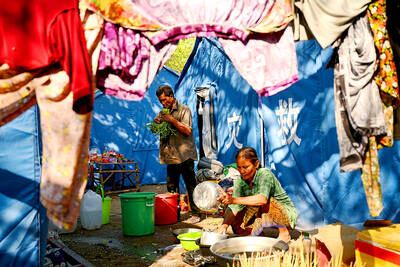
A sign hanging from a rusty ice-green shipping container installed by Thai forces on what they say is the border with Cambodia reads: “Cambodian citizens are strictly prohibited from entering this area.” On opposite sides of the makeshift barricade, fronted by coils of barbed wire, Cambodians lamented their lost homes and livelihoods as Thailand’s military showed off its gains. Thai forces took control of several patches of disputed land along the border during fighting last year, which could amount to several square kilometers in total. Cambodian Kim Ren said her house in Chouk Chey used to stand on what is now the Thai
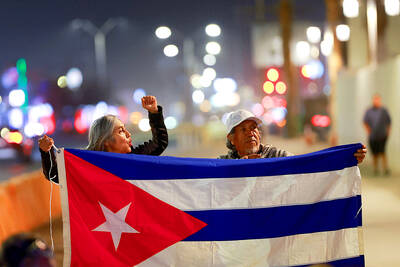
NEW RULES: There would be fewer school days, four-day workweeks, and a reduction in transportation services as the country battles a crisis exacerbated by US pressure The Cuban government on Friday announced emergency measures to address a crippling energy crisis worsened by US sanctions, including the adoption of a four-day work week for state-owned companies and fuel sale restrictions. Cuban Deputy Prime Minister Oscar Perez-Oliva Fraga blamed Washington for the crisis, telling Cuban television the government would “implement a series of decisions, first and foremost to guarantee the vitality of our country and essential services, without giving up on development.” “Fuel will be used to protect essential services for the population and indispensable economic activities,” he said. Among the new measures are the reduction of the working week in


 RSS
RSS