


Perhaps none of the shared communist legacies highlighted during North Korean leader Kim Jong-un’s “goodwill visit” to Hanoi is stranger than the embalmed leaders on display in the capital cities of Vietnam and North Korea, and the secretive team of Russian technicians that keeps the aging bodies looking ageless.
Kim on Saturday last week laid a wreath outside Ho Chi Minh’s mausoleum in Hanoi, after the conclusion of his shortened summit with US President Donald Trump.
Inside the dark interior of the mausoleum, the embalmed corpse of Vietnam’s founding father lies displayed in a glass coffin for a steady stream of tourists who silently shuffle by.
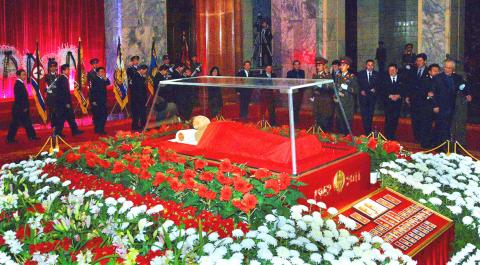
Photo: Reuters
In Pyongyang, Kim Jong-un’s grandfather and father are similarly on display in the loftily named Kumsusan Palace of the Sun, a monument to the cult of personality that surrounds North Korea’s ruling family.
All three leaders were originally preserved by specialists from the so-called “Lenin Lab” in Moscow, which first embalmed and displayed Vladimir Lenin’s body in 1924.
The Soviet Union collapsed, but the same lab performs annual maintenance on Ho, and according to one researcher, still helps North Korea keep the Kims looking fresh.
“The original embalming and the regular re-embalmings have always been conducted by the scientists of the Moscow lab,” said Alexei Yurchak, a professor of anthropology at the University of California, Berkeley, who is writing a book about the embalmed communist leaders. “Over the years they trained local scientists in some techniques, but not all, maintaining the core of the know-how secret.”
Unlike processes such as mummification, the permanent embalming pioneered by Soviet scientists kept the bodies flexible, with unblemished skin and a life-like pallor.
With North Vietnam under regular attack by US warplanes at the time of Ho’s death in 1969, the Soviet Union airlifted chemicals and equipment to a cave outside Hanoi, Yurchak said.
When the Soviet Union collapsed in the 1990s, the government lab needed funding, leading it to offer services to foreign clients, he said.
Among those customers was North Korea, where Russian specialists embalmed both Kim Il-sung and Kim Jong-il at a laboratory built into the mausoleum in Pyongyang.
The original embalming takes several months, and the bodies need regular upkeep.
“Every one-and-a-half to two years, these bodies are re-embalmed by the Moscow scientists,” Yurchak said, citing interviews that he conducted with lab scientists and his own field research.
The Web site for the committee that manages Ho’s mausoleum says that Russia started charging for the chemicals after the Soviet Union collapsed, prompting Hanoi to ask that the supplies be produced in Vietnam.
A source with the committee confirmed that the monument is closed every year for two months and that Russian technicians help with annual maintenance of the body.
The mausoleum lab in Moscow, which since 1992 has been known as the Center for Scientific Research and Teaching Methods in Biochemical Technologies, declined to comment on any aspect of its work.
The North Korean delegation at the UN did not respond to a request for comment.
It is not clear how much North Korea spends on maintaining the bodies of its leaders. When Moscow released preservation costs for the first time in 2016, it reported having spent nearly US$200,000 that year to maintain Lenin.
Originally the embalming was seen as a way of joining the various countries to international communism, as embodied in Lenin.
However, as Vietnam and North Korea developed in their own political ways, so has the meaning attached to preserving the leaders’ bodies.
“Today, this original meaning of these bodies has changed — in Vietnam the body of Ho today stands for anti-colonial struggles for independence and even for new nationalism, much more than for communism,” Yurchak said. “In North Korea, the two Kims’ bodies stand for a self-sufficient country organized around one leader and existing in the face of the ‘imperialist surroundings.’”
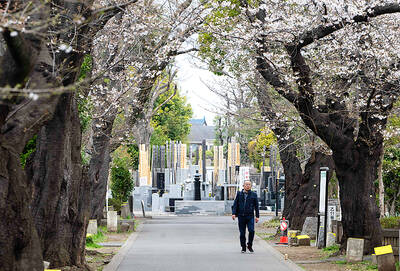
ROCKY RELATIONS: The figures on residents come as Chinese tourist numbers drop following Beijing’s warnings to avoid traveling to Japan The number of Chinese residents in Japan has continued to rise, even as ties between the two countries have become increasingly fractious, data released on Friday showed. As of the end of December last year, the number of Chinese residents had increased by 6.5 percent from the previous year to 930,428. Chinese people accounted for 22.6 percent of all foreign residents in Japan, making them by far the largest group, Japanese Ministry of Justice data showed. Beijing has criticized Tokyo in increasingly strident terms since Japanese Prime Minister Sanae Takaichi last year suggested that a military conflict around Taiwan could
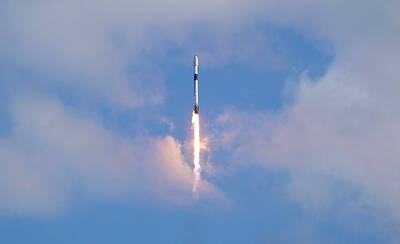
A retired US colonel behind a privately financed rocket launch site in the Dominican Republic sees the project as a response to China’s dominance of the space race in Latin America. Florida-based Launch on Demand is slated to begin building a US$600 million facility in a remote region near the border with Haiti late this year. The project is designed to meet surging demand for the heavy-lift rockets needed to put clusters of satellites into orbit. It is also an answer to China’s growing presence in the region, said CEO Burton Catledge, a former commander of the US Air Force’s 45th Operations

Germany is considering Australia’s Ghost Bat robot fighter as it looks to select a combat drone to modernize its air force, German Minister of Defense Boris Pistorius said yesterday. Germany has said it wants to field hundreds of uncrewed fighter jets by 2029, and would make a decision soon as it considers a range of German, European and US projects developing so-called “collaborative combat aircraft.” Australia has said it will integrate the Ghost Bat, jointly developed by Boeing Australia and the Royal Australian Air Force, into its military after a successful weapons test last year. After inspecting the Ghost Bat in Queensland yesterday,
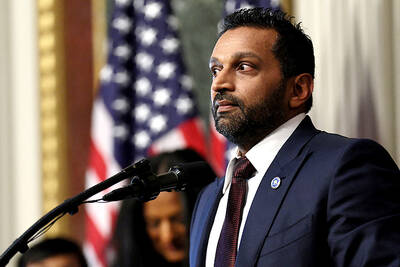
A pro-Iran hacking group claimed to breach FBI Director Kash Patel’s personal e-mail inbox and posted some of the contents online. The e-mails provided by the hacking group include travel details, correspondence with leasing agents in Washington and global entry, and loyalty account numbers. The e-mail address the hackers claim to have compromised has been previously tied to Patel’s personal details, and the leaked e-mails contain photos of Patel and others, in addition to correspondence with family members and colleagues. “The FBI is aware of malicious actors targeting Director Patel’s personal email information,” the agency said in a statement on


 RSS
RSS