


As Indonesia struggles with mountains of plastic waste going into landfills and polluting its rivers and oceans, business groups are pushing to overturn restrictions on importing plastic scrap into Southeast Asia’s biggest economy.
Indonesia, an archipelago of more than 17,000 islands, is estimated to be the second-largest contributor of plastic pollutants in the oceans after China, a 2015 study published in the journal Science said.
To tackle this, the government last year pledged up to US$1 billion a year to reduce marine plastic debris by 70 percent by 2025, but emerging divisions in the government on the issue of waste pose a fresh challenge to the targets.
SCRAP IMPORTS
Partly driving this rift is a push by the plastics industry to overturn a halt in scrap imports, which was introduced in June on concerns about a flood of waste from Western countries arriving after China barred such imports.
Indonesian Minister of Industry Airlangga Hartarto last month sent a letter urging the environment ministry to lift its bar on imports, because Indonesia does not produce enough suitable plastic waste to feed its recycling industry.
In the letter, reviewed by Reuters, Hartarto said that Indonesia needs 600,000 tonnes of imported scrap a year, much bigger than its usual 110,000 tonnes.
He said the country has about a US$40 million trade surplus, because it exports recycled plastics.
“This is a potential industry that creates a lot of jobs,” said Taufiek Bawazier, director of downstream chemical industry at the Indonesian Ministry of Industry, cautioning that focusing only on environmental risks could harm the industry.
OCEAN DEBRIS
The Science report said that almost half of the 3.2 million tonnes of plastic waste Indonesia produces in a year ends up in the sea.
The issue was graphically highlighted last month when a sperm whale was found dead with 6kg of plastic waste in its stomach on an Indonesian beach.
However, the government’s waste reduction targets are complicated by a lack of recycling culture or awareness of environmental damage in the developing country of 260 million people.
Poor waste management means plastic trash that goes to landfills is too dirty to feed Indonesia’s recycling industry, Bawazier said, adding that business would take more than the annual 1.1 million tonnes of local scrap if it was available.
NO PLASTIC HATE
Plastics lobby groups say downstream to upstream plastic industries employ 130,000 people directly, while millions make a livelihood by scavenging for waste, such as plastic bottles, for a small bit of cash.
“We must not hate plastic,” said Christine Halim, chairwoman of Indonesia’s recycling association, noting that buying foreign scrap is much cheaper than making products with virgin plastic and, as long as the environment is protected, should be seen as a business opportunity.
There were no plans to reopen scrap imports, said Deputy Coordinating Minister of Maritime Affairs Safri Burhanuddin, who overseas the environment ministry.
Nonetheless, the industry ministry argues there is no legal basis to stop imports, while the plastic industry has successfully lobbied policymakers before.
A 2016 plan to slap excise on all plastic packaging was watered down to only apply to plastic bags and even this has not been implemented yet.
The industry is also fighting a ban on plastic bags in supermarkets by some city governments. The Indonesian Olefin, Aromatic and Plastic Industry Association was cited in the media as saying that the move had led to an oversupply of bags.
However, Burhanuddin applauded local action on waste management, pledging to award the best regional performers and shame laggards on social media.
Tiza Mafira, director of the Indonesia Plastic Bags Diet Movement, a group pushing to cut use of plastic, said it is a “ridiculous idea” to import waste.
“It is proven that we cannot handle plastic trash. It will end up in the landfill,” she said.
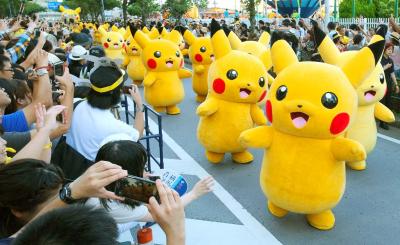
China’s military news agency yesterday warned that Japanese militarism is infiltrating society through series such as Pokemon and Detective Conan, after recent controversies involving events at sensitive sites. In recent days, anime conventions throughout China have reportedly banned participants from dressing as characters from Pokemon or Detective Conan and prohibited sales of related products. China Military Online yesterday posted an article titled “Their schemes — beware the infiltration of Japanese militarism in culture and sports.” The article referenced recent controversies around the popular anime series Pokemon, Detective Conan and My Hero Academia, saying that “the evil influence of Japanese militarism lives on in

DIPLOMATIC THAW: The Canadian prime minister’s China visit and improved Beijing-Ottawa ties raised lawyer Zhang Dongshuo’s hopes for a positive outcome in the retrial China has overturned the death sentence of Canadian Robert Schellenberg, a Canadian official said on Friday, in a possible sign of a diplomatic thaw as Canadian Prime Minister Mark Carney seeks to boost trade ties with Beijing. Schellenberg’s lawyer, Zhang Dongshuo (張東碩), yesterday confirmed China’s Supreme People’s Court struck down the sentence. Schellenberg was detained on drug charges in 2014 before China-Canada ties nosedived following the 2018 arrest in Vancouver of Huawei chief financial officer Meng Wanzhou (孟晚舟). That arrest infuriated Beijing, which detained two Canadians — Michael Spavor and Michael Kovrig — on espionage charges that Ottawa condemned as retaliatory. In January

A sign hanging from a rusty ice-green shipping container installed by Thai forces on what they say is the border with Cambodia reads: “Cambodian citizens are strictly prohibited from entering this area.” On opposite sides of the makeshift barricade, fronted by coils of barbed wire, Cambodians lamented their lost homes and livelihoods as Thailand’s military showed off its gains. Thai forces took control of several patches of disputed land along the border during fighting last year, which could amount to several square kilometers in total. Cambodian Kim Ren said her house in Chouk Chey used to stand on what is now the Thai

NEW RULES: There would be fewer school days, four-day workweeks, and a reduction in transportation services as the country battles a crisis exacerbated by US pressure The Cuban government on Friday announced emergency measures to address a crippling energy crisis worsened by US sanctions, including the adoption of a four-day work week for state-owned companies and fuel sale restrictions. Cuban Deputy Prime Minister Oscar Perez-Oliva Fraga blamed Washington for the crisis, telling Cuban television the government would “implement a series of decisions, first and foremost to guarantee the vitality of our country and essential services, without giving up on development.” “Fuel will be used to protect essential services for the population and indispensable economic activities,” he said. Among the new measures are the reduction of the working week in


 RSS
RSS