


A month before his scheduled departure after nearly two decades as president of the Democratic Republic of the Congo (DR Congo), Joseph Kabila received a procession of foreign reporters at his heavily guarded riverside palace for a rare series of interviews.
If the timing suggested a valedictory, the 47-year-old leader’s words indicated otherwise.
He vowed to remain in politics and, in one interview after another, left open the possibility of running again in 2023, when the clock resets on presidential term limits.
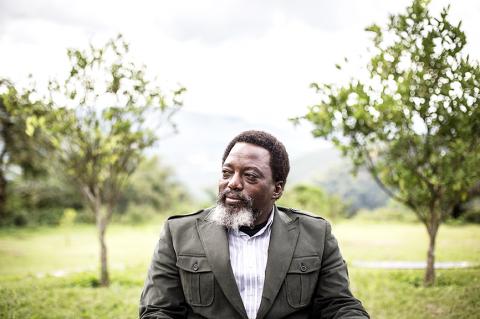
Photo: AFP
“My role will be to make sure that we don’t go back to square one, square one meaning where we found the [DR] Congo 22 years ago,” he told reporters inside an ornate reception room with high ceilings and sweeping views of the churning Congo River.
“In politics, in life, you shouldn’t rule out anything,” he said when asked about a potential return. “There are still other chapters to write.”
In the 18 years since a youthful, clean-shaven Kabila succeeded his slain father, Laurent, the now bulked-up president sporting a billowy gray beard has traced an unlikely trajectory from accidental and apparently reluctant leader to the defining Congolese figure of his time.
Whether the vote on Sunday brings down the curtain on the tumultuous Kabila era, which began when Laurent seized power in 1997, or triggers a new phase in which Joseph becomes the power behind the throne of his preferred successor, Emmanuel Ramazani Shadary, remains unclear.
It depends in part on how the Congolese reflect on his rule.
There were early accomplishments — ending a regional war and holding the first open presidential elections — but also incessant conflict, lethal crackdowns on prodemocracy protesters and corruption that the government acknowledges siphoned off billions of dollars of potential revenue.
Foreign investment has propelled DR Congo to the status of Africa’s top copper producer and the world’s leading miner of cobalt, a crucial component of batteries for electric vehicles, but militia violence has persisted in the east.
Denis Mukwege, the Congolese doctor who shared this year’s Nobel Peace Prize for his efforts to end the use of sexual violence as a weapon of war, said Kabila had a right to remain in politics, but hoped voters would remember his broken promises.
“None of the elements needed to install a real democracy have been made during his time in power,” Mukwege told reporters.
Kabila’s critics and some analysts say concerns about his personal security — his assassinated father’s mausoleum stands below the presidential palace — and the fortune reportedly amassed by his family could account for a seeming reluctance to cede power.
A report last year by a research group at New York University found that his family’s businesses are likely worth tens of millions of dollars.
Kabila has called such reports “stupidity.”
He did not specifically respond to a report by Reuters that showed nearly one-third of the purchase price of Congolese passports goes to a company in the United Arab Emirates whose owner is believed to be a close relative of the president.
Even if Shadary, a former Congolese minister of the interior who many analysts say was chosen for his loyalty and lack of an independent political base, beats his two main rivals, Kabila has reason to worry about his ability to pull the strings.
He need only look next door to Angola, where Angolan President Joao Lourenco quickly marginalized Jose Eduardo dos Santos, his powerful predecessor who ruled for 38 years, by accusing family members of corruption.
“Kabila saw what happened in Angola. That’s why he chose the person who is the most loyal and, above all, the least threatening to his personal power,” said Manya Riche, who advised Kabila from 2008 to 2011.
Referring to an arrangement in which Russian President Vladimir Putin remained that nation’s dominant leader as prime minister until he could run for president again, Riche said: “This isn’t Russia. At a certain point here, it’s the chief who’s in the chair who is the chief.”
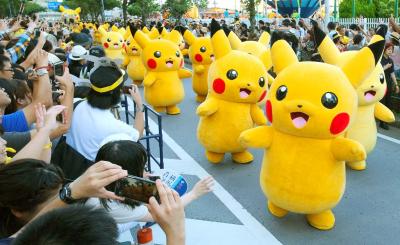
China’s military news agency yesterday warned that Japanese militarism is infiltrating society through series such as Pokemon and Detective Conan, after recent controversies involving events at sensitive sites. In recent days, anime conventions throughout China have reportedly banned participants from dressing as characters from Pokemon or Detective Conan and prohibited sales of related products. China Military Online yesterday posted an article titled “Their schemes — beware the infiltration of Japanese militarism in culture and sports.” The article referenced recent controversies around the popular anime series Pokemon, Detective Conan and My Hero Academia, saying that “the evil influence of Japanese militarism lives on in
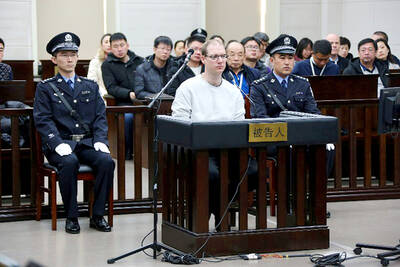
DIPLOMATIC THAW: The Canadian prime minister’s China visit and improved Beijing-Ottawa ties raised lawyer Zhang Dongshuo’s hopes for a positive outcome in the retrial China has overturned the death sentence of Canadian Robert Schellenberg, a Canadian official said on Friday, in a possible sign of a diplomatic thaw as Canadian Prime Minister Mark Carney seeks to boost trade ties with Beijing. Schellenberg’s lawyer, Zhang Dongshuo (張東碩), yesterday confirmed China’s Supreme People’s Court struck down the sentence. Schellenberg was detained on drug charges in 2014 before China-Canada ties nosedived following the 2018 arrest in Vancouver of Huawei chief financial officer Meng Wanzhou (孟晚舟). That arrest infuriated Beijing, which detained two Canadians — Michael Spavor and Michael Kovrig — on espionage charges that Ottawa condemned as retaliatory. In January
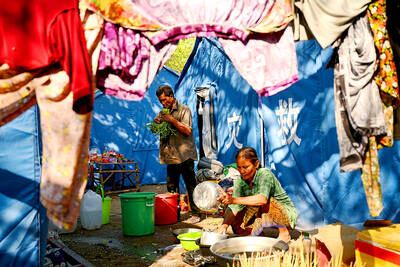
A sign hanging from a rusty ice-green shipping container installed by Thai forces on what they say is the border with Cambodia reads: “Cambodian citizens are strictly prohibited from entering this area.” On opposite sides of the makeshift barricade, fronted by coils of barbed wire, Cambodians lamented their lost homes and livelihoods as Thailand’s military showed off its gains. Thai forces took control of several patches of disputed land along the border during fighting last year, which could amount to several square kilometers in total. Cambodian Kim Ren said her house in Chouk Chey used to stand on what is now the Thai
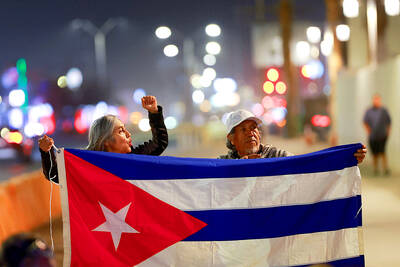
NEW RULES: There would be fewer school days, four-day workweeks, and a reduction in transportation services as the country battles a crisis exacerbated by US pressure The Cuban government on Friday announced emergency measures to address a crippling energy crisis worsened by US sanctions, including the adoption of a four-day work week for state-owned companies and fuel sale restrictions. Cuban Deputy Prime Minister Oscar Perez-Oliva Fraga blamed Washington for the crisis, telling Cuban television the government would “implement a series of decisions, first and foremost to guarantee the vitality of our country and essential services, without giving up on development.” “Fuel will be used to protect essential services for the population and indispensable economic activities,” he said. Among the new measures are the reduction of the working week in


 RSS
RSS