


Brazilians were choosing their leaders yesterday in an election marked by intense anger at the ruling class following years of political and economic turmoil, including what may be the largest corruption scandal in Latin American history.
Many had thought that “throw-the-bums-out” rage would buoy the chances of an outsider and end the hegemony of the center-left Workers’ Party and the center-right Brazilian Social Democracy Party, which have for years battled it out for the presidency.
Like much in this election, it has not turned out as predicted. The man who has benefited most from the anger is a 27-year veteran of Congress — Jair Bolsonaro — whose outsider status is based largely on hard-right positions that have alienated as many as they have attracted — nostalgia for a military dictatorship, insults to women and gay people and calls to fight crime by loosening controls on already deadly police forces.
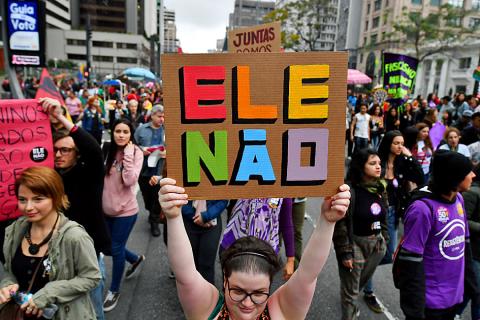
Photo: AFP
In second place is former Sao Paulo mayor Fernando Haddad of the Workers’ Party, which has won the last four presidential elections.
Bolsonaro garnered 36 percent in the latest Datafolha poll, with Haddad 14 points behind. The poll interviewed 19,552 people on Friday and Saturday and has a margin of error of 2 percentage points.
If no one gets a majority, a runoff is to be held on Oct. 28.
“In general, these are the strangest elections I’ve ever seen,” said Monica de Bolle, director of Latin American Studies at Johns Hopkins University in Baltimore, Maryland. “It’s shaping up to be a contest between the two weakest candidates possible.”
The campaign has been unpredictable and tense. Former Brazilian president Luiz Inacio Lula da Silva led initial polls by a wide margin, but was banned from running after a corruption conviction.
Bolsonaro was stabbed at a rally last month and campaigned from a hospital bed in recent weeks.
This election was once seen as the great hope for ending a turbulent era in which many politicians and business executives were jailed on corruption charges, a president was impeached and removed from office in controversial proceedings, and the economy suffered a protracted recession.
Instead, the two front-runners in a field of 13 reflect the rabid divisions that have opened up in Brazilian politics following former president Dilma Rousseff’s impeachment and the revelations emerging from the “Car Wash” graft probe.
Bolsonaro, whose base tends to be middle class, has painted a nation in collapse, where drug traffickers and politicians steal with equal impunity, and a moral rot has set in.
He has advocated loosening gun ownership laws so individuals could fight off criminals, giving police a freer hand to use force and restoring “traditional” Brazilian values — though some take issue with his definition of those values in light of his approving allusions to the past military dictatorship and his repeated derisive comments about women, blacks and gay people.
“There is a strong desire for change,” said Andre Portela, an economics professor at the Getulio Vargas Foundation, a university and think tank. “Bolsonaro has been able to channel that and present himself as the bearer of change, though it’s not clear if he really would be.”
Haddad and the Workers’ Party have portrayed a country hijacked by an elite that will protect its privileges at all costs and cannot bear to see the lives of poor and working class Brazilians improve.
Haddad has promised to roll back Brazilian President Michel Temer’s economic reforms that he says eroded workers’ rights, to increase investment in social programs and to bring back the boom years Brazil experienced under his mentor, Lula.
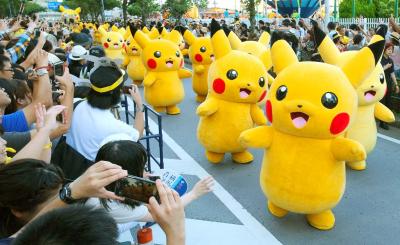
China’s military news agency yesterday warned that Japanese militarism is infiltrating society through series such as Pokemon and Detective Conan, after recent controversies involving events at sensitive sites. In recent days, anime conventions throughout China have reportedly banned participants from dressing as characters from Pokemon or Detective Conan and prohibited sales of related products. China Military Online yesterday posted an article titled “Their schemes — beware the infiltration of Japanese militarism in culture and sports.” The article referenced recent controversies around the popular anime series Pokemon, Detective Conan and My Hero Academia, saying that “the evil influence of Japanese militarism lives on in
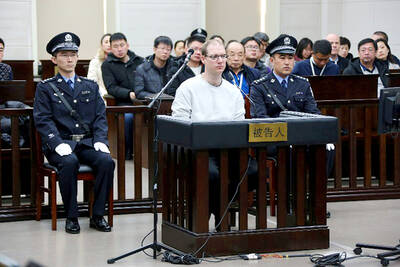
DIPLOMATIC THAW: The Canadian prime minister’s China visit and improved Beijing-Ottawa ties raised lawyer Zhang Dongshuo’s hopes for a positive outcome in the retrial China has overturned the death sentence of Canadian Robert Schellenberg, a Canadian official said on Friday, in a possible sign of a diplomatic thaw as Canadian Prime Minister Mark Carney seeks to boost trade ties with Beijing. Schellenberg’s lawyer, Zhang Dongshuo (張東碩), yesterday confirmed China’s Supreme People’s Court struck down the sentence. Schellenberg was detained on drug charges in 2014 before China-Canada ties nosedived following the 2018 arrest in Vancouver of Huawei chief financial officer Meng Wanzhou (孟晚舟). That arrest infuriated Beijing, which detained two Canadians — Michael Spavor and Michael Kovrig — on espionage charges that Ottawa condemned as retaliatory. In January

A sign hanging from a rusty ice-green shipping container installed by Thai forces on what they say is the border with Cambodia reads: “Cambodian citizens are strictly prohibited from entering this area.” On opposite sides of the makeshift barricade, fronted by coils of barbed wire, Cambodians lamented their lost homes and livelihoods as Thailand’s military showed off its gains. Thai forces took control of several patches of disputed land along the border during fighting last year, which could amount to several square kilometers in total. Cambodian Kim Ren said her house in Chouk Chey used to stand on what is now the Thai
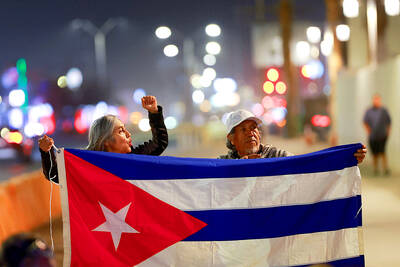
NEW RULES: There would be fewer school days, four-day workweeks, and a reduction in transportation services as the country battles a crisis exacerbated by US pressure The Cuban government on Friday announced emergency measures to address a crippling energy crisis worsened by US sanctions, including the adoption of a four-day work week for state-owned companies and fuel sale restrictions. Cuban Deputy Prime Minister Oscar Perez-Oliva Fraga blamed Washington for the crisis, telling Cuban television the government would “implement a series of decisions, first and foremost to guarantee the vitality of our country and essential services, without giving up on development.” “Fuel will be used to protect essential services for the population and indispensable economic activities,” he said. Among the new measures are the reduction of the working week in


 RSS
RSS