


Situated in a fertile plain at the foot of Mount Zerhoun, the sprawling remains of Morocco’s oldest Roman site — Volubilis — have survived pillage and long periods of neglect.
However, after decades of decay, custodians of the now closely guarded ancient city have turned the page and are bringing back the tourists.
The site, nestled among olive groves near the city of Meknes, boasts a new museum and visitor center and has been attracting hundreds of thousands of visitors.
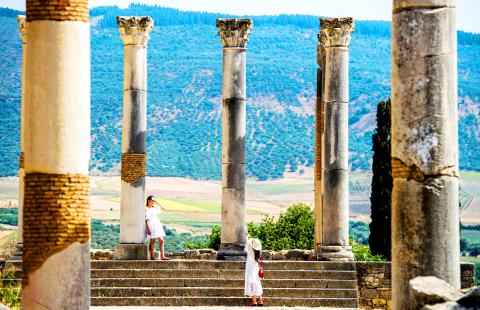
Photo: AFP
They stroll along the main artery lined with porticoes and the remnants of vast mansions, whose mosaic floors testify to a prosperous past. A triumphal arch, a classic symbol of Roman architecture, sits at the top of what once was the main compound.
Known in Arabic as “Oualili,” the city was named a UNESCO World Heritage site in 1997. The city has “known several civilizations, from the Mauritanian era to the Romans through the Islamic period,” according to Mohamed Alilou, topographer and assistant conservator of the site.
Volubilis was founded in the 3rd century BC by a Moorish community, before being annexed by the Roman Empire in 42 AD.
At its peak, it would have counted up to 15,000 inhabitants.
Threatened by civil wars across the empire, the Romans evacuated the city in 285. It did not regain its splendor until the arrival of Arab conquerors in the 7th century.
In the 8th century when the Idrisid dynasty erected the city of Fez as its new capital, Volubilis fell once more into disuse.
At the end of the 17th century, Sultan Moulay Ismail sent thousands of slaves to plunder Volubilis’ marble columns for the construction of his palace in Meknes.
“On the track leading from Volubilis to Meknes, we found capitals [of columns] abandoned by slaves, who fled when they learnt that Moulay Ismail was dead,” said Alilou, who has been watching over the site for more than 30 years.
Excavations at Volubilis began in 1915, along with research programs and restoration work, but renewed interest in the site brought with it looting, especially during the period of French colonial rule from 1912 to 1956.
Moroccan media frequently warn that the nation’s heritage — archeological finds, mosaics and ancient coins — is being looted.
However, in Volubilis, looting is a thing of the past; “the site is fenced off and well guarded,” Alilou said. “We have a team of 14 guards who work day and night, cameras are everywhere.”
Mustafa Atki, another conservator, said the whole issue of looting was “sometimes exaggerated.”
Since the opening of its museum in 2013, the 17-hectare ancient city has attracted several hundred thousand visitors a year.
“In 2017, for the first time we past the 300,000 mark,” Atki said.
Volubilis has yet to reveal all of its secrets, as one-third has yet to be excavated, Alilou said.

China’s military news agency yesterday warned that Japanese militarism is infiltrating society through series such as Pokemon and Detective Conan, after recent controversies involving events at sensitive sites. In recent days, anime conventions throughout China have reportedly banned participants from dressing as characters from Pokemon or Detective Conan and prohibited sales of related products. China Military Online yesterday posted an article titled “Their schemes — beware the infiltration of Japanese militarism in culture and sports.” The article referenced recent controversies around the popular anime series Pokemon, Detective Conan and My Hero Academia, saying that “the evil influence of Japanese militarism lives on in

DIPLOMATIC THAW: The Canadian prime minister’s China visit and improved Beijing-Ottawa ties raised lawyer Zhang Dongshuo’s hopes for a positive outcome in the retrial China has overturned the death sentence of Canadian Robert Schellenberg, a Canadian official said on Friday, in a possible sign of a diplomatic thaw as Canadian Prime Minister Mark Carney seeks to boost trade ties with Beijing. Schellenberg’s lawyer, Zhang Dongshuo (張東碩), yesterday confirmed China’s Supreme People’s Court struck down the sentence. Schellenberg was detained on drug charges in 2014 before China-Canada ties nosedived following the 2018 arrest in Vancouver of Huawei chief financial officer Meng Wanzhou (孟晚舟). That arrest infuriated Beijing, which detained two Canadians — Michael Spavor and Michael Kovrig — on espionage charges that Ottawa condemned as retaliatory. In January

A sign hanging from a rusty ice-green shipping container installed by Thai forces on what they say is the border with Cambodia reads: “Cambodian citizens are strictly prohibited from entering this area.” On opposite sides of the makeshift barricade, fronted by coils of barbed wire, Cambodians lamented their lost homes and livelihoods as Thailand’s military showed off its gains. Thai forces took control of several patches of disputed land along the border during fighting last year, which could amount to several square kilometers in total. Cambodian Kim Ren said her house in Chouk Chey used to stand on what is now the Thai

NEW RULES: There would be fewer school days, four-day workweeks, and a reduction in transportation services as the country battles a crisis exacerbated by US pressure The Cuban government on Friday announced emergency measures to address a crippling energy crisis worsened by US sanctions, including the adoption of a four-day work week for state-owned companies and fuel sale restrictions. Cuban Deputy Prime Minister Oscar Perez-Oliva Fraga blamed Washington for the crisis, telling Cuban television the government would “implement a series of decisions, first and foremost to guarantee the vitality of our country and essential services, without giving up on development.” “Fuel will be used to protect essential services for the population and indispensable economic activities,” he said. Among the new measures are the reduction of the working week in


 RSS
RSS