


A world-first study by Australian researchers has found that krill can digest certain forms of microplastic into smaller — but no less pervasive — fragments.
The study, published in Nature Communications journal on Friday, found that Antarctic krill, Euphausia superba, can break down 31.5 micron polyethylene balls into fragments less than 1 micron in diameter. The study was conducted in laboratory conditions with new plastics.
The lead researcher, Amanda Dawson, who completed the study as part of her doctorate with Griffith University, said that it was likely that microplastics in the ocean would be even easier to digest because they had already been degraded by UV radiation.
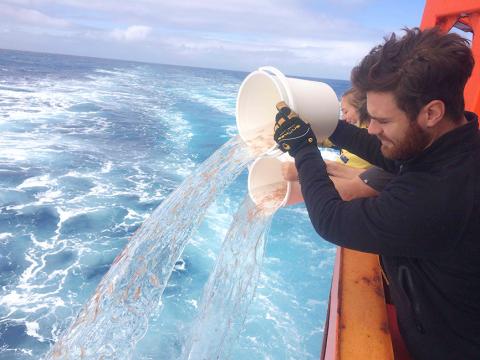
Photo: AFP / Rob King / Australian Antarctic Division
Within five days in a plastic-free environment, all plastics had left the krills’ systems, meaning that microplastics from krill would not accumulate in animals further up the food chain, such as whales.
The digested fragments were on average 78 percent smaller than the original fragments, with some up to 94 percent smaller.
Unfortunately, Dawson said, krill were unlikely to provide a solution to the levels of plastics and microplastics polluting the oceans.
“It’s not necessarily helping plastic pollution, it’s just changing it to make it easier for small animals to eat it,” she said. “It could be a new source of plastics for the deep ocean.”
A study by Newcastle University in December last year found microplastics in the stomachs of deep-sea creatures from 11km deep trenches in the Pacific Ocean.
Dawson said microplastics that had been digested by krill were also too small to be detected in most oceanic plastic surveys, meaning the level of microplastics in the ocean could be higher than currently assumed.
Coauthor So Kawaguchi, a krill biologist from the Australian Antarctic Division, where the experiments were conducted, said the krill had effectively turned microplastics into nanoplastics.
“It’s a new pathway for microplastics to interact with the ecosystem, and we need to learn more about how microplastics interact with the environment,” Kawaguchi said.
Microplastics are fragments of less than 5 millimeter in diameter. Krill cannot consume anything greater than 2mm in diameter.
“They are not going to be able to eat a drink bottle,” Dawson said.
The plastics they do consume are broken up by the animal’s gastric mill, which Dawson said functioned like a mortar and pestle.
“I would assume that other planktonic crustaceans should be able to do this as well, we just haven’t seen it yet in any laboratory studies,” she said.
It is not clear whether fibrous microplastics, such as fishing line or threads from clothing, can be digested in the same manner.
Fibrous microplastics made up a greater proportion of the microplastics encountered by krill in the wild, Dawson said.

Crowds in Bangladesh are flocking to snap photographs with an unlikely social media star — an albino buffalo with flowing blond hair nicknamed “Donald Trump” that is due to be sacrificed within days. Owner Zia Uddin Mridha, 38, said his brother named the 700kg bull over its flowing helmet of hair resembling the signature look of the US president. “My younger brother picked this name because of the buffalo’s extraordinary hair,” he said at his farm in Narayanganj, just outside the capital, Dhaka. Mridha said that a constant stream of curious visitors — social media fans, onlookers and children — have come throughout

It began as a satirical online project. Now millions of young people in India are flocking to it as an outlet for their frustration. A parody political party called the Cockroach Janta Party, with the insect as its symbol, has exploded across India’s social media by turning absurdist humor into protest. Memes and short videos mocking corruption, joblessness and political dysfunction have flooded social media sites, where millions of users are embracing the cockroach — known for its ability to survive harsh conditions — as a tongue-in-cheek symbol of endurance. The online movement’s rise has been unusually rapid. The Cockroach Janta Party (CJP)
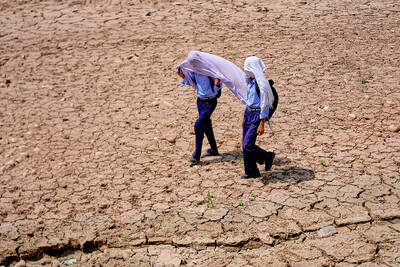
HOTTER: While Indians are accustomed to summer heat, climate change has caused northwestern India to warm faster than other parts of the country, an academic said Roads and markets have emptied during afternoons and some farmers have switched to nighttime work to avoid scorching temperatures as a heat wave grips large parts of India. The India Meteorological Department forecast maximum temperatures for yesterday of about 45°C in the capital, New Delhi, where authorities have opened temporary “cooling zones” to help people cope. The weather department warned that conditions would likely persist across several northern regions in the coming days, with temperatures staying well above seasonal averages. Authorities urged people to stay indoors during the hottest hours and take precautions against heat-related illnesses. India declares a heat wave whenever maximum temperatures

A Hong Kong astronaut is to join a Chinese space mission for the first time as part of a three-person crew launching today, as Beijing edges closer to its goal of landing people on the moon. The Tiangong space station — crewed by teams of three astronauts that are typically rotated every six months — is the crown jewel of China’s space program, boosted by billions in state investment in a bid to catch up with the US and Russia. The Shenzhou-23 mission is to blast off at 11:08pm from the Jiuquan Satellite Launch Center in northwestern China, carrying three astronauts to


 RSS
RSS