


Philippine President Rodrigo Duterte’s move to ban a critical news Web site from covering the Malacanang Palace is a threat to media freedom, rights and media groups said yesterday.
Rappler, set up in 2012, is among a clutch of Philippine news organizations that have sparred with Duterte over their critical coverage of his drug war, which the government says has claimed the lives of about 4,000 suspects.
Human rights groups charge that thousands more have been killed by shadowy vigilantes.
Duterte’s spokesman said the president had decided to bar Rappler journalists from covering his events due to a “lack of trust.”
US-based watchdog Human Rights Watch said the move “threatens media freedoms.”
“It could portend a broader assault on journalists and news organizations, whose critical watchdog role has magnified the government’s poor human rights record,” it said in a statement.
The move came as the site also faced state-enforced closure, after the government’s corporate regulator last month alleged that Rappler breached a constitutional ban on foreign ownership of local media.
Since taking power in 2016, Duterte has also publicly attacked other media outlets which have criticized his policies.
On Tuesday, guards barred Rappler’s palace reporter from entering the grounds of the presidential office.
She was later allowed to attend a news conference by Duterte’s spokesman, but was prohibited from covering the president’s speech.
Presidential spokesman Harry Roque yesterday said Duterte had decided to bar Rappler from all presidential coverage.
The order came a day after the senate summoned Duterte’s chief aide to answer questions following a Rappler report that he had intervened in a controversial US$308 million frigate project by the Philippine Navy.
Duterte had branded the story as “fake news.”
“She cannot have access to the president because the president is annoyed with her,” Roque told radio DZMM, referring to the Rappler reporter who had defended the report during Tuesday’s briefing.
Rappler, which has appealed last month’s ruling, decried Duterte’s ban as an “attempt to intimidate independent journalists.”
Local media groups and opposition lawmakers also condemned Duterte’s decision.
“It sends a clear and chilling signal that everyone else better report only what he wants you to or else,” the National Union of Journalists of the Philippines said.
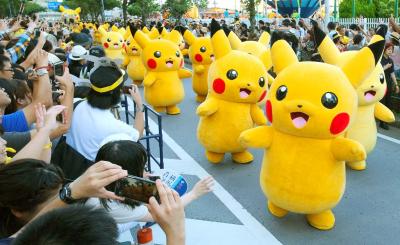
China’s military news agency yesterday warned that Japanese militarism is infiltrating society through series such as Pokemon and Detective Conan, after recent controversies involving events at sensitive sites. In recent days, anime conventions throughout China have reportedly banned participants from dressing as characters from Pokemon or Detective Conan and prohibited sales of related products. China Military Online yesterday posted an article titled “Their schemes — beware the infiltration of Japanese militarism in culture and sports.” The article referenced recent controversies around the popular anime series Pokemon, Detective Conan and My Hero Academia, saying that “the evil influence of Japanese militarism lives on in
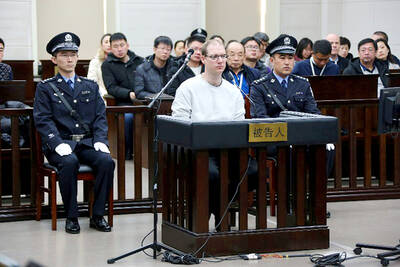
DIPLOMATIC THAW: The Canadian prime minister’s China visit and improved Beijing-Ottawa ties raised lawyer Zhang Dongshuo’s hopes for a positive outcome in the retrial China has overturned the death sentence of Canadian Robert Schellenberg, a Canadian official said on Friday, in a possible sign of a diplomatic thaw as Canadian Prime Minister Mark Carney seeks to boost trade ties with Beijing. Schellenberg’s lawyer, Zhang Dongshuo (張東碩), yesterday confirmed China’s Supreme People’s Court struck down the sentence. Schellenberg was detained on drug charges in 2014 before China-Canada ties nosedived following the 2018 arrest in Vancouver of Huawei chief financial officer Meng Wanzhou (孟晚舟). That arrest infuriated Beijing, which detained two Canadians — Michael Spavor and Michael Kovrig — on espionage charges that Ottawa condemned as retaliatory. In January
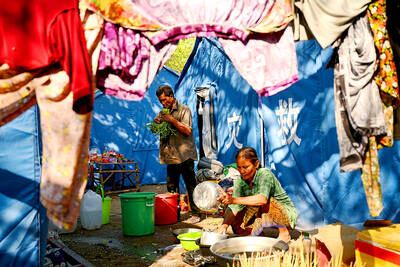
A sign hanging from a rusty ice-green shipping container installed by Thai forces on what they say is the border with Cambodia reads: “Cambodian citizens are strictly prohibited from entering this area.” On opposite sides of the makeshift barricade, fronted by coils of barbed wire, Cambodians lamented their lost homes and livelihoods as Thailand’s military showed off its gains. Thai forces took control of several patches of disputed land along the border during fighting last year, which could amount to several square kilometers in total. Cambodian Kim Ren said her house in Chouk Chey used to stand on what is now the Thai
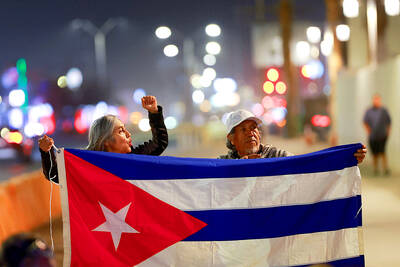
NEW RULES: There would be fewer school days, four-day workweeks, and a reduction in transportation services as the country battles a crisis exacerbated by US pressure The Cuban government on Friday announced emergency measures to address a crippling energy crisis worsened by US sanctions, including the adoption of a four-day work week for state-owned companies and fuel sale restrictions. Cuban Deputy Prime Minister Oscar Perez-Oliva Fraga blamed Washington for the crisis, telling Cuban television the government would “implement a series of decisions, first and foremost to guarantee the vitality of our country and essential services, without giving up on development.” “Fuel will be used to protect essential services for the population and indispensable economic activities,” he said. Among the new measures are the reduction of the working week in


 RSS
RSS