


Ethiopian Prime Minister Hailemariam Desalegn on Thursday announced he has submitted a resignation letter after the worst anti-government protests in a quarter-century, saying he hoped the surprise decision would help planned reforms succeed and create a “lasting peace.”
“I want to be part of the solution,” Desalegn said in remarks carried by the Ethiopian Broadcasting Corp. “I believe that the public’s demands and questions should be met and answered.”
It was not immediately clear whether lawmakers had accepted the resignation.

Photo: EPA
Ethiopia, one of Africa’s fastest-growing economies and a close security ally of the US, has been rocked by months of protests demanding wider freedoms that have left hundreds dead and tens of thousands detained. The government in recent weeks released more than 6,500 detained opposition figures, journalists and others after the prime minister in an unexpected announcement in January said he wanted to “widen the democratic space for all.”
The 53-year-old prime minister said he would continue in his role until the “power transition is completed.”
He is also seeking to unseat himself from the ruling Ethiopian People’s Revolutionary Democratic Front.
The ruling party, which controls all seats in parliament, accepted the resignation and lawmakers were yesterday expected to do the same.
The ruling party’s council is then expected to put forward Desalegn’s successor as prime minister.
Ethiopia’s demonstrations demanding wider freedoms began in late 2015 and engulfed much of the restive Oromia and Amhara regions before spreading into other parts of the nation, leading to a months-long state of emergency that has since been lifted.
“Political infighting between members of the ruling party has caused a serious fracture to the political establishment here,” opposition politician Yilikal Getnet said, adding that the fact that the prime minister hails from a minority ethnic group might have played a role in his resignation.
“There is no unity within the government. Plus the mass movement of people has rendered the party powerless and was pitting one official against the other,” Yilikal said.
Ethiopia’s government has long been accused of arresting critical journalists and opposition leaders. Rights organizations and opposition groups have called for their release, saying they were arrested on trumped-up charges and punished for their points of view.
A favorite to replace the prime minister is the head of Ethiopia’s Oromia region, Lemma Megerssa. Many see Lemma, the president of the largest federal state, as politically assertive and having the acceptance of many in the younger generation.
However, a legal academic at Mekelle Universtiy, Meressa Tsehaye, said the deputy prime minister is widely expected to succeed Hailemariam.
Another option is that the four core parties of the ruling coalition will elect a new party leader who then will lead the country.
“If both these don’t happen, then a caretaker or transitional government will be set up. I don’t see that a snap election will be needed here,” he said.
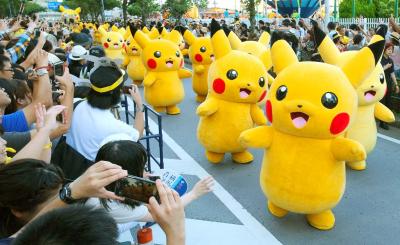
China’s military news agency yesterday warned that Japanese militarism is infiltrating society through series such as Pokemon and Detective Conan, after recent controversies involving events at sensitive sites. In recent days, anime conventions throughout China have reportedly banned participants from dressing as characters from Pokemon or Detective Conan and prohibited sales of related products. China Military Online yesterday posted an article titled “Their schemes — beware the infiltration of Japanese militarism in culture and sports.” The article referenced recent controversies around the popular anime series Pokemon, Detective Conan and My Hero Academia, saying that “the evil influence of Japanese militarism lives on in

DIPLOMATIC THAW: The Canadian prime minister’s China visit and improved Beijing-Ottawa ties raised lawyer Zhang Dongshuo’s hopes for a positive outcome in the retrial China has overturned the death sentence of Canadian Robert Schellenberg, a Canadian official said on Friday, in a possible sign of a diplomatic thaw as Canadian Prime Minister Mark Carney seeks to boost trade ties with Beijing. Schellenberg’s lawyer, Zhang Dongshuo (張東碩), yesterday confirmed China’s Supreme People’s Court struck down the sentence. Schellenberg was detained on drug charges in 2014 before China-Canada ties nosedived following the 2018 arrest in Vancouver of Huawei chief financial officer Meng Wanzhou (孟晚舟). That arrest infuriated Beijing, which detained two Canadians — Michael Spavor and Michael Kovrig — on espionage charges that Ottawa condemned as retaliatory. In January

A sign hanging from a rusty ice-green shipping container installed by Thai forces on what they say is the border with Cambodia reads: “Cambodian citizens are strictly prohibited from entering this area.” On opposite sides of the makeshift barricade, fronted by coils of barbed wire, Cambodians lamented their lost homes and livelihoods as Thailand’s military showed off its gains. Thai forces took control of several patches of disputed land along the border during fighting last year, which could amount to several square kilometers in total. Cambodian Kim Ren said her house in Chouk Chey used to stand on what is now the Thai

NEW RULES: There would be fewer school days, four-day workweeks, and a reduction in transportation services as the country battles a crisis exacerbated by US pressure The Cuban government on Friday announced emergency measures to address a crippling energy crisis worsened by US sanctions, including the adoption of a four-day work week for state-owned companies and fuel sale restrictions. Cuban Deputy Prime Minister Oscar Perez-Oliva Fraga blamed Washington for the crisis, telling Cuban television the government would “implement a series of decisions, first and foremost to guarantee the vitality of our country and essential services, without giving up on development.” “Fuel will be used to protect essential services for the population and indispensable economic activities,” he said. Among the new measures are the reduction of the working week in


 RSS
RSS