


US President Donald Trump’s son-in-law, Jared Kushner, has been questioned by special counsel Robert Mueller’s team of investigators about former national security adviser Michael Flynn, a person familiar with the investigation said on Wednesday.
The person said the questioning of Kushner earlier this month took about 90 minutes or less and was aimed in part at establishing whether Kushner had any information on Flynn that might be exculpatory.
The person said multiple White House witnesses have been asked about their knowledge of Flynn, who was forced to resign from the White House in February after officials concluded he had misled them about his contacts with the then-Russian ambassador.
The confirmation of Kushner’s interview came as prosecutors working for Mueller postponed grand jury testimony related to Flynn’s private business dealings.
The reason for the postponement was not immediately clear, but it comes one week after attorneys for Flynn alerted Trump’s legal team that they could no longer share information about the case.
That discussion between lawyers was widely seen as a possible indication that Flynn was moving to cooperate with Mueller’s investigation or attempting to negotiate a deal for himself.
An attorney for Flynn, Robert Kelner, did not immediately respond to e-mail and telephone messages on Wednesday afternoon.
Peter Carr, a spokesman for Mueller, declined comment.
Kushner’s attorney, Abbe Lowell, said in a statement: “Mr Kushner has voluntarily cooperated with all relevant inquiries and will continue to do so.”
The details of Kushner’s questioning and the postponement of the grand jury testimony were confirmed by people familiar with Mueller’s investigation.
They spoke on condition of anonymity because they were not authorized to publicly discuss the ongoing investigation.
Both developments were first reported by CNN.
The grand testimony that had been scheduled for the coming days related to Flynn’s firm, Flynn Intel Group, its work with a public relations firm and interactions with congressional staff, one of the people said.
Mueller and the FBI have been interested in hearing from employees at the public relations firm, SGR LLC, because of the firm’s work with Flynn Intel Group. SGR LLC, which does business as Sphere Consulting, did public relations work on a film Flynn Intel Group was working on about Turkish cleric Fethullah Gulen, who lives in exile in Pennsylvania.
The film was never completed.
Mueller was appointed by the US Department of Justice in May to oversee an investigation into potential coordination between Russia and the Trump campaign to influence the outcome of last year’s presidential election.
The investigation, which produced its first criminal charges last month against three former Trump campaign officials, incorporated an earlier FBI inquiry into Flynn’s lobbying and investigative research work on behalf of a Turkish businessman.
Flynn’s firm was paid US$530,000 for the work.
Sphere employees have cooperated for months with Mueller’s investigation, including by turning over documents requested by investigators and sitting for voluntary interviews.

A humanoid robot that won a half-marathon race for robots in Beijing on Sunday ran faster than the human world record in a show of China’s technological leaps. The winner from Honor, a Chinese smartphone maker, completed the 21km race in 50 minutes and 26 seconds, said a WeChat post by the Beijing Economic-Technological Development Area, also known as Beijing E-Town, where the race began. That was faster than the human world record holder, Ugandan Jacob Kiplimo, who finished the same distance in about 57 minutes in March at the Lisbon road race. The performance by the robot marked a significant step forward
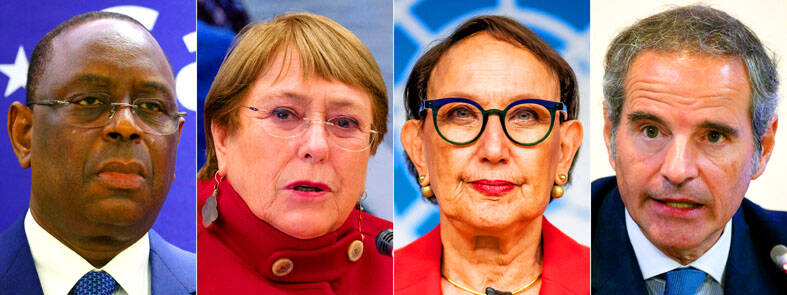
Four contenders are squaring up to succeed Antonio Guterres as secretary-general of the UN, which faces unprecedented global instability, wars and its own crushing budget crisis. Chile’s Michelle Bachelet, Argentina’s Rafael Grossi, Costa Rica’s Rebeca Grynspan and Senegal’s Macky Sall are each to face grillings by 193 member states and non-governmental organizations for three hours today and tomorrow. It is only the second time the UN has held a public question-and-answer, a format created in 2016 to boost transparency. Ultimately the five permanent members of the UN’s top body, the Security Council, hold the power, wielding vetoes over who leads the

South Korea’s air force yesterday apologized for a 2021 midair collision involving two fighter jets, a day after auditors said the pilots were taking selfies and filming during the flight and held them responsible for the accident. “We sincerely apologize to the public for the concern caused by the accident that occurred in 2021,” an air force spokesman told a news conference, adding that one of the pilots involved had been suspended from flying duties, received severe disciplinary action and has since left the military. The apology followed a report released on Wednesday by the South Korean Board of Audit and Inspection,
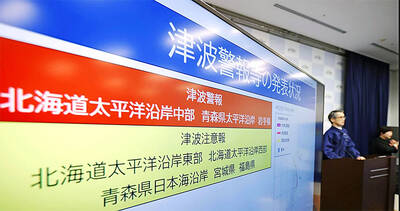
An earthquake registering a preliminary magnitude of 7.7 off northern Japan on Monday prompted a short-lived tsunami alert and the advisory of a higher risk of a possible mega-quake for coastal areas there. The Cabinet Office and the Japan Meteorological Agency said there was a 1% chance for a mega-quake, compared to a 0.1% chance during normal times, in the next week or so following the powerful quake near the Chishima and Japan trenches. Officials said the advisory was not a quake prediction but urged residents in 182 towns along the northeastern coasts to raise their preparedness while continuing their daily lives. Prime


 RSS
RSS