


The French president and the Dutch king on Tuesday visited Caribbean territories that were hammered by Hurricane Irma, bringing in much-needed food, water and medical supplies amid accusations that European governments were unprepared, slow to react and sometimes even racist in their responses to the devastation.
The visit came as residents tried to revive a sense of normalcy amid the chaos and destruction wrought by the Category 5 hurricane with small gestures like sharing radios and rescuing dogs.
The Dutch Red Cross said more than 200 people were still listed as missing on Saint Martin, but with communications extremely spotty a week after the storm hit it was not clear how many were simply without mobile phone service and power and unable to let friends and family know they survived.
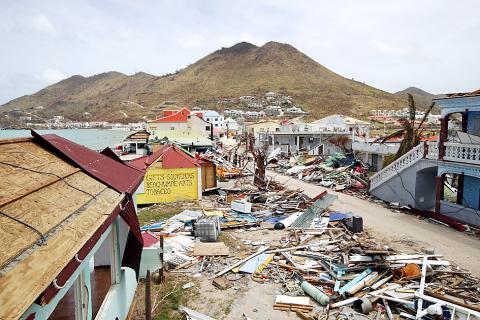
Photo: AP
The organization said 90 percent of buildings on the Dutch territory were damaged and a third destroyed as Irma roared across the island.
Yogesh Bodha, a jewelry store employee, said that there was no response from European officials for two days and that he has not seen many changes since Dutch authorities arrived.
“They should’ve been more organized than they were,” he said. “We have not received any food or water. They say it’s on its way. Let’s see.”
For Liseth Echevarria, who works as a bartender, offering whatever she could to family, strangers and abandoned pets was helping her cope — and those around her were doing the same.
The manager of a marina next door threw over a hose so Echevarria and her husband could have a semblance of an outdoor shower. He also offered them a temporary power connection from his generator so they could charge telephones and listen to the sole radio station still broadcasting.
“This is the only communication that Saint Martin has with the world right now,” she said.
It was thanks to that radio station that she found out about a flight for all Latin Americans stuck in Saint Martin. She rushed to the airport with her brother, who was evacuating back to Colombia.
As she dropped him off, Echevarrie saw a Yorkshire Terrier tied to a metal barricade, abandoned by a passenger fleeing the island and told they could not bring pets on the plane.
Echevarria scooped up the dog, named Oliver, and took him home to meet her three other dogs, including one rescued from a neighbor’s property. The neighbor fled with her son after the hurricane destroyed their home. There was nothing left of it other than jagged pieces of wood and a shower curtain covered in colorful butterflies tangled in a toppled tree
Echevarria’s husband, Lex Kools, a civil engineer, jumps over the fence every day to feed the other two dogs on the property.
“They were attacking each other, they were so hungry,” he said.
French President Emmanuel Macron flew into Guadeloupe on Tuesday before heading to hard-hit Saint Martin, where he met in debris-littered streets with residents.
He was accompanied by doctors and teams of experts who were to help lead the recovery effort.
“The situation is very critical,” he said. “What I want to do is to have a very fast recovery, so we are trying to fix the situation regarding health, education, access to water, energy and telecom.”
He said he hoped changes would be noticeable by the week’s end.
Macron said 11 people were killed in Saint Martin, while another four people died on the Dutch side of the island, bringing the death toll in the Caribbean to at least 37.
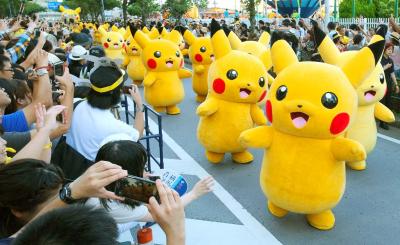
China’s military news agency yesterday warned that Japanese militarism is infiltrating society through series such as Pokemon and Detective Conan, after recent controversies involving events at sensitive sites. In recent days, anime conventions throughout China have reportedly banned participants from dressing as characters from Pokemon or Detective Conan and prohibited sales of related products. China Military Online yesterday posted an article titled “Their schemes — beware the infiltration of Japanese militarism in culture and sports.” The article referenced recent controversies around the popular anime series Pokemon, Detective Conan and My Hero Academia, saying that “the evil influence of Japanese militarism lives on in

DIPLOMATIC THAW: The Canadian prime minister’s China visit and improved Beijing-Ottawa ties raised lawyer Zhang Dongshuo’s hopes for a positive outcome in the retrial China has overturned the death sentence of Canadian Robert Schellenberg, a Canadian official said on Friday, in a possible sign of a diplomatic thaw as Canadian Prime Minister Mark Carney seeks to boost trade ties with Beijing. Schellenberg’s lawyer, Zhang Dongshuo (張東碩), yesterday confirmed China’s Supreme People’s Court struck down the sentence. Schellenberg was detained on drug charges in 2014 before China-Canada ties nosedived following the 2018 arrest in Vancouver of Huawei chief financial officer Meng Wanzhou (孟晚舟). That arrest infuriated Beijing, which detained two Canadians — Michael Spavor and Michael Kovrig — on espionage charges that Ottawa condemned as retaliatory. In January

A sign hanging from a rusty ice-green shipping container installed by Thai forces on what they say is the border with Cambodia reads: “Cambodian citizens are strictly prohibited from entering this area.” On opposite sides of the makeshift barricade, fronted by coils of barbed wire, Cambodians lamented their lost homes and livelihoods as Thailand’s military showed off its gains. Thai forces took control of several patches of disputed land along the border during fighting last year, which could amount to several square kilometers in total. Cambodian Kim Ren said her house in Chouk Chey used to stand on what is now the Thai
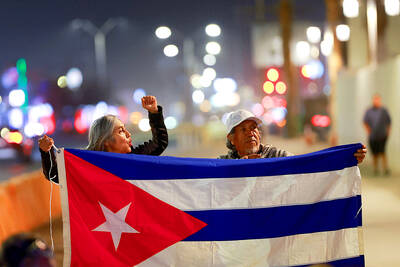
NEW RULES: There would be fewer school days, four-day workweeks, and a reduction in transportation services as the country battles a crisis exacerbated by US pressure The Cuban government on Friday announced emergency measures to address a crippling energy crisis worsened by US sanctions, including the adoption of a four-day work week for state-owned companies and fuel sale restrictions. Cuban Deputy Prime Minister Oscar Perez-Oliva Fraga blamed Washington for the crisis, telling Cuban television the government would “implement a series of decisions, first and foremost to guarantee the vitality of our country and essential services, without giving up on development.” “Fuel will be used to protect essential services for the population and indispensable economic activities,” he said. Among the new measures are the reduction of the working week in


 RSS
RSS