


An armed group is stopping refugee boats from setting off across the Mediterranean from a city west of Tripoli that has been a springboard for people smugglers, causing a sudden drop in departures over the past month, sources in the area said.
The revelation throws new light on the sharp reduction in refugee arrivals from Italy, which took over from the Aegean route as the main focus of European concerns in the crisis.
Arrivals in Italy from North Africa, the main route for migration to Europe this year, dropped by more than 50 percent last month from a year earlier, and arrivals so far this month are down even further. July and August are peak months for refugee boats because of favorable sea conditions.
Sources in Sabratha, 70km west of the capital, said the sudden drop had been caused by a new force in the seaside city, which is preventing refugees from leaving, often by locking them up.
The group in Sabratha “works on the ground, the beach, to prevent the refugees leaving on boats towards Italy,” said a civil society organizer from the city, speaking on condition of anonymity.
The group is made up of several hundred “civilians, policemen, army figures,” he said.
It is conducting a “very strong campaign” that was launched by a “former mafia boss,” said a second Sabratha source who follows smuggling activity closely.
A third source with contacts in Libya, who also asked not to be named, said the Sabratha group was making “a significant effort to police the area.”
The two Sabratha sources said the group was running a detention center for refugees who are turned back or taken from smugglers. One sent a photograph of hundreds of refugees sitting in the sand in front of a high wall.
One of the sources said he thought the group was seeking legitimacy and financial support from Tripoli, where European states have tried to partner with a UN-backed Government of National Accord (GNA) to stem refugee flows.
An official from the Libyan Ministry of the Interior’s Department for Combating Illegal Migration in Sabratha did not respond to a request for comment, while it was not possible to contact the group, which the third source said was called Brigade 48, although other sources did not confirm this.
Italy has been trying to bolster the GNA’s ability to stop people smuggling with cash, training and by sending a ship to help repair Tripoli’s coast guard and navy vessels.
About 600,000 refugees have reached Italy by sea from North Africa since 2014, testing the nation’s ability to cope. More than 12,000 have died trying.
Most leave from Libya’s western coast. Following a local backlash against smugglers in Zuwara in the west in 2015, Sabratha became the most frequently used departure point.
Italy wants to replicate a deal with Libya that the EU struck with Turkey last year, largely shutting down the refugee route through Greece and the Balkans.
With a national election looming during the first half of next year, the government in Rome is under pressure to show it can stop, or at least slow, migration.
Last week Italy seized on the drop in arrivals, with Italian Minister of the Interior Marco Minniti saying he saw a “light at the end of the tunnel.”
Refugees rescued last week in the Mediterranean confirmed that conditions had changed in Sabratha, according to an International Organization for Migration (IMO) spokesman, which interviewed refugees who arrived in Trapani, Sicily, on Saturday last week.
“They said that it was very difficult to depart from Sabratha. There are people stopping the boats before they set out and if they get out to sea they’re immediately sent back,” IOM spokesman Flavio Di Giacomo said in Rome.
Some refugees were also turned back before reaching Sabratha, he said.
The EU’s European Border and Coast Guard Agency, Frontex, last week said “clashes in Sabratha” contributed to last month’s decline, also citing changeable weather and increased Libyan coast guard presence.
The Sabratha sources were not aware of any clashes.
Another shift in recent weeks has been a clampdown on smuggling of Bangladeshi and North African refugees through Tripoli’s Mitiga International Airport, after a militia that controlled the trade was forced out by a GNA-aligned armed group at the start of last month, Libyan and European officials said.
However, that might take time to take effect. Hundreds of thousands of refugees are already in Libya. In Sabratha, the changes may not stick.
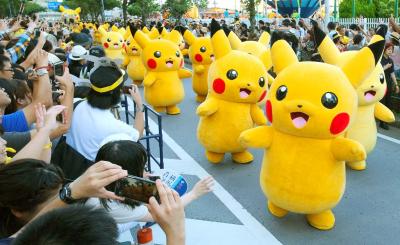
China’s military news agency yesterday warned that Japanese militarism is infiltrating society through series such as Pokemon and Detective Conan, after recent controversies involving events at sensitive sites. In recent days, anime conventions throughout China have reportedly banned participants from dressing as characters from Pokemon or Detective Conan and prohibited sales of related products. China Military Online yesterday posted an article titled “Their schemes — beware the infiltration of Japanese militarism in culture and sports.” The article referenced recent controversies around the popular anime series Pokemon, Detective Conan and My Hero Academia, saying that “the evil influence of Japanese militarism lives on in

DIPLOMATIC THAW: The Canadian prime minister’s China visit and improved Beijing-Ottawa ties raised lawyer Zhang Dongshuo’s hopes for a positive outcome in the retrial China has overturned the death sentence of Canadian Robert Schellenberg, a Canadian official said on Friday, in a possible sign of a diplomatic thaw as Canadian Prime Minister Mark Carney seeks to boost trade ties with Beijing. Schellenberg’s lawyer, Zhang Dongshuo (張東碩), yesterday confirmed China’s Supreme People’s Court struck down the sentence. Schellenberg was detained on drug charges in 2014 before China-Canada ties nosedived following the 2018 arrest in Vancouver of Huawei chief financial officer Meng Wanzhou (孟晚舟). That arrest infuriated Beijing, which detained two Canadians — Michael Spavor and Michael Kovrig — on espionage charges that Ottawa condemned as retaliatory. In January
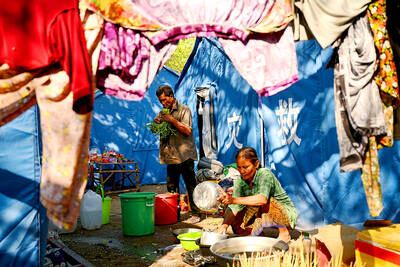
A sign hanging from a rusty ice-green shipping container installed by Thai forces on what they say is the border with Cambodia reads: “Cambodian citizens are strictly prohibited from entering this area.” On opposite sides of the makeshift barricade, fronted by coils of barbed wire, Cambodians lamented their lost homes and livelihoods as Thailand’s military showed off its gains. Thai forces took control of several patches of disputed land along the border during fighting last year, which could amount to several square kilometers in total. Cambodian Kim Ren said her house in Chouk Chey used to stand on what is now the Thai
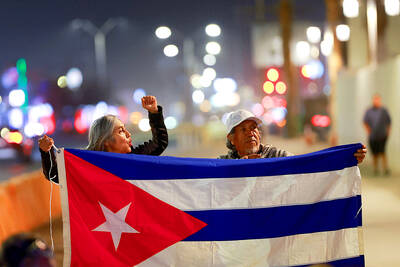
NEW RULES: There would be fewer school days, four-day workweeks, and a reduction in transportation services as the country battles a crisis exacerbated by US pressure The Cuban government on Friday announced emergency measures to address a crippling energy crisis worsened by US sanctions, including the adoption of a four-day work week for state-owned companies and fuel sale restrictions. Cuban Deputy Prime Minister Oscar Perez-Oliva Fraga blamed Washington for the crisis, telling Cuban television the government would “implement a series of decisions, first and foremost to guarantee the vitality of our country and essential services, without giving up on development.” “Fuel will be used to protect essential services for the population and indispensable economic activities,” he said. Among the new measures are the reduction of the working week in


 RSS
RSS