


Canada is attacking its expanding opioid crisis with an unusual measure: It is giving addicts a safe place to shoot up.
The government has already allowed seven “safe injection sites” to open and a score of others are being considered across the country.
The storefront sites give addicts clean syringes, medical supervision and freedom from arrest. They do not get help in kicking their problem unless they ask for it, but the program dramatically reduces the chance of a fatal overdose or the transmission of blood-borne diseases, such as hepatitis or HIV.
The effort, inspired by some in Europe, is being closely watched in the US, where officials are struggling to cope with a surge in overdose deaths from opioid use.
Several US cities have said they are considering similar measures, despite fears that they might encourage drug use.
Dozens of people a day have been visiting three new centers in Montreal, where users are given a small kit to safely inject drugs they bring with them and then an opportunity to relax for a half-hour on couches listening to music, said a 30-year-old addict, who would only give his first name, Francois.
The operators denied access to the media once they opened.
“They give you everything you need,” Francois said as he left a center in the gentrifying downtown neighborhood around Saint Catherine Street after injecting heroin. “Everyone is pretty relaxed.”
A single injection site opened in 2003, run by a Vancouver nonprofit organization under authorization by Health Canada. It last year received 214,898 visits by 8,040 individuals, with nurses intervening in 1,781 overdoses.
It said it has never had an overdose death.
Another center has also opened in Vancouver and over the past few weeks two more have opened in British Columbia and three in Montreal. Another is scheduled to open in Montreal soon and three in Toronto.
More than a dozen other potential sites are being considered across Canada, federal officials said.
Canadian Minister of Health Jane Philpott said the government felt compelled to add sites because of the escalating number of overdose deaths, which topped 2,400 last year.
“They are absolutely known to save lives and reduce infections,” Philpott said. “We have a very significant public health issue in our country.”
She acknowledged they are not a complete answer to the drug problem.
“This is only one in a very broad range of tools. A comprehensive approach is necessary,” she said.
US drug overdose deaths have tripled in 15 years, reaching at least 52,000 in 2015, making it the leading cause of death for people under 50.
Seattle and King County in Washington state are moving forward with plans for safe injection centers, while a city task force in Philadelphia has proposed some, although such measures have faced opposition.
Former White House Office of National Drug Control Policy director John Walters said safe injection sites merely prolong addiction and eventually lead to deaths.
Walters said that overdose deaths have risen sharply in British Columbia, despite the presence of the first safe injection site in North America.
The province had 136 deaths in April, a 97 percent increase over the same month a year earlier. There were 967 overdose deaths in British Columbia last year, up from 517 in 2015, and there have already been 640 this year through May.
“Government-sanctioned injection sites are now said by advocates to prevent overdose deaths. That clearly has not happened in British Columbia,” Walters said.
Jonathan Caulkins, a drug policy expert at Carnegie Mellon University in Pittsburgh, is not convinced they work either, but said he understands their appeal.
“The opioid crisis is so horrible that you are desperate and willing to try anything,” he said. “There’s a part of me that says: ‘Sure, give it a shot.’”

Crowds in Bangladesh are flocking to snap photographs with an unlikely social media star — an albino buffalo with flowing blond hair nicknamed “Donald Trump” that is due to be sacrificed within days. Owner Zia Uddin Mridha, 38, said his brother named the 700kg bull over its flowing helmet of hair resembling the signature look of the US president. “My younger brother picked this name because of the buffalo’s extraordinary hair,” he said at his farm in Narayanganj, just outside the capital, Dhaka. Mridha said that a constant stream of curious visitors — social media fans, onlookers and children — have come throughout

It began as a satirical online project. Now millions of young people in India are flocking to it as an outlet for their frustration. A parody political party called the Cockroach Janta Party, with the insect as its symbol, has exploded across India’s social media by turning absurdist humor into protest. Memes and short videos mocking corruption, joblessness and political dysfunction have flooded social media sites, where millions of users are embracing the cockroach — known for its ability to survive harsh conditions — as a tongue-in-cheek symbol of endurance. The online movement’s rise has been unusually rapid. The Cockroach Janta Party (CJP)

BIGGER ROLE: Beijing has said it maintains an impartial stance on the war in Ukraine, but by training Russian troops, China is far more involved than previously known China’s armed forces secretly trained about 200 Russian military personnel in China late last year, and some have since returned to fight in Ukraine, according to three European intelligence agencies and documents seen by Reuters. While China and Russia have held a number of joint military exercises since Moscow’s full-scale invasion of Ukraine in 2022, Beijing has repeatedly said that it is neutral in the conflict and presents itself as a peace mediator. The covert training sessions, which predominantly focused on the use of drones, were outlined in a dual-language Russian-Chinese agreement signed by senior Russian and Chinese officers in Beijing on
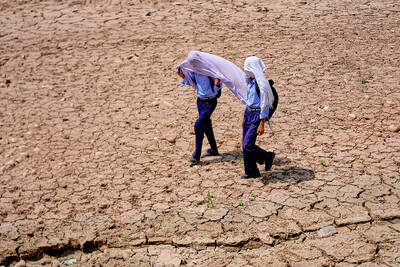
HOTTER: While Indians are accustomed to summer heat, climate change has caused northwestern India to warm faster than other parts of the country, an academic said Roads and markets have emptied during afternoons and some farmers have switched to nighttime work to avoid scorching temperatures as a heat wave grips large parts of India. The India Meteorological Department forecast maximum temperatures for yesterday of about 45°C in the capital, New Delhi, where authorities have opened temporary “cooling zones” to help people cope. The weather department warned that conditions would likely persist across several northern regions in the coming days, with temperatures staying well above seasonal averages. Authorities urged people to stay indoors during the hottest hours and take precautions against heat-related illnesses. India declares a heat wave whenever maximum temperatures


 RSS
RSS