


Detainees at an Australian asylum-seeker camp in Papua New Guinea yesterday were awarded millions of dollars in compensation for “degrading and cruel” treatment, in a decision hailed as an important human rights victory.
Abuse, self-harm and mental health problems are reportedly rife in offshore processing centers, with detainees resorting to desperate protests like sewing their own lips together to raise awareness of their plight.
Yesterday’s A$70 million (US$53 million) conditional settlement, to be shared by 1,905 people who have been held on Manus Island since 2012, averted a public trial against the government and security providers Transfield and G4S.
A class action had sought damages for what claimants said was suffering due to the harsh conditions in which they were held.
It also called for a payout for false imprisonment after the Papua New Guinea Supreme Court ruled last year that holding asylum seekers on Manus Island was unconstitutional and illegal.
Law firm Slater and Gordon said they believed it was the largest human rights class action settlement in Australian history, with the defendants also agreeing to pay more than A$20 million in costs.
“The people detained on Manus Island have endured extremely hostile conditions, but they will no longer suffer in silence,” the firm’s Andrew Baker said. “While no amount of money could fully recognize the terrible conditions the detainees endured, we hope today’s settlement can begin to provide them with an opportunity to help put this dark chapter of their lives behind them.”
The Manus Island detention center opened in 2012 to hold people trying to enter Australia by boat, under a tough immigration policy that sends people offshore to be processed. They are blocked from resettling in Australia even if found to be refugees.
Conditions in the camp and another one on Nauru, in the Pacific Ocean, have been widely criticized by refugee advocates and medical professionals, with reports of maltreatment and neglect, leading to serious health problems.
Amnesty International called the decision “historic” and “a major crack in the Australian government’s crumbling system of abuse.”
“It must be a turning point towards a better solution for refugees — one that is grounded in protection, not abuse,” Amnesty Pacific researcher Kate Schuetze said.
Australian Minister for Immigration Peter Dutton said the payout was not an admission of liability, but to avoid a costly six-month trial.
“In such circumstances a settlement was considered a prudent outcome for Australian taxpayers,” he said in a statement. “The commonwealth strongly refutes and denies the claims made in these proceedings. Settlement is not an admission of liability in any regard.”
Slater and Gordon lawyer Rory Walsh said the government and its contractor’s defense “was that it was the PNG [Papua New Guinean] authorities doing the imprisoning and detaining and not them.”
“The denial of liability allows the commonwealth and the defendants to run those positions in any other cases and maintain that position,” he told the Australian Broadcasting Corp.

The pledge by Japanese Prime Minister Sanae Takaichi to “work, work, work, work and work” for her country has been named the catchphrase of the year, recognizing the effort Japan’s first female leader had to make to reach the top. Takaichi uttered the phrase in October when she was elected as head of the ruling Liberal Democratic Party (LDP). Many were initially as worried about her work ethic as supportive of her enthusiasm. In a country notorious for long working hours, especially for working women who are also burdened with homemaking and caregiving, overwork is a sensitive topic. The recognition triggered a

Tropical Storm Koto killed three people and left another missing as it approached Vietnam, authorities said yesterday, as strong winds and high seas buffeted vessels off the country’s flood-hit central coast. Heavy rains have lashed Vietnam’s middle belt in recent weeks, flooding historic sites and popular holiday destinations, and causing hundreds of millions of dollars in damage. Authorities ordered boats to shore and diverted dozens of flights as Koto whipped up huge waves and dangerous winds, state media reported. Two vessels sank in the rough seas, a fishing boat in Khanh Hoa province and a smaller raft in Lam Dong, according to the
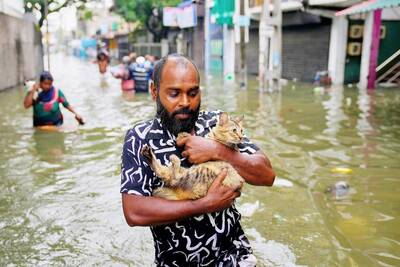
Sri Lanka made an appeal for international assistance yesterday as the death toll from heavy rains and floods triggered by Cyclone Ditwah rose to 123, with another 130 reported missing. The extreme weather system has destroyed nearly 15,000 homes, sending almost 44,000 people to state-run temporary shelters, the Sri Lankan Disaster Management Centre (DMC) said. DMC Director-General Sampath Kotuwegoda said relief operations had been strengthened with the deployment of thousands of troops from the country’s army, navy and air force. “We have 123 confirmed dead and another 130 missing,” Kotuwegoda told reporters in Colombo. Cyclone Ditwah was moving away from the island yesterday and

‘HEART IS ACHING’: Lee appeared to baffle many when he said he had never heard of six South Koreans being held in North Korea, drawing criticism from the families South Korean President Lee Jae-myung yesterday said he was weighing a possible apology to North Korea over suspicions that his ousted conservative predecessor intentionally sought to raise military tensions between the war-divided rivals in the buildup to his brief martial law declaration in December last year. Speaking to reporters on the first anniversary of imprisoned former South Korean president Yoon Suk-yeol’s ill-fated power grab, Lee — a liberal who won a snap presidential election following Yoon’s removal from office in April — stressed his desire to repair ties with Pyongyang. A special prosecutor last month indicted Yoon and two of his top


 RSS
RSS