


South Korean President Lee Jae-myung yesterday said he was weighing a possible apology to North Korea over suspicions that his ousted conservative predecessor intentionally sought to raise military tensions between the war-divided rivals in the buildup to his brief martial law declaration in December last year.
Speaking to reporters on the first anniversary of imprisoned former South Korean president Yoon Suk-yeol’s ill-fated power grab, Lee — a liberal who won a snap presidential election following Yoon’s removal from office in April — stressed his desire to repair ties with Pyongyang.
A special prosecutor last month indicted Yoon and two of his top defense officials over allegations that he ordered drone flights over North Korea to stoke tensions. South Korean media also reported on Monday that South Korea’s military under Yoon’s presidency flew balloons carrying propaganda leaflets across the border.
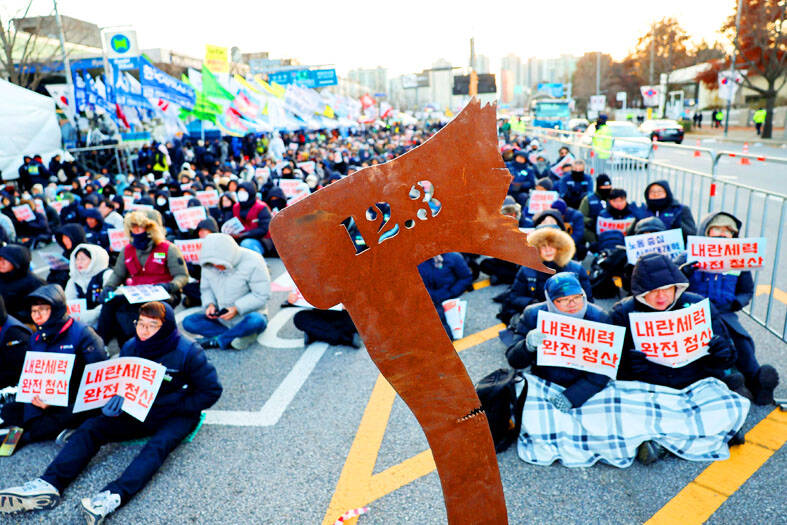
Photo: Reuters
While the drone and leafleting allegations have yet to be proven in court, Lee still said he personally wished to apologize to North Korea.
“I do think we need to apologize, but I haven’t been able to say so because I worry it could be used to smear [me] as pro-North Korean or spark political ideological battles” in South Korea, Lee said. “That’s all I will say for the time being.”
When asked about how his government would bring back six South Korean nationals detained in North Korea in the past decade or so, Lee baffled many when he said had never heard of the cases and asked his national security director: “Is it correct that [South] Korean nationals are being held?”
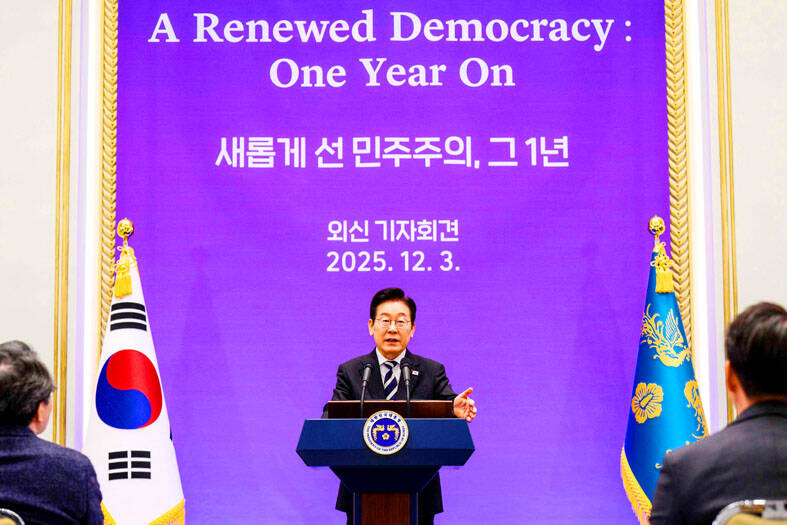
Photo: AFP
He later said he lacked “specific information since this happened a long time ago” and would need more details before commenting.
Three of the six detainees are Christian missionaries who were involved in covert efforts to spread Christianity in the North. They were arrested in 2013 or 2014 before being convicted of plotting to overthrow North Korea’s government and spying for Seoul and sentenced to hard labor for life. The other three are North Korean-born defectors who had resettled in the South, and little is known about their arrests.
“My heart is aching. I think President Lee has little interest” in the detainees, said Kim Jeong-sam, brother of one of the jailed missionaries, Kim Jung-wook. “I still pray for my brother’s safe return at least three times a day.”
Ethan Hee-Seok Shin, a legal analyst at the Seoul-based Transitional Justice Working Group, said it was “unbelievable” for Lee to say he did not know the issue.
“As president of our country, he should have known this and agonized how to resolve it, though it would be difficult to resolve it anytime soon,” he said.
During the news conference, Lee credited South Koreans for “suppressing a self-coup,” pointing to how thousands gathered around the South Korean National Assembly to protest Yoon’s power grab and help lawmakers get inside.
He said South Korea’s experience offers hope to people worldwide fighting for democracy.
Also at the news conference, Lee said South Korea would not take sides in an escalating war of words between Japan and China, calling for the two sides to “coexist.”
Tokyo and Beijing have been locked in a dispute after Japanese Prime Minister Sanae Takaichi suggested that Tokyo could intervene militarily should China invade Taiwan, as such an attack would threaten Japan’s existence.
The comments triggered a sharp diplomatic backlash from Beijing, which has urged its citizens to avoid traveling to Japan.
“The ideal approach is to coexist, respect one another, and cooperate as much as possible,” he said, describing northeast Asia as a “highly dangerous region in terms of military security.”
Lee has sought to improve ties with China after years of deep freeze under his predecessor Yoon, who cleaved close to Seoul’s longtime security partner the US.
Lee and Chinese President Xi Jinping (習近平) last month met on the sidelines of the APEC summit in Gyeongju, South Korea, in what Seoul framed as an opportunity to reset ties.
Lee yesterday told journalists his talks with Xi had been “interesting” and said he hoped to visit China soon.
“He was, unexpectedly, quite good at making jokes,” Lee said.
Additional reporting by AFP
ROCKY RELATIONS: The figures on residents come as Chinese tourist numbers drop following Beijing’s warnings to avoid traveling to Japan The number of Chinese residents in Japan has continued to rise, even as ties between the two countries have become increasingly fractious, data released on Friday showed. As of the end of December last year, the number of Chinese residents had increased by 6.5 percent from the previous year to 930,428. Chinese people accounted for 22.6 percent of all foreign residents in Japan, making them by far the largest group, Japanese Ministry of Justice data showed. Beijing has criticized Tokyo in increasingly strident terms since Japanese Prime Minister Sanae Takaichi last year suggested that a military conflict around Taiwan could
A retired US colonel behind a privately financed rocket launch site in the Dominican Republic sees the project as a response to China’s dominance of the space race in Latin America. Florida-based Launch on Demand is slated to begin building a US$600 million facility in a remote region near the border with Haiti late this year. The project is designed to meet surging demand for the heavy-lift rockets needed to put clusters of satellites into orbit. It is also an answer to China’s growing presence in the region, said CEO Burton Catledge, a former commander of the US Air Force’s 45th Operations
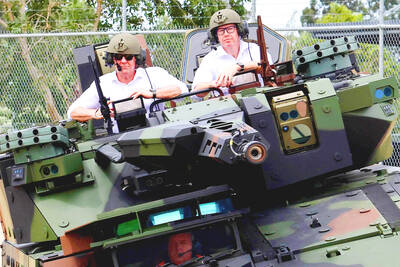
Germany is considering Australia’s Ghost Bat robot fighter as it looks to select a combat drone to modernize its air force, German Minister of Defense Boris Pistorius said yesterday. Germany has said it wants to field hundreds of uncrewed fighter jets by 2029, and would make a decision soon as it considers a range of German, European and US projects developing so-called “collaborative combat aircraft.” Australia has said it will integrate the Ghost Bat, jointly developed by Boeing Australia and the Royal Australian Air Force, into its military after a successful weapons test last year. After inspecting the Ghost Bat in Queensland yesterday,
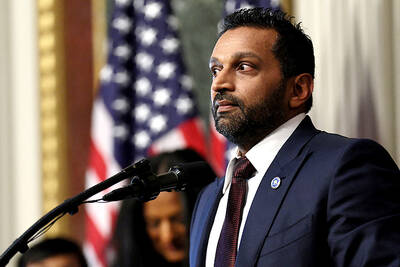
A pro-Iran hacking group claimed to breach FBI Director Kash Patel’s personal e-mail inbox and posted some of the contents online. The e-mails provided by the hacking group include travel details, correspondence with leasing agents in Washington and global entry, and loyalty account numbers. The e-mail address the hackers claim to have compromised has been previously tied to Patel’s personal details, and the leaked e-mails contain photos of Patel and others, in addition to correspondence with family members and colleagues. “The FBI is aware of malicious actors targeting Director Patel’s personal email information,” the agency said in a statement on


 RSS
RSS