


When Brazil’s top TV station picked its latest dancer to cheerlead coverage of the upcoming Rio carnival, viewers were in for a shock: She was wearing clothes.
TV Globo’s dancer, known as Globeleza — a mash-up of Globo and the Portuguese word for beauty — is an annual institution. Always young, beautiful, black and skilled at samba, she wiggles her hips in a short, slickly produced clip interspersing carnival programming.
Since her first appearance in 1991, Globeleza has performed naked, other than high heels, sequins, a lick or two of shimmery paint — and some years barely that.

Photo: AP
So the unveiling of the latest muse, Erika Moura, in lush, even ankle-length, folkloric costumes last month, was national news.
“For the first time, Globeleza is dressed” and: “Who dressed Globeleza?” were among the chorus of headlines.
However, Globeleza’s new look is only one sign of shifting morality in Brazil as carnival attendees rehearse for the famously wild pre-Lenten bash starting on Friday.
Rio de Janeiro Mayor Marcelo Crivella, an Evangelical bishop elected last year on the conservative wave sweeping the country, reportedly will not even attend the carnival.
Although this has not been confirmed, the city’s culture secretary says he has been deputized to stand in for Crivella on Friday at the traditional handing over of the city keys to Rei Momo, the carnival king who is typically a large, jolly man elected by samba enthusiasts.
Given that the carnival is Rio de Janeiro’s biggest annual event, drawing approximately 1 million tourists, the absence of the mayor might seem odd.
Crivella, whose billionaire uncle founded the Universal Church of the Kingdom of God, would be the first mayor to miss the first carnival of his time in office.
His absence would be all the starker given that former Rio de Janeiro mayor Eduardo Paes never looked happier than with a beer and a tambourine in hand.
Crivella appears unperturbed by the fuss.
His office would only say that it refuses to comment on “speculation about the destination of the mayor.”
However, another former Rio de Janeiro mayor, Cesar Maia, is not amused.
“I understand that because of his religion he doesn’t like to dance samba or something like that, but his presence ... is obligatory,” he told O Globo newspaper.
Crivella might find the Rio debauchery not to his liking, but it is pressure from elsewhere that is having the biggest effect.
Globeleza has long been targeted by rights advocates who saw her nudity reinforcing popular images about black women as sex objects.
They were also angered by an episode in 2014 when the dancer picked by Globo took flak on social media for being too dark and was replaced the following year by the lighter-skinned Moura.
Globo TV downplayed this year’s switch to a clothed Globeleza, merely saying it wanted to “enrich” the character and that “the warm reaction of the public shows we took the right path.”
However, Luana Genot, who founded a racial equality nonprofit organization called ID_BR, is celebrating Globeleza’s reinvention.
“That’s something that the black feminist movement has been struggling to get for years and years,” she said.
“Our struggle right now is for people to see that [black women] cannot be reduced only to this stereotype,” she said. “People were just turning off the TV and sending a message that black people don’t want to be portrayed this way anymore.”
Music is another battleground. Feminists targeting sexual harassment have come up with a new carnival anthem, sung by Bruna Caram and Chico Cesar, that mixes the traditional body-shaking rhythm with a promise of respect.
“It doesn’t matter what you wear, I won’t touch you unless you consent,” the lyrics say.
There is also fierce debate over alleged sexism and racism in the lyrics of some of the carnival’s classic marching songs, for example in their use of the politically charged word for mixed-race women mulata.
Several street carnival groups, known as blocos, have cut the songs, often written more than half a century ago, from their playlists.
Debora Thome — who founded feminist bloco Mulheres Rodadas — said the tide is turning.
“It’s something new. A lot of people have talked about it for years, but not as much as now,” she said. “In our bloco we play about 10 songs and we choose from music sung by women or composed by women and which have empowering lyrics, or funny ones.”
However, veteran carnival composer Joao Roberto Kelly, whose output of samba hits includes the perhaps awkwardly titled Menino Gay (Gay Boy) and Maria Sapatao (Maria the Dyke) accuses feminists of spoiling the party.
“I’ve not seen such censorship since the time of the dictatorship,” he said in the O Estado de Sao Paulo daily.
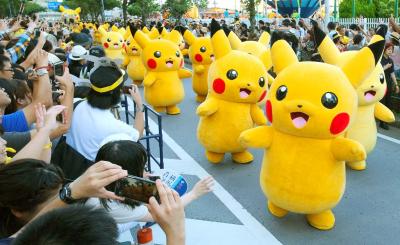
China’s military news agency yesterday warned that Japanese militarism is infiltrating society through series such as Pokemon and Detective Conan, after recent controversies involving events at sensitive sites. In recent days, anime conventions throughout China have reportedly banned participants from dressing as characters from Pokemon or Detective Conan and prohibited sales of related products. China Military Online yesterday posted an article titled “Their schemes — beware the infiltration of Japanese militarism in culture and sports.” The article referenced recent controversies around the popular anime series Pokemon, Detective Conan and My Hero Academia, saying that “the evil influence of Japanese militarism lives on in

DIPLOMATIC THAW: The Canadian prime minister’s China visit and improved Beijing-Ottawa ties raised lawyer Zhang Dongshuo’s hopes for a positive outcome in the retrial China has overturned the death sentence of Canadian Robert Schellenberg, a Canadian official said on Friday, in a possible sign of a diplomatic thaw as Canadian Prime Minister Mark Carney seeks to boost trade ties with Beijing. Schellenberg’s lawyer, Zhang Dongshuo (張東碩), yesterday confirmed China’s Supreme People’s Court struck down the sentence. Schellenberg was detained on drug charges in 2014 before China-Canada ties nosedived following the 2018 arrest in Vancouver of Huawei chief financial officer Meng Wanzhou (孟晚舟). That arrest infuriated Beijing, which detained two Canadians — Michael Spavor and Michael Kovrig — on espionage charges that Ottawa condemned as retaliatory. In January

A sign hanging from a rusty ice-green shipping container installed by Thai forces on what they say is the border with Cambodia reads: “Cambodian citizens are strictly prohibited from entering this area.” On opposite sides of the makeshift barricade, fronted by coils of barbed wire, Cambodians lamented their lost homes and livelihoods as Thailand’s military showed off its gains. Thai forces took control of several patches of disputed land along the border during fighting last year, which could amount to several square kilometers in total. Cambodian Kim Ren said her house in Chouk Chey used to stand on what is now the Thai
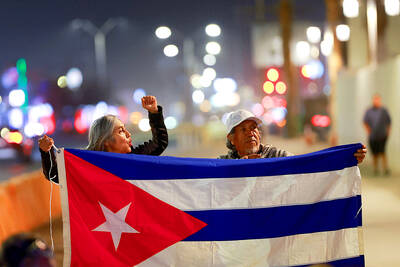
NEW RULES: There would be fewer school days, four-day workweeks, and a reduction in transportation services as the country battles a crisis exacerbated by US pressure The Cuban government on Friday announced emergency measures to address a crippling energy crisis worsened by US sanctions, including the adoption of a four-day work week for state-owned companies and fuel sale restrictions. Cuban Deputy Prime Minister Oscar Perez-Oliva Fraga blamed Washington for the crisis, telling Cuban television the government would “implement a series of decisions, first and foremost to guarantee the vitality of our country and essential services, without giving up on development.” “Fuel will be used to protect essential services for the population and indispensable economic activities,” he said. Among the new measures are the reduction of the working week in


 RSS
RSS