


Turkish President Recep Tayyip Erdogan on Friday said he might walk away from a deal that has substantially reduced the flow of refugees and migrants to the EU, and also effectively end Ankara’s membership bid by bringing back capital punishment.
Erdogan’s warning that he could open Turkey’s borders to illegal migrants bound for Europe prompted an immediate objection from Germany that such “threats” were unhelpful.
Greece, which would face a heightened influx of migrants if Turkey took the action, also expressed “concern” at what it said would be “an act of aggression.”
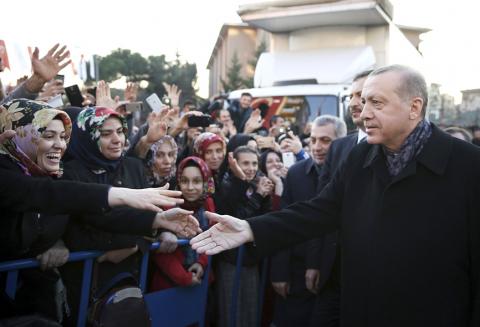
Photo: AP
Erdogan’s comments came a day after the European Parliament angered Ankara by backing a freeze of its EU accession talks, already hit by alarm over its crackdown in the wake of a failed coup in July.
“Listen to me. If you go any further, then the frontiers will be opened, bear that in mind,” Erdogan told the EU during a speech in Istanbul.
At a later meeting, Erdogan reaffirmed he would sign a law bringing back the death penalty if it is approved by parliament.
“If the people say: ‘We want the death penalty’ ... and this goes to parliament and parliament passes it and it comes to me, I declare I will approve this,” he said.
EU officials have repeatedly made clear that bringing back the death penalty would instantly end Turkey’s bid for membership, as abolishing capital punishment is a key precondition.
On March 18, Ankara and Brussels forged a deal for Turkey to halt the flow of refugees and migrants to Europe — an accord that has largely been successful in reducing numbers crossing the Aegean Sea between Turkey and Greece.
According to the International Organization for Migration, a little more than 171,000 have crossed to Greece so far this year, much lower than the comparable figure for last year of almost 740,000.
Hundreds of refugees and migrants drowned while trying to cross the Aegean last year on unseaworthy boats.
Turkey agreed to step up maritime and land border controls in exchange for incentives on its long-stalled membership bid, including visa-free travel for its citizens and an acceleration of the accession talks.
However, with last month’s target passing, no apparent progress on the visa issue and the accession talks stalled, Ankara has accused Brussels of failing to keep its side of the bargain.
In response to Erdogan’s remarks, German Chancellor Angela Merkel’s spokeswoman Ulrike Demmer said the deal was in the interest “of all parties” and that “threats on either side are not helpful.”
Greek Deputy Minister of Defense Dimitris Vitsas said that “using refugees and migrants to achieve other objectives [than those related to managing the influx] is an act of aggression.”
EU Commission spokesman Margaritis Schinas said it would not get involved in “statements about hypothetical scenarios” and was still committed to implementing the agreement.
Erdogan has also accused Brussels of failing to fulfil a promise to deliver about 6 billion euros (US$6.3 billion) in aid for refugees.
The EU says the money is to be transferred gradually for individual projects and not in a single payment.
Erdogan said that while Turkey itself was looking after 3 million refugees — including 2.7 million Syrians who escaped the civil war and also Iraqis — “you [the EU] did not fulfill your promises.”
The European Parliament vote to freeze the accession talks reflected spiralling tensions with Ankara after Brussels repeatedly expressed alarm over the magnitude of Turkey’s crackdown after the coup attempts as well as the threats to bring back capital punishment.
The vote is non-binding and earlier this month, all EU foreign ministers — with the exception of Austria — said they favoured continuing the accession talks.
However, analysts say the entire membership process is in deep trouble, with little hope of progress and several risk factors that could lead to its collapse.


Showcasing phallus-shaped portable shrines and pink penis candies, Japan’s annual fertility festival yesterday teemed with tourists, couples and families elated by its open display of sex. The spring Kanamara Matsuri near Tokyo features colorfully dressed worshipers carrying a trio of giant phallic-shaped objects as they parade through the street with glee. The festival, as legend has it, honors a local blacksmith in the Edo Period (1603-1868) who forged an iron dildo to break the teeth of a sharp-toothed demon inhabiting a woman’s vagina that had been castrating young men on their wedding nights. A 1m black steel phallus sits in the courtyard of

JAN. 1 CLAUSE: As military service is voluntary, applications for permission to stay abroad for over three months for men up to age 45 must, in principle, be granted A little-noticed clause in sweeping changes to Germany’s military service policy has triggered an uproar after it emerged that the law requires men aged up to 45 to get permission from the armed forces before any significant stay abroad, even in peacetime. The legislation, which went into effect on Jan. 1 aims to bolster the military and demands all 18-year-old men fill out a questionnaire to gauge their suitability to serve in the armed forces, but stops short of conscription. If the “modernized” model fails to pull in enough recruits, parliament will be compelled to discuss the reintroduction of compulsory service, German
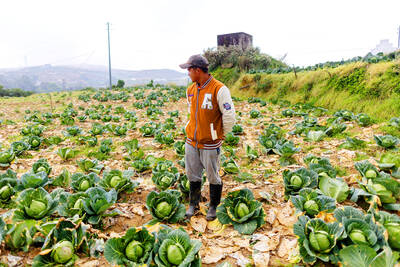
Filipino farmers like Romeo Wagayan have been left with little choice but to let their vegetables rot in the field rather than sell them at a loss, as rising oil prices linked to the Iran war drive up the cost of harvesting, labor and transport. “There’s nothing we can do,” said Wagayan, a 57-year old vegetable farmer in the northern Philippine province of Benguet. “If we harvest it, our losses only increase because of labor, transportation and packing costs. We don’t earn anything from it. That’s why we decided not to harvest at all,” he said. Soaring costs caused by the Middle East

Hungarian Prime Minister Viktor Orban’s officially declared wealth is fairly modest: some savings and a jointly owned villa in Budapest. However, voters in what Transparency International deems the EU’s most corrupt country believe otherwise — and they might make Orban pay in a general election this Sunday that could spell an end to his 16-year rule. The wealth amassed by Orban’s inner circle is fueling the increasingly palpable frustration of a population grappling with sluggish growth, high inflation and worsening public services. “The government’s communication machine worked well as long as our economic situation remained relatively good,” said Zoltan Ranschburg, a political analyst


 RSS
RSS