


A study has found that unusually warm Pacific Ocean temperatures helped cause a massive bloom of toxic algae last year that closed lucrative fisheries from California to British Columbia and disrupted marine life from seabirds to sea lions.
Scientists linked the large patch of warm ocean water, nicknamed the “blob,” to the vast ribbon of toxic algae that flourished last year and produced record-breaking levels of a neurotoxin that is harmful to people, fish and marine life.
The outbreak of domoic acid, the largest ever recorded on the west coast of the US, closed razor clam seasons in Washington and Oregon, as well as delaying lucrative Dungeness crab fisheries along the coast. High levels were also detected in many stranded marine mammals.
“We’re not surprised now having looked at the data, but our study is the first to demonstrate that linkage,” said Ryan McCabe, lead author and a research scientist at the University of Washington’s Joint Institute for the Study of the Atmosphere and Ocean. “It’s the first question that everyone was asking.”
McCabe and his coauthors explain how the toxic algae bloom thrived in their study published in the journal Geophysical Research Letters.
Seasonal algae blooms are common each year along the west coast, but most are not toxic. The scientists found that the algae bloom was dominated by a single species called Pseudo-nitzschia australis that is highly toxic.
The algae survived and took advantage of warm, nutrient-poor conditions set up by the patch of water that was warmer at the surface than normal.
Coastal upwelling last spring — a seasonal event that brings nutrient-rich, cooler waters up from the deep ocean — provided nutrients for the algae to bloom into a large population fairly quickly.
A series of late spring storms delivered the bloom to the coast.
“While temperature isn’t everything, it’s serving as a decent proxy,” McCabe said. “We think there’s a linkage between toxic events along our coast and climate variability indices.”
The blob was a one-time event that was not due to global warming, “but we are looking at this event as a potential window into the future as what conditions could look like,” McCabe said.
Kathi Lefebvre, a coauthor and marine biologist at the Northwest Fisheries Science Center, said the bloom resulted in the highest levels of domoic acid contamination in the food chain ever recorded for many species.
Domoic acid accumulates in anchovies, sardines and other small fish, as well as shellfish that eat the algae. Marine mammals and fish-eating birds get sick from eating the contaminated fish. In people, it can trigger amnesic shellfish poisoning, which can cause permanent loss of short-term memory in severe cases.
“This is an eye-opener for what the future may hold as ocean conditions continue to warm globally,” Lefebvre said.

Crowds in Bangladesh are flocking to snap photographs with an unlikely social media star — an albino buffalo with flowing blond hair nicknamed “Donald Trump” that is due to be sacrificed within days. Owner Zia Uddin Mridha, 38, said his brother named the 700kg bull over its flowing helmet of hair resembling the signature look of the US president. “My younger brother picked this name because of the buffalo’s extraordinary hair,” he said at his farm in Narayanganj, just outside the capital, Dhaka. Mridha said that a constant stream of curious visitors — social media fans, onlookers and children — have come throughout

It began as a satirical online project. Now millions of young people in India are flocking to it as an outlet for their frustration. A parody political party called the Cockroach Janta Party, with the insect as its symbol, has exploded across India’s social media by turning absurdist humor into protest. Memes and short videos mocking corruption, joblessness and political dysfunction have flooded social media sites, where millions of users are embracing the cockroach — known for its ability to survive harsh conditions — as a tongue-in-cheek symbol of endurance. The online movement’s rise has been unusually rapid. The Cockroach Janta Party (CJP)

BIGGER ROLE: Beijing has said it maintains an impartial stance on the war in Ukraine, but by training Russian troops, China is far more involved than previously known China’s armed forces secretly trained about 200 Russian military personnel in China late last year, and some have since returned to fight in Ukraine, according to three European intelligence agencies and documents seen by Reuters. While China and Russia have held a number of joint military exercises since Moscow’s full-scale invasion of Ukraine in 2022, Beijing has repeatedly said that it is neutral in the conflict and presents itself as a peace mediator. The covert training sessions, which predominantly focused on the use of drones, were outlined in a dual-language Russian-Chinese agreement signed by senior Russian and Chinese officers in Beijing on
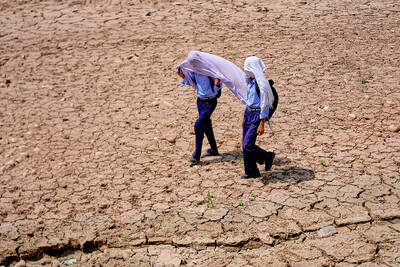
HOTTER: While Indians are accustomed to summer heat, climate change has caused northwestern India to warm faster than other parts of the country, an academic said Roads and markets have emptied during afternoons and some farmers have switched to nighttime work to avoid scorching temperatures as a heat wave grips large parts of India. The India Meteorological Department forecast maximum temperatures for yesterday of about 45°C in the capital, New Delhi, where authorities have opened temporary “cooling zones” to help people cope. The weather department warned that conditions would likely persist across several northern regions in the coming days, with temperatures staying well above seasonal averages. Authorities urged people to stay indoors during the hottest hours and take precautions against heat-related illnesses. India declares a heat wave whenever maximum temperatures


 RSS
RSS