


At a sprawling displacement camp on the outskirts of the South Sudanese capital, women have faced a wrenching choice: risk starvation or sexual assault.
When her family ran out of food last month, Angelina Nhokmar, a 20-year-old mother of two, ventured outside the camp’s gates.
She said she was lucky to have made it to the market and back unharmed, because dozens of women were raped by government soldiers in recent weeks as they made the same journey.
“It’s not safe,” she said, tossing handfuls of sorghum into a pot of boiling water. “Our enemies are outside.”
The civil war that ripped apart South Sudan, the world’s youngest country, ended on paper months ago, but an eruption of clashes between the nation’s rival factions last month put a chokehold on regular food distribution for the tens of thousands of people stranded in UN-run displacement camps. As families struggled to find sustenance, they endured an increase in healthcare crises, ethnic tensions and sexual violence.
Nearly 30,000 people have been sheltering at UN sites around the capital, Juba, since South Sudan erupted into civil war in 2013. For more than two years, soldiers loyal to South Sudanese President Salva Kiir — who belongs to the Dinka ethnic group, South Sudan’s largest — battled troops led by Riek Machar of the Nuer ethnic group, which is believed to be the second largest.
Tens of thousands of people lost their lives in the war, and troops on both sides committed human rights abuses against civilians on a devastating scale.
A peace deal officially ended the fighting last year. Machar, who had served as vice president before being fired in 2013, agreed to become Kiir’s deputy again and moved back to Juba in April.
Fighting broke out again between the two sides on July 7, killing hundreds. Machar’s residence was destroyed and he fled the capital. He has refused to return to Juba unless more international troops are deployed.
Kiir opposes this, arguing that the 12,000 UN peacekeeping troops already stationed there are enough.
For years, the displacement camps have been worlds unto themselves: communities complete with churches, shops and schools.
They are also plagued by overcrowding, recurring shortages of basic goods and the uncertainty faced by residents, who have no idea when, if ever, they will feel safe enough to leave.
So they stay, cloistered inside barbed-wire fences guarded by UN troops who have failed to keep peace in the capital or even to prevent assaults just outside the camps’ perimeters.
Sexual assaults in Juba surged last month to at least 217 reported cases, UN Human Rights High Commissioner Zeid Ra’ad al-Hussein said in a statement on Thursday.
Members of South Sudan’s national army seemed to be responsible for most of the assaults, he said, adding that most of those attacked were displaced Nuer women and girls.
Many were women living in the camps who ventured out to the markets when food ran out. Others were fleeing the clashes and making their way to the displacement sites for the first time.
The civilians who came to these camps in 2013 were overwhelmingly Nuer. Last week, thousands of them demonstrated against Kiir for recognizing a new vice president to take Machar’s place, calling it a violation of the peace deal.
Such a gathering would be unimaginable now in central Juba.
The streets of the capital are firmly under the control of the president’s forces, though they are still tense. Many properties have been destroyed, and many more looted — often by men wearing army uniforms.
International partners have also suffered, including the UN peacekeeping mission, which lost two Chinese soldiers to crossfire inside the camp last month, and the World Food Program, whose main warehouse in South Sudan was looted from top to bottom in one of the worst such episodes the organization has experienced in years.
It was not just the food, which totaled about 4,500 tonnes and consisted mostly of nutritional supplements for children and pregnant or nursing mothers, World Food Program spokeswoman Challiss McDonough said.
“Everything was stripped,” McDonough said. “Technical equipment, generators, fuel stocks — every single thing was gone.”
Also stolen were several trucks specially outfitted to deliver food across the country, a near-impossible task for normal vehicles in the current rainy season.
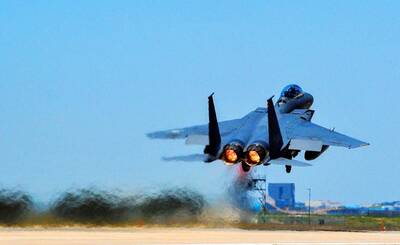
South Korea’s air force yesterday apologized for a 2021 midair collision involving two fighter jets, a day after auditors said the pilots were taking selfies and filming during the flight and held them responsible for the accident. “We sincerely apologize to the public for the concern caused by the accident that occurred in 2021,” an air force spokesman told a news conference, adding that one of the pilots involved had been suspended from flying duties, received severe disciplinary action and has since left the military. The apology followed a report released on Wednesday by the South Korean Board of Audit and Inspection,

About 240 Indians claiming descent from a Biblical tribe landed at Tel Aviv airport on Thursday as part of a government operation to relocate them to Israel. The newcomers passed under a balloon arch in blue and white, the colors of the Israeli flag, as dozens of well-wishers welcomed them with a traditional Jewish song. They were the first “bnei Menashe” (“sons of Manasseh”) to arrive in Israel since the government in November last year announced funding for the immigration of about 6,000 members of the community from the states of Manipur and Mizoram in northeast India. The community claims to descend from

Indonesian police have arrested 13 people after shocking images of alleged abuse against small children at a daycare center went viral, sparking outrage across the nation, officials said on Monday. Police on Friday last week raided Little Aresha, a daycare center in Yogyakarta on Java island, following a report from a former employee. CCTV footage circulating on social media showed children, most younger than two, lying on the floor wearing only diapers, their hands and feet bound with rags. The police have confirmed that the footage is authentic. Police said they also found 20 children crammed into a room just 3m by 3m. “So

‘TROUBLING’: The firing of Phelan, who was an adviser to a nonprofit that supported the defense of Taiwan, was another example of ‘dysfunction’ under Trump, a US senator said US Secretary of the Navy John Phelan has been fired, a US official and a person familiar with the matter said on Wednesday, in another wartime shakeup at the Pentagon coming just weeks after US Secretary of Defense Pete Hegseth ousted the Army’s top general. The Pentagon announced his departure in a brief statement, saying he was leaving the administration “effective immediately,” but it did not provide a reason or say whether it was his decision to go. The sources, who spoke on condition of anonymity, said Phelan was dismissed in part because he was moving too slowly to implement reforms to


 RSS
RSS