


El Salvador, ranked one of the most dangerous countries in the world, has nearly halved its staggeringly bloody monthly murder rate amid a fierce crackdown on fearsome gangs.
However, analysts said that the number of homicides this year is still above where it was the same time last year, and warned that the government offensive against the gangs needs to continue to break them apart.
Salvadoran Minister of Justice and Security Mauricio Ramirez on Thursday said that the “extraordinary measures” El Salvador has employed “have managed to reduce the crime rate by more than 50 percent.”
Isolating gang bosses in prison, sending in elite troops and police to arrest gang members, and erasing gang graffiti from the streets of at least one town all appear to be bearing fruit.
The Institute for Forensic Medicine said about 353 murders were recorded in each of the months of May and April.
While that is still high, it is significantly less than the 611 homicides in March, 644 in February and 740 in January.
However, the total number of murders so far this year, 2,721, is still higher than the 2,188 registered for the same period last year.
That underlines El Salvador’s notoriety as the country with the most murders per capita in the world outside of a war zone.
El Salvador’s government in April started its crackdown in a bid to roll back that reputation and to challenge the perception that it had lost control of swathes of territory to the gangs.
BARRED
Ramirez acknowledged that “to maintain security and the positive results so far, we have to keep control over the penitentiaries,” where gang bosses are now barred from receiving visitors and cellphone signals are blocked.
University professor and analyst Juan Ramon Medrano said that the first phase of the government’s plan to reduce the number of murders “is working.”
However, “the current success is going to depend on keeping up a sustainable tactical offense over the duration,” he said.
No let-up should be given in the efforts to bust the gangs’ leadership and to prevent them winning back turf from the authorities, he said.
Howard Cotto, the head of the national police force, also said that, beyond the operations by the security forces, “citizen participation in prevention tasks, such as tip-offs,” had an important role to play.
Part of the reason El Salvador has made progress this time against the gangs is that it has put thousands of soldiers onto its streets to back up the police.
The deployment helps to contain gang members, who are said to number about 70,000, of which about 13,000 are already behind bars.
The operations have resulted in the deaths of several gang members and the arrest of dozens on various charges.
ESCAPE
“What is happening is a remilitarization of public security,” analyst Roberto Canas said.
Under the urban operations and pressure of the joint army-police crackdown, the gangs “are changing” and in some cases are moving out to rural areas to escape the law enforcement heat, he said.
Jannet Aguilar, director of the Public Opinion Institute of the University of Central America, said the gangs “are being neutralized,” but were not disappearing from the communities they lived in.
“The gangs are in a time of falling back, but recent history has shown that they soon manage to get around the application of the law, to be able to develop the illegal economy they thrive on,” Aguilar said.
A recent study by El Salvador’s central bank estimated that the cost of the violence in the country to the state, households and businesses was US$4 billion, or 16 percent of GDP.
The government has allocated about half that amount over the next five years to finance its security plan, branded “Secure El Salvador.”
Late last month, lawmakers approved a government bond issue worth US$152 million that will go to giving pay hikes to the police, army and prisons on the frontline of the fight against the gangs.

Crowds in Bangladesh are flocking to snap photographs with an unlikely social media star — an albino buffalo with flowing blond hair nicknamed “Donald Trump” that is due to be sacrificed within days. Owner Zia Uddin Mridha, 38, said his brother named the 700kg bull over its flowing helmet of hair resembling the signature look of the US president. “My younger brother picked this name because of the buffalo’s extraordinary hair,” he said at his farm in Narayanganj, just outside the capital, Dhaka. Mridha said that a constant stream of curious visitors — social media fans, onlookers and children — have come throughout

It began as a satirical online project. Now millions of young people in India are flocking to it as an outlet for their frustration. A parody political party called the Cockroach Janta Party, with the insect as its symbol, has exploded across India’s social media by turning absurdist humor into protest. Memes and short videos mocking corruption, joblessness and political dysfunction have flooded social media sites, where millions of users are embracing the cockroach — known for its ability to survive harsh conditions — as a tongue-in-cheek symbol of endurance. The online movement’s rise has been unusually rapid. The Cockroach Janta Party (CJP)

BIGGER ROLE: Beijing has said it maintains an impartial stance on the war in Ukraine, but by training Russian troops, China is far more involved than previously known China’s armed forces secretly trained about 200 Russian military personnel in China late last year, and some have since returned to fight in Ukraine, according to three European intelligence agencies and documents seen by Reuters. While China and Russia have held a number of joint military exercises since Moscow’s full-scale invasion of Ukraine in 2022, Beijing has repeatedly said that it is neutral in the conflict and presents itself as a peace mediator. The covert training sessions, which predominantly focused on the use of drones, were outlined in a dual-language Russian-Chinese agreement signed by senior Russian and Chinese officers in Beijing on
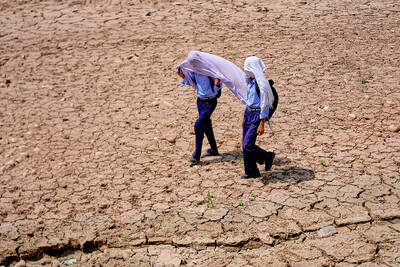
HOTTER: While Indians are accustomed to summer heat, climate change has caused northwestern India to warm faster than other parts of the country, an academic said Roads and markets have emptied during afternoons and some farmers have switched to nighttime work to avoid scorching temperatures as a heat wave grips large parts of India. The India Meteorological Department forecast maximum temperatures for yesterday of about 45°C in the capital, New Delhi, where authorities have opened temporary “cooling zones” to help people cope. The weather department warned that conditions would likely persist across several northern regions in the coming days, with temperatures staying well above seasonal averages. Authorities urged people to stay indoors during the hottest hours and take precautions against heat-related illnesses. India declares a heat wave whenever maximum temperatures


 RSS
RSS