


Harwati forces a smile as she guides visitors around a bubbling mud volcano in Indonesia, pausing as they snap selfies on the bleak wasteland she once called home.
These disaster tourists are a lifeline for the single mother who lost everything when the earth beneath a paddy field near her village opened up without warning 10 years ago, sending pungent, steaming mud bursting out, unabated.
The mudflow buried villages, factories, shops and even a major highway in the Sidoarjo District of Java. Thirteen people died when an underground gas pipeline in the disaster zone exploded, while thousands were left homeless.
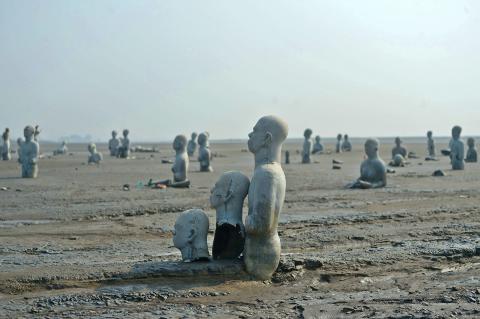
Photo: AFP
Today, Harwati and many others scrape a meager living from the curious visitors who flock to see rooftops and debris poking above the bubbling mud lake.
“This is the only way to earn a living and afford school for my kids,” said Harwati, who like many Indonesians goes by one name. “After my village was flooded, there were no jobs.”
Visitors pose next to faceless statues lying semi-submerged in the mud, a silent reminder of the human toll of the disaster.
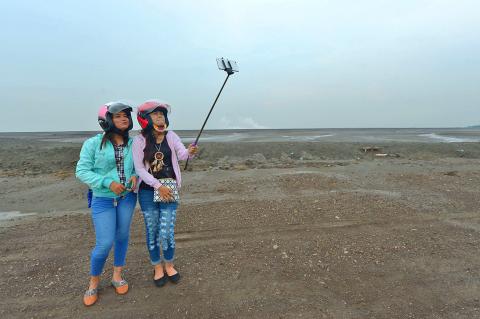
Photo: AFP
As victims prepare to mark 10 years since the start of the disaster, the mud geysers show no signs of stopping: The equivalent of 10 Olympic swimming pools of mud and water still spurt out daily.
An area roughly equivalent to 650 soccer pitches is now buried beneath up to 40m of sludge.
Intrigue has surrounded the cause of the mudflow ever since it first gushed out in the densely populated farming area on May 29, 2006. There are two main theories on what triggered it — drilling for natural resources or an earthquake.
Mud volcanoes — which do not spew out lava or hot ash, but instead water and clay — occur globally, but Sidoarjo’s is believed to be the biggest in the world.
Efforts to plug it, including with huge concrete balls, have proved futile. The area was declared a disaster zone and sealed off, with warning signs dotting the perimeter.
Undeterred, visitors still came and an impromptu industry has sprung up. Busloads of tourists arrive at the weekends and DVDs dramatizing the disaster are hugely popular souvenirs.
“I was very intrigued. I really wanted to see how big the mud was, because I had heard many houses were buried,” said Andri, a tourist from Surabaya.
Debate about what caused the strange phenomenon has only fueled the fascination and protracted the fight for compensation. Independent studies alternate blame between oil and gas company PT Lapindo Brantas, which was drilling in the area at the time, and an earthquake that struck two days earlier about 260km away.
Lapindo — part of a business empire controlled by Indonesia’s powerful Bakrie family — was eventually ordered to compensate victims, but payments took years, triggering angry protests.
The government finally intervened last year and loaned Lapindo the funds to expedite the remaining payments.
Lapindo says on its Web site that after investigations, “it was determined that no correlation could be proven between the drilling activities and the mud eruption.”
The Sidoarjo Mudflow Handling Agency, a government-backed task force, said more than 3,300 households — or 95 percent of those affected by the volcano — had now received payments.
Tens of thousands of liters of mud leak daily into the nearby rivers and a number of research surveys have detected high levels of heavy metals in the area, including one study by Java’s University of Brawijaya.
Environmental activists warn that this has serious implications for the local communities who rely on the waterways.
“It’s not just found in the water or the sediment, but now in the bodies of the fish,” said Rere Christanto, an activist with the Indonesian Forum for the Environment. “The people who consume these fish, they’re going to be affected. There’s a real danger... There’s a lot of heavy metal in that mud.”
Those living near the disaster site complain of health problems, and contaminated land and water. Maksuri, a villager living next to one of the towering dykes, said he was ineligible for compensation, despite his water being often clouded with a foul-smelling yellow tinge.
Even some of those who received payouts have found little relief. Many spent virtually all their compensation paying off huge debts accrued setting up their lives from scratch, Christanto said.
“The compensation didn’t make them rich,” he said.
Christanto has first hand experience — his parents lost their home in the disaster.
Out at the geyser, tourists shriek as thick muck spurts out of the ground. The tour guides whoop and clap on cue, jokingly encouraging mother nature to put on a show for the visitors, but once the crowds depart, the mood is sombre.
Mud tourism has helped some entrepreneurial locals eke out a living from their tragedy, but the reality is far from rosy.
Sukampto had a “comfortable life” and a steady job at a furniture factory before the eruption upended his life. Now he earns a pittance shuttling tourists around the disaster zone.
He stops to point out where his village was — now nothing but a crumbling wall protrudes from a swamp of clay.
“Mosques, schools, boarding houses — everything was lost,” he said.
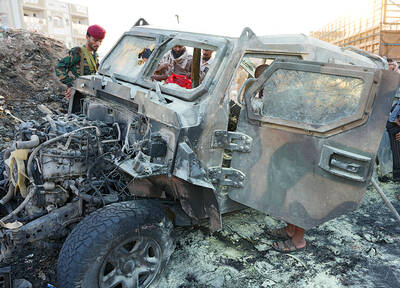
‘TERRORIST ATTACK’: The convoy of Brigadier General Hamdi Shukri resulted in the ‘martyrdom of five of our armed forces,’ the Presidential Leadership Council said A blast targeting the convoy of a Saudi Arabian-backed armed group killed five in Yemen’s southern city of Aden and injured the commander of the government-allied unit, officials said on Wednesday. “The treacherous terrorist attack targeting the convoy of Brigadier General Hamdi Shukri, commander of the Second Giants Brigade, resulted in the martyrdom of five of our armed forces heroes and the injury of three others,” Yemen’s Saudi Arabia-backed Presidential Leadership Council said in a statement published by Yemeni news agency Saba. A security source told reporters that a car bomb on the side of the road in the Ja’awla area in
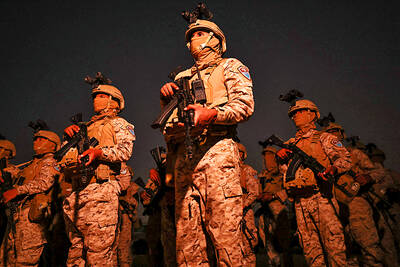
PRECARIOUS RELATIONS: Commentators in Saudi Arabia accuse the UAE of growing too bold, backing forces at odds with Saudi interests in various conflicts A Saudi Arabian media campaign targeting the United Arab Emirates (UAE) has deepened the Gulf’s worst row in years, stoking fears of a damaging fall-out in the financial heart of the Middle East. Fiery accusations of rights abuses and betrayal have circulated for weeks in state-run and social media after a brief conflict in Yemen, where Saudi airstrikes quelled an offensive by UAE-backed separatists. The United Arab Emirates is “investing in chaos and supporting secessionists” from Libya to Yemen and the Horn of Africa, Saudi Arabia’s al-Ekhbariya TV charged in a report this week. Such invective has been unheard of

US President Donald Trump on Saturday warned Canada that if it concludes a trade deal with China, he would impose a 100 percent tariff on all goods coming over the border. Relations between the US and its northern neighbor have been rocky since Trump returned to the White House a year ago, with spats over trade and Canadian Prime Minister Mark Carney decrying a “rupture” in the US-led global order. During a visit to Beijing earlier this month, Carney hailed a “new strategic partnership” with China that resulted in a “preliminary, but landmark trade agreement” to reduce tariffs — but
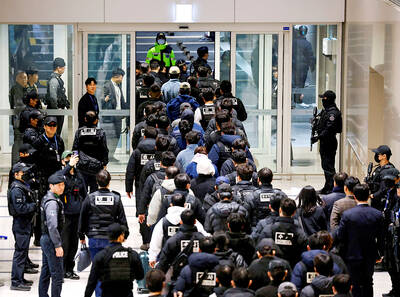
SCAM CLAMPDOWN: About 130 South Korean scam suspects have been sent home since October last year, and 60 more are still waiting for repatriation Dozens of South Koreans allegedly involved in online scams in Cambodia were yesterday returned to South Korea to face investigations in what was the largest group repatriation of Korean criminal suspects from abroad. The 73 South Korean suspects allegedly scammed fellow Koreans out of 48.6 billion won (US$33 million), South Korea said. Upon arrival in South Korea’s Incheon International Airport aboard a chartered plane, the suspects — 65 men and eight women — were sent to police stations. Local TV footage showed the suspects, in handcuffs and wearing masks, being escorted by police officers and boarding buses. They were among about 260 South


 RSS
RSS