


Britain has come under renewed pressure to stop arms sales to Saudi Arabia after UN Secretary-General Ban Ki-moon accused the Saudis of indiscriminate bombing in Yemen and said countries such as the UK had a duty to stop the flow of weapons to Riyadh-led forces.
Speaking in London on Friday, Ban said: “Yemen is in flames and coalition air strikes in particular continue to strike schools, hospitals, mosques and civilian infrastructure.”
He said that Yemen “was awash with weapons,” adding: “We need states that are party to [the] arms trade treaty to set an example in fulfilling one of the treaty’s main purposes — controlling arms flows to actors that may use them in ways that breach international humanitarian law.”
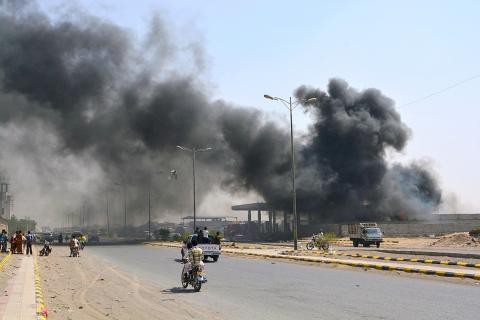
Photo: Reuters
Ban said permanent members of the UN security council , including the UK, had a special responsibility to secure peace in intractable conflicts.
The normally mild mannered Ban made his pointed remarks in a speech in which he bemoaned the failure of major powers to live up to their promises to prevent massacres and human rights abuses on the scale of Syria, Rwanda, Srebrenica, Cambodia and Yemen.
The promises of “never again” have become more muted, he said.
A special UN panel report, leaked a fortnight ago, accused Saudi Arabia of making numerous breaches of international humanitarian law by conducting an indiscriminate bombing campaign in Yemen.
The UK’s international development select committee, supported by the Labour Party leadership, this week called on the government to suspend all arms sales to Saudi Arabia and set up an independent international inquiry into the allegations made by the UN panel.
Partly under pressure from the UK Foreign Office, Saudi Arabia has set up its own inquiry into the allegations, but the committee said an inquiry conducted by the Saudis into their own actions was unacceptable.
The UN panel documented that the coalition had conducted air strikes targeting civilians and civilian objects, in violation of international humanitarian law. These included:
‧ Camps for internally displaced persons and refugees;
‧ Civilian gatherings, including weddings;
‧ Civilian vehicles, including buses, and civilian residential areas; and
‧ Medical facilities, schools, mosques, markets, factories, food storage warehouses and other essential civilian infrastructure, such as Sana’a airport and domestic transit routes.
Britain has denied allegations that it has influence over the Saudi targeting, but admitted being involved in training some of the pilots involved in the air strikes. The UK has granted close to £3 billion (US$4.35 billion) of arms export licences to Saudi Arabia in the past six months.
It is the first time that Ban has commented on the scale of the alleged atrocities in Yemen.
The secretary-general was speaking at a Chatham House event at Central Hall in Westminster, where the UN first met 70 years ago. He was in London as the UN was acting as the cosponsor of the international fundraising conference that generated nearly US$10 billion for Syrian refugees over the next few years.
Ban also gave a broad hint that he wants a woman to succeed him as secretary general later this year, saying that the whole landscape is changed when there is a woman at the top of political organizations.
“It is proven [that] companies with large numbers of women on their boards are more successful and profitable,” he said.
His criticism of Saudi Arabia comes after the country began bombing Yemen in March last year in an attempt to push back Houthi rebels who had managed to take control of the capital, Sana’a, and force Yemeni President Abd Rabbu Mansour Hadi to flee. Hadi is backed by the Saudis, while the Houthi rebels are aligned, at least loosely, with Iran.
Britain is under some diplomatic pressure to loosen its ties with Saudi Arabia since Iran, the kingdom’s arch rival in Yemen, Syria and Lebanon, is making overtures to the west in the wake of the historic nuclear deal that led to the lifting of sanctions against Iran last month.
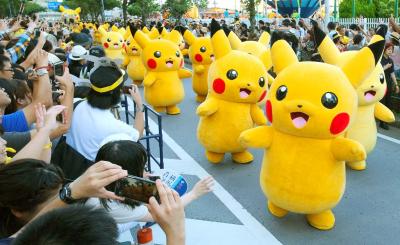
China’s military news agency yesterday warned that Japanese militarism is infiltrating society through series such as Pokemon and Detective Conan, after recent controversies involving events at sensitive sites. In recent days, anime conventions throughout China have reportedly banned participants from dressing as characters from Pokemon or Detective Conan and prohibited sales of related products. China Military Online yesterday posted an article titled “Their schemes — beware the infiltration of Japanese militarism in culture and sports.” The article referenced recent controversies around the popular anime series Pokemon, Detective Conan and My Hero Academia, saying that “the evil influence of Japanese militarism lives on in
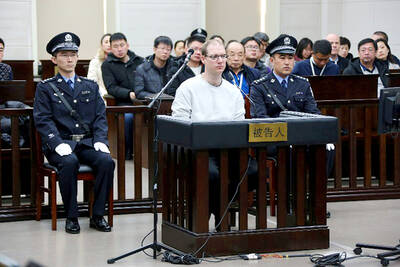
DIPLOMATIC THAW: The Canadian prime minister’s China visit and improved Beijing-Ottawa ties raised lawyer Zhang Dongshuo’s hopes for a positive outcome in the retrial China has overturned the death sentence of Canadian Robert Schellenberg, a Canadian official said on Friday, in a possible sign of a diplomatic thaw as Canadian Prime Minister Mark Carney seeks to boost trade ties with Beijing. Schellenberg’s lawyer, Zhang Dongshuo (張東碩), yesterday confirmed China’s Supreme People’s Court struck down the sentence. Schellenberg was detained on drug charges in 2014 before China-Canada ties nosedived following the 2018 arrest in Vancouver of Huawei chief financial officer Meng Wanzhou (孟晚舟). That arrest infuriated Beijing, which detained two Canadians — Michael Spavor and Michael Kovrig — on espionage charges that Ottawa condemned as retaliatory. In January
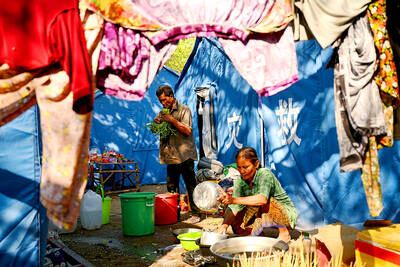
A sign hanging from a rusty ice-green shipping container installed by Thai forces on what they say is the border with Cambodia reads: “Cambodian citizens are strictly prohibited from entering this area.” On opposite sides of the makeshift barricade, fronted by coils of barbed wire, Cambodians lamented their lost homes and livelihoods as Thailand’s military showed off its gains. Thai forces took control of several patches of disputed land along the border during fighting last year, which could amount to several square kilometers in total. Cambodian Kim Ren said her house in Chouk Chey used to stand on what is now the Thai
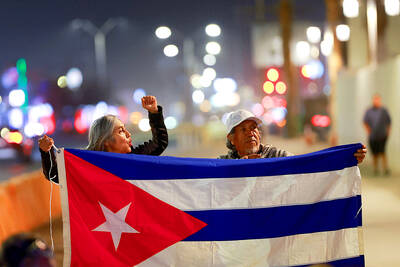
NEW RULES: There would be fewer school days, four-day workweeks, and a reduction in transportation services as the country battles a crisis exacerbated by US pressure The Cuban government on Friday announced emergency measures to address a crippling energy crisis worsened by US sanctions, including the adoption of a four-day work week for state-owned companies and fuel sale restrictions. Cuban Deputy Prime Minister Oscar Perez-Oliva Fraga blamed Washington for the crisis, telling Cuban television the government would “implement a series of decisions, first and foremost to guarantee the vitality of our country and essential services, without giving up on development.” “Fuel will be used to protect essential services for the population and indispensable economic activities,” he said. Among the new measures are the reduction of the working week in


 RSS
RSS