


In the future, China is to shut down a factory before it even pollutes — or so it hopes, as it deploys big data in the fight against bad air.
In Beijing’s environmental bureau, a team of engineers tends to giant mainframe computers that keep a watchful eye on the city’s pollution. Using everything from factories’ infrared profiles to social media posts, the machines can call up three-day pollution forecasts with resolution of up to 1km2and detect trends up to 10 days out.
The computer program, developed by IBM, is one of several high-tech measures, ranging from drones and satellites to remote sensors, which China is deploying to deal with its chronic pollution.
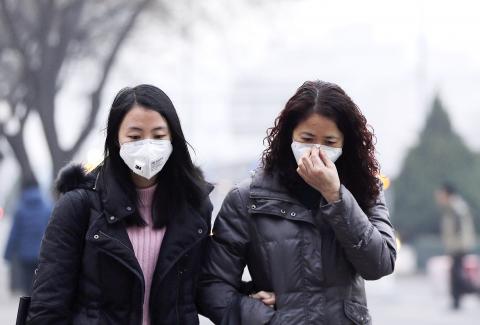
Photo: AP
It seeks to solve an incongruous reality: In a country where security cameras are ubiquitous and Communist authorities operate a vast public surveillance system, accurate information about pollution remains scarce — even to officials.
As a result, Beijing and its neighboring provinces “can’t coordinate joint defense and joint control” of their anti-smog efforts, leaving rogue companies to “secretly discharge and secretly dump,” said Chen Long (陳龍), chief executive officer of Encanwell, which develops air quality monitoring and early warning systems.
The company is trying to achieve total pollution awareness: the ability to know, with perfect accuracy, where haze comes from and use that information to predict and preempt its future sources.
China has found itself in a double bind in the face of a relentless assault from bad air that put the capital on its first-ever air quality red alert this month.
Ahead of the 2008 Olympics, China closed factories across the region, halting construction and pulling half of all private cars off the roads. It was an effective strategy, but came at an estimated cost in the hundreds of millions of US dollars.
Ensuring blue skies for major events, such as last year’s APEC summit, the World Championships in Athletics in August and a World War II anniversary parade, required a similar brute force approach that inflicted collateral damage on the economy in the country, where growth is slowing.
Failure to act, on the other hand, runs the risk of inflaming public discontent — a perpetual source of concern for the government, part of whose claim to legitimacy rests on maintaining an image of supreme competence.
“It’s a complicated problem. It has an impact on society, on industry, on the economy, on health,” said Herve Robin, chief technology officer of Airvisual.com, a China-based social enterprise developing tools for a global pollution monitoring network.
Choking pollution descended on Beijing twice in the past two weeks, and the country’s meteorological bureau expects it might come twice more before the month is out.
“If each time the weather conditions are not good for pollution, they shut down everything, then it would be every week,” Robin said.
Improving prediction capabilities through increased monitoring is a key part of the plan to trade in the country’s anti-pollution sledgehammer for a scalpel.
In July, leadership in Beijing vowed to establish a national network for detecting pollution that would incorporate multiple technologies on land, in the air and space.
So far, the IBM software has achieved only 75 percent accuracy for its 10-day forecasts, developers say.
The hope is that by the time Beijing hosts the Winter Olympics in 2022, the technology “will be able to target specific activities in particular locations and times with the maximum effect, but with much less impact on economic activity and the daily lives of citizens,” said Zhang Meng (張盟), an IBM scientist working on the project with Beijing.
However, despite progress in digital monitoring, dealing with polluters is still primarily an analog process.
During Beijing’s red alert this month, the country’s environmental bureau dispatched 12 teams of inspectors to deal with thousands of companies in high-polluting industries in the capital and surrounding areas.
The city’s social media account posted a running log of its own enforcement efforts, including fines for factories that had failed to activate legally required pollution reduction systems.
Some factories install the equipment, but do not use it “because it costs money to run” and affects productivity, Robin said.
Currently, the capital has fewer than 40 pollution sensors.
Achieving the resolution necessary to precisely pinpoint polluters in a “big city like Delhi or Beijing or Paris, takes a couple of thousand,” Robin said.
The capital might someday achieve that level of surveillance, but for the time being “you have to start from where you are,” IBM’s China research director Shen Xiaowei (沈曉衛) told reporters. “The physical world has not been perfectly monitored — yet.”

South Korea’s air force yesterday apologized for a 2021 midair collision involving two fighter jets, a day after auditors said the pilots were taking selfies and filming during the flight and held them responsible for the accident. “We sincerely apologize to the public for the concern caused by the accident that occurred in 2021,” an air force spokesman told a news conference, adding that one of the pilots involved had been suspended from flying duties, received severe disciplinary action and has since left the military. The apology followed a report released on Wednesday by the South Korean Board of Audit and Inspection,

About 240 Indians claiming descent from a Biblical tribe landed at Tel Aviv airport on Thursday as part of a government operation to relocate them to Israel. The newcomers passed under a balloon arch in blue and white, the colors of the Israeli flag, as dozens of well-wishers welcomed them with a traditional Jewish song. They were the first “bnei Menashe” (“sons of Manasseh”) to arrive in Israel since the government in November last year announced funding for the immigration of about 6,000 members of the community from the states of Manipur and Mizoram in northeast India. The community claims to descend from

Indonesian police have arrested 13 people after shocking images of alleged abuse against small children at a daycare center went viral, sparking outrage across the nation, officials said on Monday. Police on Friday last week raided Little Aresha, a daycare center in Yogyakarta on Java island, following a report from a former employee. CCTV footage circulating on social media showed children, most younger than two, lying on the floor wearing only diapers, their hands and feet bound with rags. The police have confirmed that the footage is authentic. Police said they also found 20 children crammed into a room just 3m by 3m. “So

‘TROUBLING’: The firing of Phelan, who was an adviser to a nonprofit that supported the defense of Taiwan, was another example of ‘dysfunction’ under Trump, a US senator said US Secretary of the Navy John Phelan has been fired, a US official and a person familiar with the matter said on Wednesday, in another wartime shakeup at the Pentagon coming just weeks after US Secretary of Defense Pete Hegseth ousted the Army’s top general. The Pentagon announced his departure in a brief statement, saying he was leaving the administration “effective immediately,” but it did not provide a reason or say whether it was his decision to go. The sources, who spoke on condition of anonymity, said Phelan was dismissed in part because he was moving too slowly to implement reforms to


 RSS
RSS