


Venezuela’s opposition plans to prioritize laws to free jailed activists and reform the crisis-hit economy if it wins Dec. 6 elections to take control of the legislature away from the ruling socialists for the first time in 16 years.
However, there would be no “witch hunt” against foes or any rush toward a recall referendum to try to oust Venezuelan President Nicolas Maduro, Democratic Unity coalition head Jesus Torrealba said in an interview.
“If we take control of the National Assembly simply to say ‘We are going to recall so-and-so,’ then it would be perceived by the country as a tit-for-tat measure and that could split the electorate who are behind us in their majority now,” Torrealba said at his spartan headquarters, shared with an opposition newspaper.
After losing multiple elections since 1998 to Venezuela’s socialist “Chavismo” movement, named for founder and former president Hugo Chavez, polls show the opposition with its best chance to win the legislature.
Victory could enable it to chip away at Maduro’s power by holding ministers to account, approving or rejecting budgets, and influencing appointments to judicial and electoral authorities
The economic crisis has battered Maduro’s approval ratings, although he retains a hard core of support from Venezuelans still devoted to the memory of Chavez and scared the opposition will dismantle state welfare projects.
Electoral district geography and superior campaign resources also favor the government, meaning the outcome may be tighter than confident opposition strategists think.
Torrealba said the opposition’s priority in the 167-seat legislature would be an amnesty and reconciliation law to end the jailing and alleged persecution of opposition leaders and other indigenous, union or environmental activists who have fallen out with the government.
“We have to unite the country. It has been torn apart, bitterly divided for 16 years by demagogic and cruel discourse,” said the 57-year-old former community TV show host, activist and teacher.
Recession and other economic woes from the world’s highest inflation rate to shortages of many basic goods are the main factors weighing on Venezuelans ahead of the Dec. 6 vote. Economists see no easy fix to problems rooted in heavy dependence on oil, and rigid currency and price controls.
Torrealba said an opposition-led National Assembly would seek to alleviate the crisis by stimulating production, reversing nationalizations, increasing the central bank’s autonomy and improving salaries and pensions.
“They’ve subjected the Venezuelan people to the same sacrifices as a structural adjustment program — but without any of its benefits,” he said. “Nowhere in the world is an oil producer, an OPEC member in a situation like us... The depth of the crisis is difficult to exaggerate.”
Maduro has mocked Torrealba as looking like an “evil Shrek,” and the government accuses his coalition of being “closet coup-plotters” who want to put Venezuela’s oil wealth in the hands of the elite.
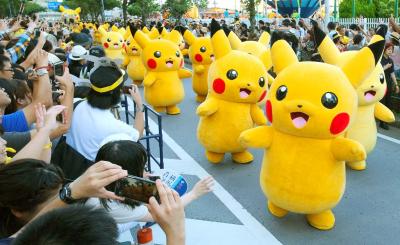
China’s military news agency yesterday warned that Japanese militarism is infiltrating society through series such as Pokemon and Detective Conan, after recent controversies involving events at sensitive sites. In recent days, anime conventions throughout China have reportedly banned participants from dressing as characters from Pokemon or Detective Conan and prohibited sales of related products. China Military Online yesterday posted an article titled “Their schemes — beware the infiltration of Japanese militarism in culture and sports.” The article referenced recent controversies around the popular anime series Pokemon, Detective Conan and My Hero Academia, saying that “the evil influence of Japanese militarism lives on in
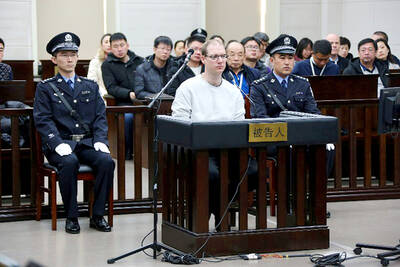
DIPLOMATIC THAW: The Canadian prime minister’s China visit and improved Beijing-Ottawa ties raised lawyer Zhang Dongshuo’s hopes for a positive outcome in the retrial China has overturned the death sentence of Canadian Robert Schellenberg, a Canadian official said on Friday, in a possible sign of a diplomatic thaw as Canadian Prime Minister Mark Carney seeks to boost trade ties with Beijing. Schellenberg’s lawyer, Zhang Dongshuo (張東碩), yesterday confirmed China’s Supreme People’s Court struck down the sentence. Schellenberg was detained on drug charges in 2014 before China-Canada ties nosedived following the 2018 arrest in Vancouver of Huawei chief financial officer Meng Wanzhou (孟晚舟). That arrest infuriated Beijing, which detained two Canadians — Michael Spavor and Michael Kovrig — on espionage charges that Ottawa condemned as retaliatory. In January

A sign hanging from a rusty ice-green shipping container installed by Thai forces on what they say is the border with Cambodia reads: “Cambodian citizens are strictly prohibited from entering this area.” On opposite sides of the makeshift barricade, fronted by coils of barbed wire, Cambodians lamented their lost homes and livelihoods as Thailand’s military showed off its gains. Thai forces took control of several patches of disputed land along the border during fighting last year, which could amount to several square kilometers in total. Cambodian Kim Ren said her house in Chouk Chey used to stand on what is now the Thai
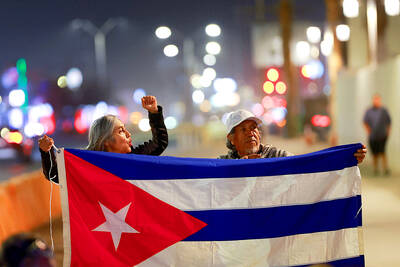
NEW RULES: There would be fewer school days, four-day workweeks, and a reduction in transportation services as the country battles a crisis exacerbated by US pressure The Cuban government on Friday announced emergency measures to address a crippling energy crisis worsened by US sanctions, including the adoption of a four-day work week for state-owned companies and fuel sale restrictions. Cuban Deputy Prime Minister Oscar Perez-Oliva Fraga blamed Washington for the crisis, telling Cuban television the government would “implement a series of decisions, first and foremost to guarantee the vitality of our country and essential services, without giving up on development.” “Fuel will be used to protect essential services for the population and indispensable economic activities,” he said. Among the new measures are the reduction of the working week in


 RSS
RSS