


CHINA
New fires in Tianjin
Emergency workers raced to put out four new fires that had broken out close to the site where two massive explosions in a warehouse storing dangerous chemicals killed 114 people last week, Xinhua news agency said yesterday. Xinhua said one of the “ignition points” came from within an automobile distribution area near the blast site and the other three were within the central blast area.
AUSTRALIA
Qantas deal approved
The country’s competition watchdog yesterday reversed a draft decision against a joint venture between Qantas and China Eastern, giving the carriers the green light to coordinate pricing and scheduling. The Competition and Consumer Commission (ACCC) in March said the original proposal between the airlines would harm competition. However, the regulator yesterday said that China Eastern had since agreed to increase the frequencies of its services between the country and China and introduce a new route if the deal was allowed. Qantas and China Eastern will also expand the destinations covered by their existing codeshare agreement as they seek to establish a gateway through China Eastern’s Shanghai hub for connecting services between the countries.
TURKEY
Troops kill 771 PKK: media
Troops have killed 771 militants of the Kurdistan Workers’ Party (PKK) in northern Iraq and southeastern Turkey over the past four weeks, the state news agency Anatolia said yesterday. The agency, whose figures could not be confirmed independently, said among those killed were 430 rebels who died in air raids on PKK camps in Iraq. Another 260 were killed in ground operations in the southeast, Anatolia said, quoting what it said were sources in military intelligence. The offensive was launched after 33 pro-Kurdish activists were killed on July 20 in a suicide bombing on the Syrian border blamed on Islamic State (IS) militants. The attack prompted a violent reaction against police and troops from Kurdish militants, who accuse Ankara’s Islamic-rooted government of complicity with IS. On July 24, Ankara launched its first air strikes against IS in Syria and then also began attacking targets of the PKK in northern Iraq, in a dual “war on terror.” Dozens of air strikes have been carried out, but only three have officially been targeted at IS. The PKK has been blamed for attacks that have killed about 50 Turkish soldiers.
CHINA
Foreigners learn kung fu
In the countryside outside the birthplace of the sage Confucius (孔子), 35 students — the vast majority of them foreigners — battle the elements, as well as exhaustion at a remote kung fu training academy. The students in Qufu, from as far afield as Brazil, Ukraine, Spain and France, vary in age from six — a young boy who accompanied his mother on a summer holiday — to 50. It is a disciplined, regimented regime, with activities beginning at 6am every day and featuring several hours of practice. This includes runs up and down thousands of steps through the steep hills of a neighboring national park, interspersed with meals. The students are divided into three groups based on their ability, with each group assigned a kung fu master who blows a whistle at the start of every activity. They line up to pay their respects to him each time. The learners can choose how long to stay, from those taking short breaks to one Dutch man who has been training for a year to become a kung fu master and open his own academy in the Netherlands.
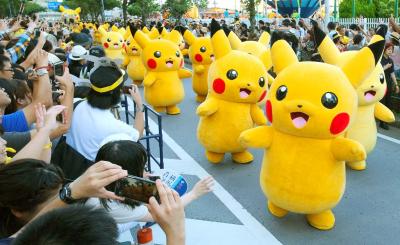
China’s military news agency yesterday warned that Japanese militarism is infiltrating society through series such as Pokemon and Detective Conan, after recent controversies involving events at sensitive sites. In recent days, anime conventions throughout China have reportedly banned participants from dressing as characters from Pokemon or Detective Conan and prohibited sales of related products. China Military Online yesterday posted an article titled “Their schemes — beware the infiltration of Japanese militarism in culture and sports.” The article referenced recent controversies around the popular anime series Pokemon, Detective Conan and My Hero Academia, saying that “the evil influence of Japanese militarism lives on in

DIPLOMATIC THAW: The Canadian prime minister’s China visit and improved Beijing-Ottawa ties raised lawyer Zhang Dongshuo’s hopes for a positive outcome in the retrial China has overturned the death sentence of Canadian Robert Schellenberg, a Canadian official said on Friday, in a possible sign of a diplomatic thaw as Canadian Prime Minister Mark Carney seeks to boost trade ties with Beijing. Schellenberg’s lawyer, Zhang Dongshuo (張東碩), yesterday confirmed China’s Supreme People’s Court struck down the sentence. Schellenberg was detained on drug charges in 2014 before China-Canada ties nosedived following the 2018 arrest in Vancouver of Huawei chief financial officer Meng Wanzhou (孟晚舟). That arrest infuriated Beijing, which detained two Canadians — Michael Spavor and Michael Kovrig — on espionage charges that Ottawa condemned as retaliatory. In January

A sign hanging from a rusty ice-green shipping container installed by Thai forces on what they say is the border with Cambodia reads: “Cambodian citizens are strictly prohibited from entering this area.” On opposite sides of the makeshift barricade, fronted by coils of barbed wire, Cambodians lamented their lost homes and livelihoods as Thailand’s military showed off its gains. Thai forces took control of several patches of disputed land along the border during fighting last year, which could amount to several square kilometers in total. Cambodian Kim Ren said her house in Chouk Chey used to stand on what is now the Thai

NEW RULES: There would be fewer school days, four-day workweeks, and a reduction in transportation services as the country battles a crisis exacerbated by US pressure The Cuban government on Friday announced emergency measures to address a crippling energy crisis worsened by US sanctions, including the adoption of a four-day work week for state-owned companies and fuel sale restrictions. Cuban Deputy Prime Minister Oscar Perez-Oliva Fraga blamed Washington for the crisis, telling Cuban television the government would “implement a series of decisions, first and foremost to guarantee the vitality of our country and essential services, without giving up on development.” “Fuel will be used to protect essential services for the population and indispensable economic activities,” he said. Among the new measures are the reduction of the working week in


 RSS
RSS