


Turkey has killed 260 Kurdish militants in a week-long air offensive on targets in northern Iraq, official media claimed on Saturday, as regional Iraqi authorities said it was time the rebels pulled out with concerns growing over civilian casualties.
Turkey said it had launched an investigation after pro-Kurdish media reports said nine civilians had been killed in a botched air strike, as the military pressed on with its relentless air bombardment campaign against Kurdistan Workers’ Party (PKK) militants in northern Iraq.
Ankara has launched a two-pronged “anti-terror” offensive against Islamic State group in Syria and PKK militants based in northern Iraq after a wave of attacks inside Turkey.
So far the bombardments have focused far more on the Kurdish rebels and a report by Turkey’s official Anatolia news agency of 260 alleged PKK militants killed and up to 400 wounded was the first concrete indication of the scale of the casualties.
Turkish F-16 aircraft carried out more air strikes on Saturday morning, NTV television said.
On Friday, 28 Turkish F-16s destroyed 65 PKK targets, including shelters and arms depots, following heavy airstrikes the day before when 80 Turkish aircraft hit 100 PKK targets, Anatolia said.
“For the peace and security of our people, the fight against terror organizations will continue without interruption,” the office of Turkish Prime Minister Ahmet Davutoglu said in a statement.
Turkey’s Kurdish militants have sought cover in neighboring northern Iraq, where the presence of the PKK has long been tolerated in Iraq’s Kurdish-ruled region. More fighters also crossed into the area from Turkey as part of the 2013 ceasefire.
CHANGING DYNAMIC
However, the PKK’s relations with the autonomous Iraqi Kurdish authorities in Erbil have been beset by tensions, while Iraqi Kurds have expanded economic cooperation and relations with Turkey.
The office of Iraqi Kurdistan Region President Masoud Barzani on Saturday said in a statement that the PKK rebels should move out of the region to prevent civilian casualties.
“The PKK must keep the battlefield away from the Kurdistan region in order for civilians not to become victims of this war,” it said.
The regional government issued a softer statement urging the PKK to keep its “forces ... away from populated areas.”
Iraqi Kurdish officials on Saturday said six people had been killed in a pre-dawn strike by Turkish warplanes on the village of Zarkel and there have been reports of civilian casualties.
The pro-PKK Firat news agency described the attack as a “massacre” that left at least nine civilians dead.
The Turkish Ministry of Foreign Affairs promised a “full investigation” into the claims, but also accused the PKK of using civilians as “human shields.”
POLITICAL PRESSURE
Anatolia said that among those wounded in the northern Iraq strikes was Nurettin Demirtas, the brother of the leader of the pro-Kurdish Peoples’ Democratic Party (HDP), Selahattin Demirtas.
Selahattin Demirtas openly acknowledged that his elder brother Nurettin had gone to Kandil Mountain in northern Iraq where the PKK’s military headquarters are based.
However, yesterday he said he could not confirm the Anatolia report, as Nurettin had moved on. He is “resisting the Islamic State on behalf of the people,” Selahattin Demirtas said, without giving further details.
The Turkish authorities have also been upping the pressure on the HDP, with prosecutors opening criminal investigations against both of its coleaders.
The HDP has angrily claimed that the current security crisis was provoked by Turkish President Recep Tayyip Erdogan to call snap elections and avenge the ruling party’s disappointing performance in June 7 polls.
Demirtas on Sunday said that a legal adviser to Erdogan, Burhan Kuzu, was planning to close the party possibly “by the end of the year.”
“We will stop this fascist approach,” he said.
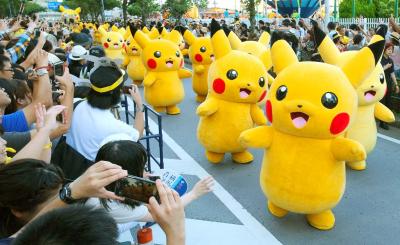
China’s military news agency yesterday warned that Japanese militarism is infiltrating society through series such as Pokemon and Detective Conan, after recent controversies involving events at sensitive sites. In recent days, anime conventions throughout China have reportedly banned participants from dressing as characters from Pokemon or Detective Conan and prohibited sales of related products. China Military Online yesterday posted an article titled “Their schemes — beware the infiltration of Japanese militarism in culture and sports.” The article referenced recent controversies around the popular anime series Pokemon, Detective Conan and My Hero Academia, saying that “the evil influence of Japanese militarism lives on in
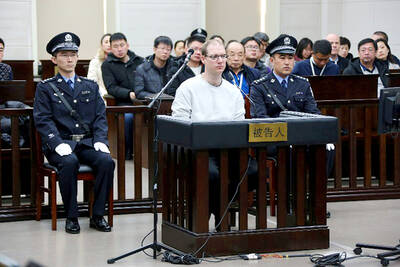
DIPLOMATIC THAW: The Canadian prime minister’s China visit and improved Beijing-Ottawa ties raised lawyer Zhang Dongshuo’s hopes for a positive outcome in the retrial China has overturned the death sentence of Canadian Robert Schellenberg, a Canadian official said on Friday, in a possible sign of a diplomatic thaw as Canadian Prime Minister Mark Carney seeks to boost trade ties with Beijing. Schellenberg’s lawyer, Zhang Dongshuo (張東碩), yesterday confirmed China’s Supreme People’s Court struck down the sentence. Schellenberg was detained on drug charges in 2014 before China-Canada ties nosedived following the 2018 arrest in Vancouver of Huawei chief financial officer Meng Wanzhou (孟晚舟). That arrest infuriated Beijing, which detained two Canadians — Michael Spavor and Michael Kovrig — on espionage charges that Ottawa condemned as retaliatory. In January

A sign hanging from a rusty ice-green shipping container installed by Thai forces on what they say is the border with Cambodia reads: “Cambodian citizens are strictly prohibited from entering this area.” On opposite sides of the makeshift barricade, fronted by coils of barbed wire, Cambodians lamented their lost homes and livelihoods as Thailand’s military showed off its gains. Thai forces took control of several patches of disputed land along the border during fighting last year, which could amount to several square kilometers in total. Cambodian Kim Ren said her house in Chouk Chey used to stand on what is now the Thai
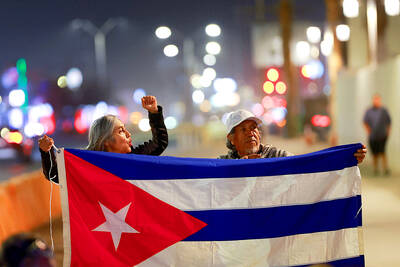
NEW RULES: There would be fewer school days, four-day workweeks, and a reduction in transportation services as the country battles a crisis exacerbated by US pressure The Cuban government on Friday announced emergency measures to address a crippling energy crisis worsened by US sanctions, including the adoption of a four-day work week for state-owned companies and fuel sale restrictions. Cuban Deputy Prime Minister Oscar Perez-Oliva Fraga blamed Washington for the crisis, telling Cuban television the government would “implement a series of decisions, first and foremost to guarantee the vitality of our country and essential services, without giving up on development.” “Fuel will be used to protect essential services for the population and indispensable economic activities,” he said. Among the new measures are the reduction of the working week in


 RSS
RSS