


Tupou VI was formally crowned King of Tonga yesterday before thousands of people, including heads of state and dignitaries from around the world, capping a week steeped in traditional rites.
Because it is taboo for Tongans to touch their king’s head, a retired Australian minister was flown in to perform the televised crowning.
The new king also becomes the 24th Tu’i Kanokupolu, an ancient Tongan title that predates the monarchy by centuries.
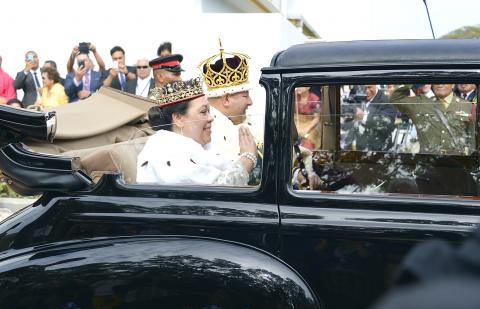
Photo: AP
Celebrations and ancient rituals leading up to the coronation began the previous Saturday with a Taumafa Kava, a traditional ceremony in which Tupou VI drank the mildly narcotic kava drink to confirm his title as king of Tonga.
The historic rite — in which about 150 nobles, wearing traditional ta’ovala mats around their waists, sat in a circle to drink kava from coconut shells — launched seven days of street parties, black-tie balls, fashion shows and feasting, before the king was crowned by Australian D’Arcy Wood.
“No Tongan citizen can do it as it is forbidden for a Tongan to touch the king’s head,” the 78-year-old retired Methodist minister said last week before flying to Tonga from his home near Melbourne.
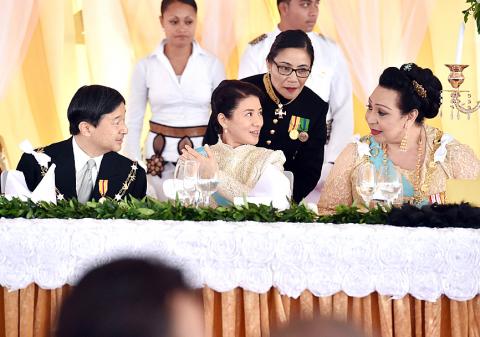
Photo: AFP
Wood was born in Tonga when his father worked there in 1924 and met the new king when he was the Tongan High Commissioner to Australia in the 1990s.
Tupou VI, 55, ascended to the throne following the death of his bachelor brother Tupou V, who died in 2012 after a six-year reign of major reforms that expanded democracy in the nation of about 110,000 people.
An estimated 15,000 people, mainly expatriate Tongans, flew in for the coronation, with the invited guests including Japanese Crown Prince Naruhito, his wife, Princess Masako, and European royals Prince Georg von Habsburg from Hungary and Princess Marie-Therese von Hohenberg from Austria.
Hundreds of schoolchildren sitting on traditional mats, formed a guard of honor as the robed King Tupou VI and his wife, Queen Nanasipau’u, arrived at the Free Wesleyan Centenary Church for the ceremony.
The celebrations were to continue in the evening with a Tupakapakanava — the lighting of torches along the coast line — and are due to end on Tuesday with a military tattoo.
Although Tonga has economic problems, including high youth unemployment, most of its citizens have deep respect for their monarchy and the lavishness of the coronation was not a concern.
Auckland-based Ofa Taufo’ou, who returned home for the celebrations, told Radio New Zealand that Tongans value their royalty and culture.
“I don’t have the words to explain how much it means to me to have royalty and to have this occasion,” he said.
Wood said Tongans’ affection for their monarch is deeply entrenched in their history.
“The monarch represents for them continuity and security — a symbolic role which unites and reassures the people,” he said.
Tonga’s monarchy can trace its history back 1,000 years and by the 13th century the nation wielded power and influence over surrounding islands, including Samoa, nearly 900km to the east.
Tupou I, who converted to Christianity after coming under the influence of missionaries, was proclaimed king in 1845 after winning control of the monarchy from two other royal lines.
By 1900 the nation had become a British protectorate and it acquired its independence in 1970. It remains the only monarchy among South Pacific island nations.
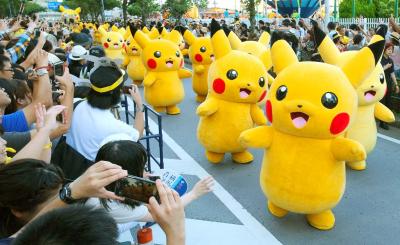
China’s military news agency yesterday warned that Japanese militarism is infiltrating society through series such as Pokemon and Detective Conan, after recent controversies involving events at sensitive sites. In recent days, anime conventions throughout China have reportedly banned participants from dressing as characters from Pokemon or Detective Conan and prohibited sales of related products. China Military Online yesterday posted an article titled “Their schemes — beware the infiltration of Japanese militarism in culture and sports.” The article referenced recent controversies around the popular anime series Pokemon, Detective Conan and My Hero Academia, saying that “the evil influence of Japanese militarism lives on in

DIPLOMATIC THAW: The Canadian prime minister’s China visit and improved Beijing-Ottawa ties raised lawyer Zhang Dongshuo’s hopes for a positive outcome in the retrial China has overturned the death sentence of Canadian Robert Schellenberg, a Canadian official said on Friday, in a possible sign of a diplomatic thaw as Canadian Prime Minister Mark Carney seeks to boost trade ties with Beijing. Schellenberg’s lawyer, Zhang Dongshuo (張東碩), yesterday confirmed China’s Supreme People’s Court struck down the sentence. Schellenberg was detained on drug charges in 2014 before China-Canada ties nosedived following the 2018 arrest in Vancouver of Huawei chief financial officer Meng Wanzhou (孟晚舟). That arrest infuriated Beijing, which detained two Canadians — Michael Spavor and Michael Kovrig — on espionage charges that Ottawa condemned as retaliatory. In January
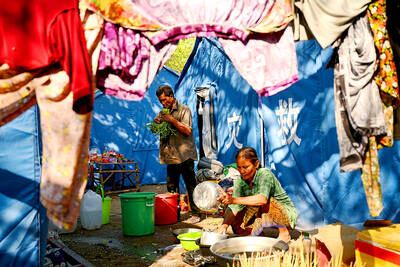
A sign hanging from a rusty ice-green shipping container installed by Thai forces on what they say is the border with Cambodia reads: “Cambodian citizens are strictly prohibited from entering this area.” On opposite sides of the makeshift barricade, fronted by coils of barbed wire, Cambodians lamented their lost homes and livelihoods as Thailand’s military showed off its gains. Thai forces took control of several patches of disputed land along the border during fighting last year, which could amount to several square kilometers in total. Cambodian Kim Ren said her house in Chouk Chey used to stand on what is now the Thai
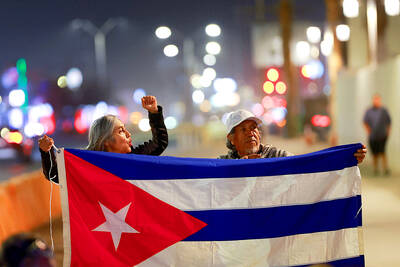
NEW RULES: There would be fewer school days, four-day workweeks, and a reduction in transportation services as the country battles a crisis exacerbated by US pressure The Cuban government on Friday announced emergency measures to address a crippling energy crisis worsened by US sanctions, including the adoption of a four-day work week for state-owned companies and fuel sale restrictions. Cuban Deputy Prime Minister Oscar Perez-Oliva Fraga blamed Washington for the crisis, telling Cuban television the government would “implement a series of decisions, first and foremost to guarantee the vitality of our country and essential services, without giving up on development.” “Fuel will be used to protect essential services for the population and indispensable economic activities,” he said. Among the new measures are the reduction of the working week in


 RSS
RSS