


A Taliban suicide bomber and gunmen attacked the Afghan National Assembly yesterday, shattering windows, wounding at least 19 people and sending a plume of black smoke across Kabul, as a second district in two days fell to the group in the north.
The attack on the symbolic center of power, one of the most brazen in years, along with a series of Taliban gains elsewhere, raise questions about the NATO-trained Afghan security forces’ ability to cope and how far the militants can advance.
Violence has spiraled in Afghanistan since the departure of most foreign forces at the end of last year, as the insurgents push to take territory more than 13 years after the US-led military intervention that toppled the Taliban from power.
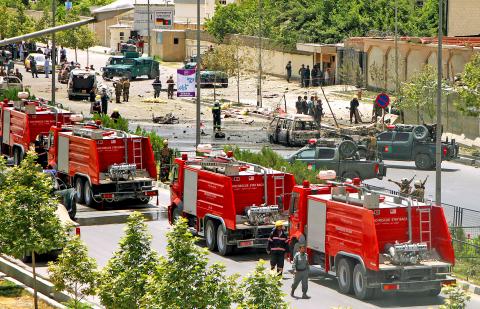
Photo: EPA
The attack began when a Taliban fighter driving a car loaded with explosives blew up outside parliament gates, Kabul police spokesman Ebadullah Karimi said, raising questions about how the driver got through several security checkpoints.
Six gunmen took up positions in a building near parliament, he said. Security forces killed the six after a gun battle lasting nearly two hours.
Four women were among the 19 wounded, said Sayed Kabir Amiri, a health official who coordinates Kabul hospitals.
Kabul police chief Abdul Rahman Rahimi said all lawmakers were safe and that fighting was ongoing. TV images showed legislators calmly leaving the building, which was engulfed with dust and smoke.
Taliban spokesman Zabihullah Mujahid claimed responsibility.
“We have launched an attack on parliament, as there was an important gathering to introduce the country’s defense minister,” he said by telephone.
Afghan lawmaker Shukria Barekzai said: “It was a huge blast that shook the building and shattered windows.”
Afghan lawmaker Farhad Sediqi was among several lawmakers who criticized security agencies for not preventing the attack.
“It shows a big failure in the intelligence and security departments of the government,” he said.
The withdrawal of foreign forces and a reduction in US air strikes have allowed Taliban fighters to launch several major attacks in important Afghan provinces.
The second district to fall to the Taliban yesterday was in the northern province of Kunduz. Officials said it fell after urgently needed reinforcements failed to arrive.
The Taliban captured the Dasht-e-Archi District a day after hundreds of militants fought their way to the center of the adjacent district of Chardara.
“The Taliban managed to take it over this morning, as the area has been surrounded for days,” Nasruddin Saeedi, the district governor who escaped to the provincial capital, Kunduz, told reporters by telephone.
“They are many foreign fighters with heavy machine guns. We have asked for reinforcements, but none arrived,” Saeedi said.
Afghan soldiers were preparing a counterattack to retake both districts, another local official said.
Yesterday’s heavy fighting was just 3km from the governor’s compound.
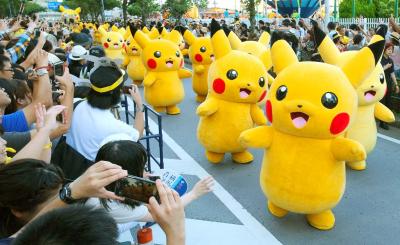
China’s military news agency yesterday warned that Japanese militarism is infiltrating society through series such as Pokemon and Detective Conan, after recent controversies involving events at sensitive sites. In recent days, anime conventions throughout China have reportedly banned participants from dressing as characters from Pokemon or Detective Conan and prohibited sales of related products. China Military Online yesterday posted an article titled “Their schemes — beware the infiltration of Japanese militarism in culture and sports.” The article referenced recent controversies around the popular anime series Pokemon, Detective Conan and My Hero Academia, saying that “the evil influence of Japanese militarism lives on in
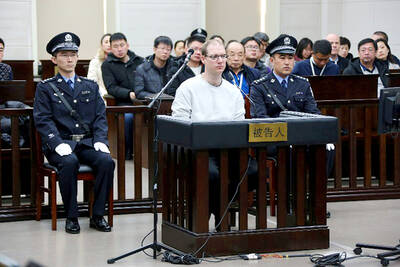
DIPLOMATIC THAW: The Canadian prime minister’s China visit and improved Beijing-Ottawa ties raised lawyer Zhang Dongshuo’s hopes for a positive outcome in the retrial China has overturned the death sentence of Canadian Robert Schellenberg, a Canadian official said on Friday, in a possible sign of a diplomatic thaw as Canadian Prime Minister Mark Carney seeks to boost trade ties with Beijing. Schellenberg’s lawyer, Zhang Dongshuo (張東碩), yesterday confirmed China’s Supreme People’s Court struck down the sentence. Schellenberg was detained on drug charges in 2014 before China-Canada ties nosedived following the 2018 arrest in Vancouver of Huawei chief financial officer Meng Wanzhou (孟晚舟). That arrest infuriated Beijing, which detained two Canadians — Michael Spavor and Michael Kovrig — on espionage charges that Ottawa condemned as retaliatory. In January
A sign hanging from a rusty ice-green shipping container installed by Thai forces on what they say is the border with Cambodia reads: “Cambodian citizens are strictly prohibited from entering this area.” On opposite sides of the makeshift barricade, fronted by coils of barbed wire, Cambodians lamented their lost homes and livelihoods as Thailand’s military showed off its gains. Thai forces took control of several patches of disputed land along the border during fighting last year, which could amount to several square kilometers in total. Cambodian Kim Ren said her house in Chouk Chey used to stand on what is now the Thai
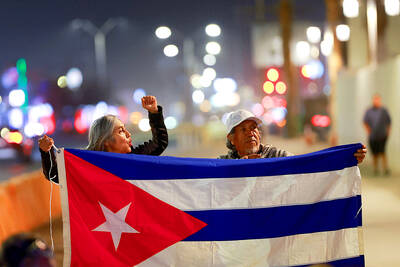
NEW RULES: There would be fewer school days, four-day workweeks, and a reduction in transportation services as the country battles a crisis exacerbated by US pressure The Cuban government on Friday announced emergency measures to address a crippling energy crisis worsened by US sanctions, including the adoption of a four-day work week for state-owned companies and fuel sale restrictions. Cuban Deputy Prime Minister Oscar Perez-Oliva Fraga blamed Washington for the crisis, telling Cuban television the government would “implement a series of decisions, first and foremost to guarantee the vitality of our country and essential services, without giving up on development.” “Fuel will be used to protect essential services for the population and indispensable economic activities,” he said. Among the new measures are the reduction of the working week in


 RSS
RSS